Agate: The Dreamy, Banded Stone of a Thousand Patterns
| Property | Value |
|---|---|
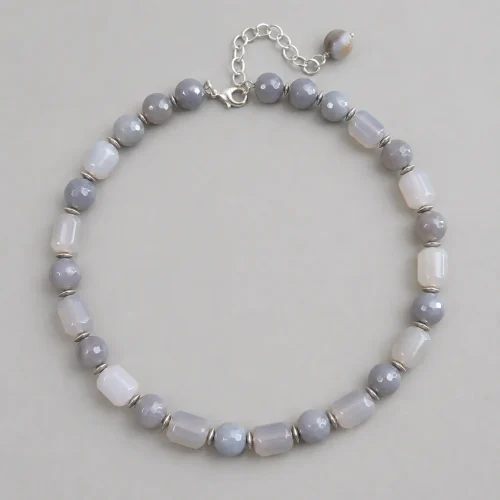
| Natural colours | White, grey, brown, black, cream, red and orange, with some varieties displaying naturally occurring blue, green or pink hues. |
| Chemical Formula | SiO₂ |
| Mineral Family | Chalcedony (Quartz) |
| Mohs Hardness | 6.5–7 |
| Crystal System | Trigonal |
| Transparency | Translucent to semi-transparent |
| Formation | Forms in cavities within volcanic rocks |
| Chakra (traditional) | Root (most commonly); some varieties are associated with other chakras |
| Zodiac (traditional) | Gemini, Virgo, Taurus, Capricorn |
| Birthstone | Not a traditional birthstone |
Agate stands out in the mineral world for its remarkable visual variety. Crack one open and you might find delicate concentric rings, wispy moss-like inclusions, fiery plumes of colour, or fine parallel stripes — no two specimens are ever quite alike. Agate has been picked up off riverbanks and carved into seals, amulets, and jewelry for thousands of years, and it remains one of the most beloved stones among collectors, jewelers, and crystal enthusiasts alike. Here’s a full look at where it comes from, how it forms, and why people have been drawn to it for millennia.
Where Agate Is Found
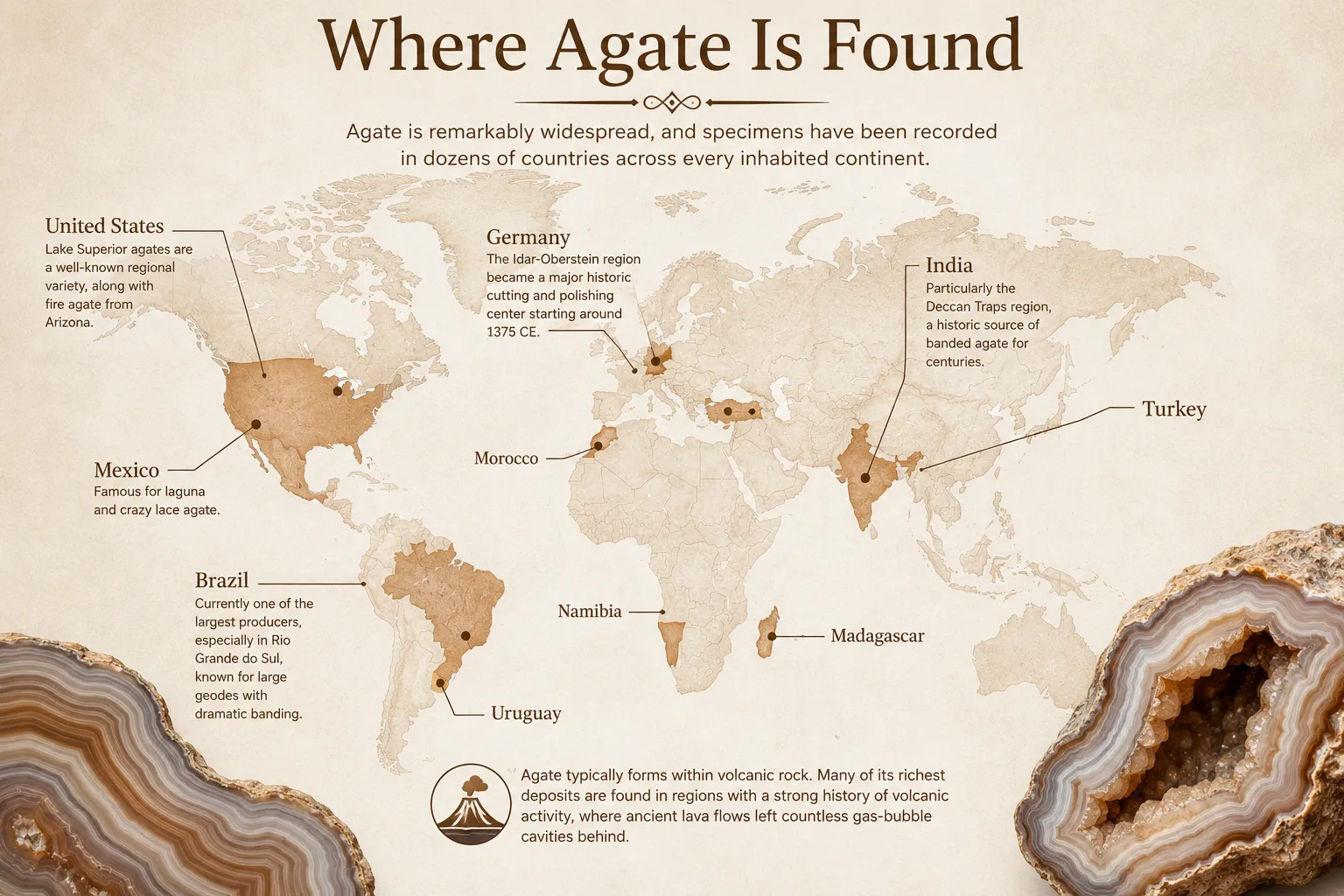
Agate is remarkably widespread, and specimens have been recorded in dozens of countries across every inhabited continent. Some of the most notable sources include:
- Brazil — currently one of the largest producers, especially in Rio Grande do Sul, known for large geodes with dramatic banding
- India — particularly the Deccan Traps region, a historic source of banded agate for centuries
- Madagascar
- Mexico — famous for laguna and crazy lace agate
- United States — Lake Superior agates are a well-known regional variety, along with fire agate from Arizona
- Germany — the Idar-Oberstein region became a major historic cutting and polishing center starting around 1375 CE
- Uruguay, Namibia, Morocco, and Turkey
Agate typically forms within volcanic rock, so many of its richest deposits are found in regions with a strong history of volcanic activity, where ancient lava flows left countless gas-bubble cavities behind.
When Was Agate First Discovered?
Agate’s story stretches back into humanity’s earliest dawns — a stone shaped by both earth and hand since time immemorial. Long before it gleamed in rings and pendants, early peoples discovered its strength and beauty, carving it into small tools and ornaments. By the Bronze Age, it had become a treasure of artisans and mystics alike: Sumerian craftspeople etched it into seals and beads, and Mycenaean artists transformed it into miniature masterpieces. The most famous of these, the Pylos Combat Agate from a warrior’s tomb in Greece, dates to around 1450 BCE and reveals astonishing detail — proof that even then, agate was revered as something more than mere stone.
The name itself carries a whisper of antiquity. The Greek philosopher Theophrastus, a student of Aristotle, gave agate its name after finding it along the River Achates in Sicily — now called the Dirillo. Whether the river lent its name to the gem or the gem to the river, no one can say for certain; but the word travelled through Latin and Old French, arriving in English centuries later, still shimmering with its ancient resonance.

Chemical Composition and Hardness
Agate is a variety of chalcedony, which is itself a microcrystalline form of quartz. Its chemical formula is SiO₂ (silicon dioxide) — the same basic formula as pure quartz, though agate’s structure is made up of countless tiny, tightly packed crystals invisible to the naked eye rather than one large crystal.
Key physical properties include:
- Hardness: 6.5 to 7 on the Mohs scale, placing it between feldspar and quartz — hard enough to resist scratching in everyday wear
- Composition: Roughly 90% quartz and up to 10–20% moganite, a closely related silica mineral with a slightly different crystal structure
- Specific gravity: Approximately 2.58 to 2.64
- Luster: Waxy to vitreous
- Transparency: Translucent to semi-transparent, distinguishing it from the more opaque jasper
- Water content: Unlike ordinary quartz, agate typically contains small trace amounts of water (roughly 0.5–3%) bound within its structure
Because of its hardness and resistance to chemical attack, agate has historically been used for far more than jewelry — including mortars and pestles for grinding chemicals, precision laboratory bearings, and even the turn-and-bank indicators in WWII-era military aircraft.
How Agate Forms – Earth’s Slow Alchemy
Agate begins its life in silence. Deep within ancient volcanic rock, tiny hollow spaces — once bubbles of gas — become the cradle for something extraordinary. Over thousands, sometimes millions of years, mineral‑rich water seeps into these pockets. Layer by layer, the minerals settle and crystallise, forming delicate bands, wisps, plumes, and patterns that look almost painted by hand.
Every agate is a record of time passing. A ring for each shift in the earth. A colour for each change in the water. A pattern shaped by patience.
Some agates grow in gentle, even stripes. Others bloom like moss, or flare like fire, or swirl like storm clouds. No two ever form in the same way — which is why wearing agate feels a little like wearing a small, private landscape.
Collectors often say that agate is a stone that rewards attention. Look closely, and you’ll see worlds inside it: forests, waves, sunsets, drifting smoke, or tiny galaxies. It’s a reminder that beauty doesn’t always shout; sometimes it reveals itself slowly, inviting you to pause and notice.
Varieties of Agate
Agate’s patterns and inclusions have led to dozens of named varieties, including:
Lake Superior agate — a regional North American variety prized by rockhounds, often tumbled smooth by glacial and river action
Moss agate — featuring dendritic, moss- or fern-like inclusions of iron or manganese oxide
Fire agate — displaying an iridescent, flame-like play of colour caused by thin internal layers of iron oxide
Blue lace agate — pale blue with soft, delicate banding
Crazy lace agate — known for intricate, swirling, almost chaotic banding patterns
Fortification (banded) agate — the “classic” concentric banded look, resembling the walls of a fortress in cross-section
Plume agate — showing feathery, plume-like mineral inclusions
Dendritic agate — tree-like branching mineral patterns without the moss-like colouring
Sardonyx — a variety with straight, parallel bands of sard (reddish-brown) and onyx (white or black)

Spiritual Beliefs and Symbolism
Agate has carried a reputation for protection and grounding across an unusually wide range of cultures. In ancient Greece and Rome, it was worn by warriors believed to bring courage and victory in battle, and by farmers hoping for an abundant harvest. Persian and Arabic traditions held that agate could calm storms and strengthen the heart, while medieval Europeans treasured carved agate bowls and ornaments, believing them capable of warding off sickness and negative influences. In Mesopotamia and Egypt, agate was carved into amulets, seals, and ceremonial vessels meant to protect the wearer from danger and attract good fortune.
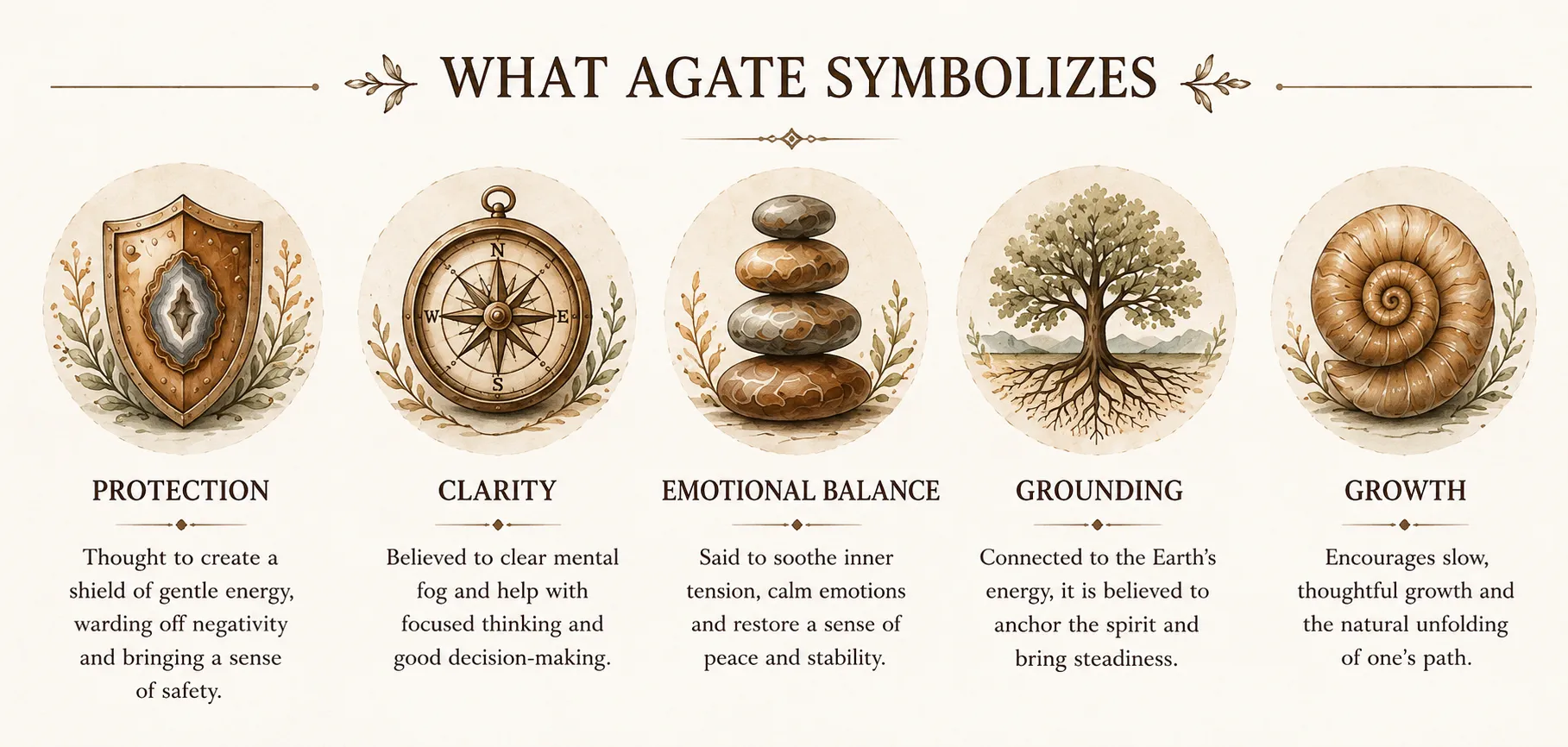
Its layered, banded structure has often been read symbolically as well — a visual reminder of balance, resilience, and the way strength can be built up gradually, one layer at a time.
Agate is often called a stone of inner harmony. Its layered structure mirrors the layers within us: thoughts, memories, hopes, and fears. Holding or wearing agate is said to help these layers settle, allowing the spirit to breathe more freely. Some feel it encourages slow, thoughtful growth — not sudden transformation, but the kind that unfolds naturally, like rings forming inside the stone itself.
Different varieties of agate have their own whispered qualities. Moss agate is cherished for its connection to nature and renewal. Blue lace agate is beloved for soothing communication and softening the voice of worry. Fire agate is said to spark courage and creative energy.

Astrological Associations
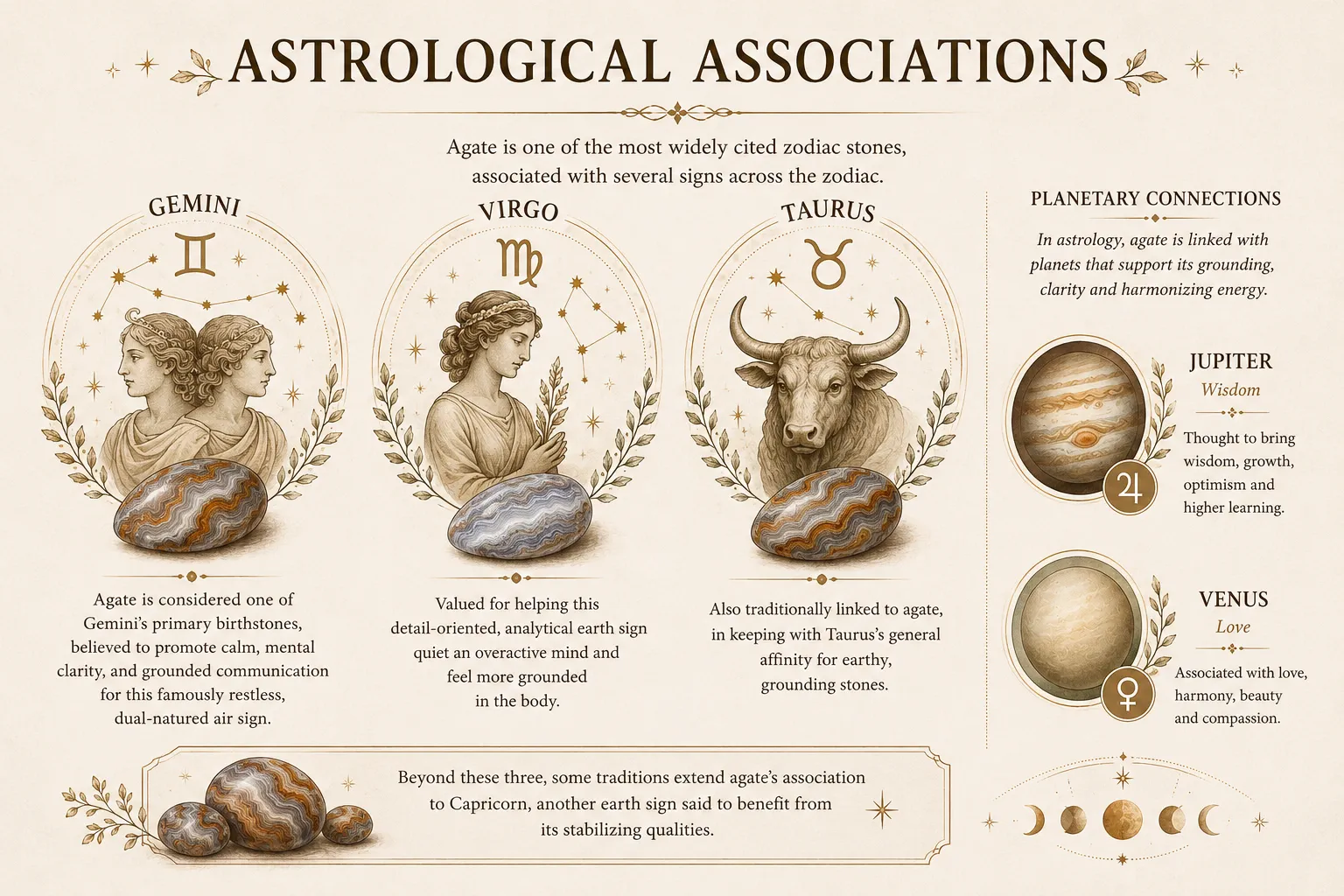
Agate is one of the most widely cited zodiac stones, associated with several signs:
- Gemini — agate is considered one of Gemini’s primary birthstones, believed to promote calm, mental clarity, and grounded communication for this famously restless, dual-natured air sign
- Virgo — valued for helping this detail-oriented, analytical earth sign quiet an overactive mind and feel more grounded in the body
- Taurus — also traditionally linked to agate, in keeping with Taurus’s general affinity for earthy, grounding stones
Beyond these three, some traditions extend agate’s association to Capricorn, another earth sign said to benefit from its stabilizing qualities.
Healing and Meditation Practices
In modern crystal healing traditions, agate is often described as a stabilizing, calming stone — sometimes called a stone of “inner stability” or grounding. Unlike some crystals associated with dramatic energy shifts, agate’s reputation leans toward gentle, steady support rather than intense transformation.
Common practices associated with agate include:
- Grounding and stability — agate is frequently used to help people feel more anchored, both physically and emotionally, especially during periods of stress or overthinking
- Root Chakra work — most commonly associated with the root chakra, tied to security, stability, and a sense of connection to the earth
- Meditation — often held during meditation to quiet a racing mind, ease anxiety, and encourage a calmer, more centered state
- Specific varieties for specific intentions — blue lace agate is often used for calm communication and throat chakra work, moss agate for connection to nature and abundance, and fire agate for confidence and vitality
- Emotional balance — some traditions describe agate as helping harmonize yin and yang energies, or bringing emotional, physical, and intellectual balance into alignment
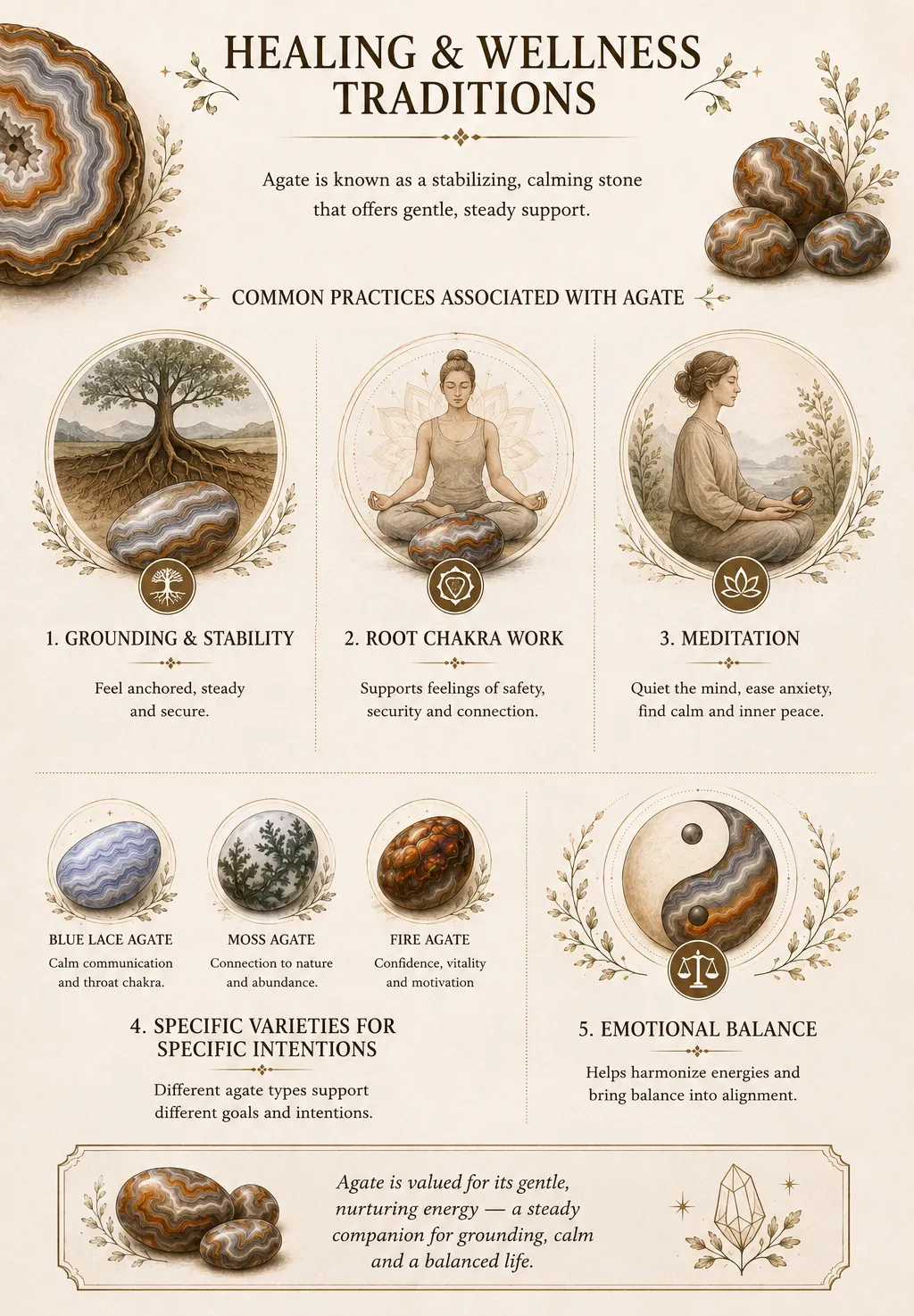
According to crystal healing traditions, agate is thought to support:
- Emotional and mental stability — helping calm anxiety, overthinking, and scattered energy
- Grounding — fostering a stronger sense of connection to the present moment and the physical body
- Confidence and courage — echoing its ancient reputation as a stone carried by warriors
- Clear communication — particularly associated with public speaking and expressing thoughts more clearly
- Balance — said to harmonize opposing energies, whether emotional, physical, or intellectual
- Protection — a long-standing belief across many ancient cultures, from Mesopotamia to Rome
- Connection to nature — especially through moss and dendritic varieties, tied to growth and the natural world
(Note: these are traditional folk beliefs and metaphysical claims, not scientifically established properties.)
Interesting Facts About Agate
- The word “agate” may have given a river its name, rather than the other way around — historians still aren’t entirely sure which came first.
- The Pylos Combat Agate, a tiny carved agate seal stone from a Bronze Age grave in Greece, contains such fine detail that some archaeologists believe it may have been carved with the aid of a magnifying lens — over 3,000 years before magnifying glasses were believed to exist.
- Agates are typically much harder than the volcanic rock they form inside of, which is why so many agates are found as loose, rounded nodules on riverbanks and beaches, long separated from their original host rock.
- During World War II, black agate beads mined in Queensland, Australia were used to make precision components for turn-and-bank indicators in military aircraft — a rare case of a “healing crystal” also serving a critical mechanical role.
- Idar-Oberstein, Germany, became a major center of the global agate trade starting around 1375 CE, and its lapidary tradition continues today even though local agate deposits were largely exhausted long ago — the region simply pivoted to importing and cutting agate from around the world.
- No two agates are ever truly identical: the banding patterns are the product of countless tiny fluctuations in mineral-rich water over time, making each stone a one-of-a-kind geological fingerprint.