Jasper: The Earthy, Grounding Stone of Endless Patterns
| Property | Information |
|---|---|
| Family | Quartz (chalcedony) |
| Composition | Silicon dioxide (SiO₂) |
| Hardness | 6.5–7 Mohs |
| Lustre | Waxy to vitreous |
| Transparency | Opaque |
| Colours | Almost every colour imaginable |
| Forms in | Volcanic rocks and sedimentary deposits |
Jasper is one of the world’s most colourful decorative stones. Formed from microcrystalline quartz and shaped by millions of years of geological activity, it has been prized for tools, seals, jewellery and ornament since prehistoric times. This guide explores how jasper forms, where it is found, its many varieties, and the history and traditions surrounding it.
Where Jasper Is Found
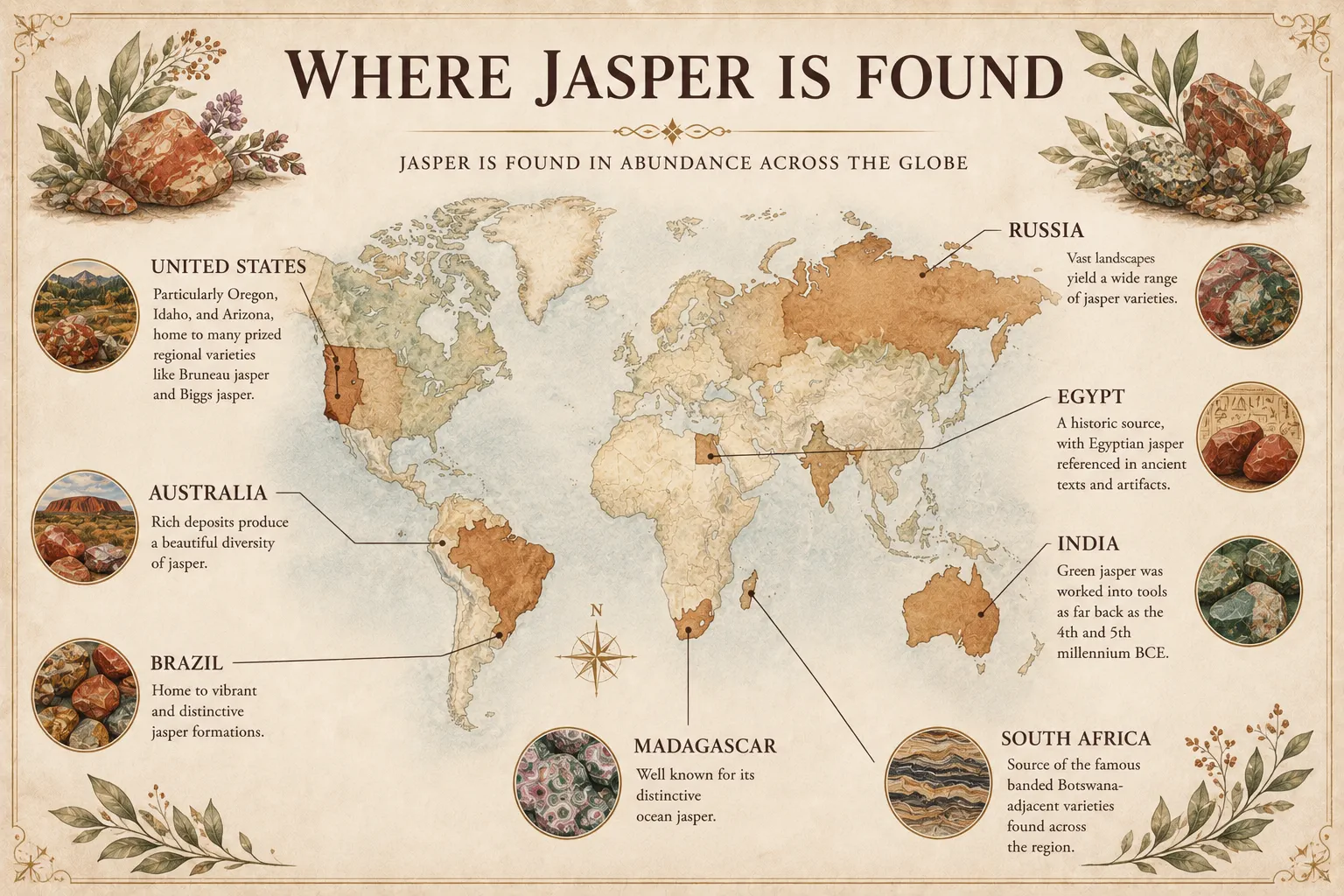
Jasper is found in abundance across the globe, with notable deposits including:
- United States — particularly Oregon, Idaho, and Arizona, home to many prized regional varieties like Bruneau jasper and Biggs jasper
- Australia
- Brazil
- Egypt — a historic source, with Egyptian jasper referenced in ancient texts and artifacts
- India — where green jasper was worked into tools as far back as the 4th and 5th millennium BCE
- Madagascar — well known for its distinctive ocean jasper
- Russia
- South Africa — the source of the famous banded Botswana-adjacent varieties found across the region
Because jasper forms through so many different geological processes, it turns up almost anywhere silica-rich fluids have moved through volcanic or sedimentary rock, which is part of why it’s found on nearly every continent.
When Was Jasper First Discovered?
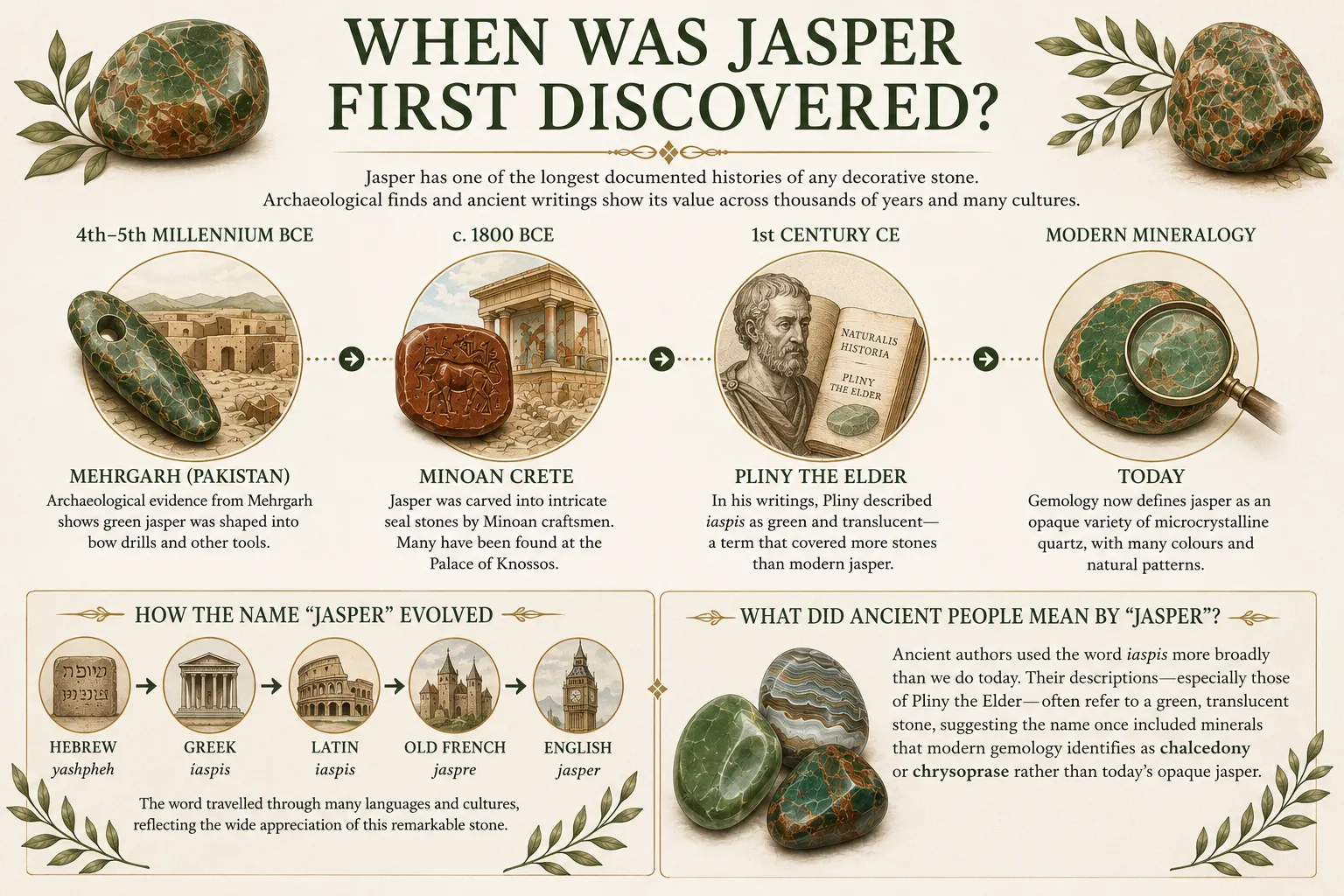
Jasper has one of the longest documented histories of any decorative stone. Archaeological evidence shows that green jasper was already being worked at Mehrgarh (in present-day Pakistan) during the 4th–5th millennium BCE, where it was shaped into bow drills and other tools. Around 1800 BCE, Minoan craftsmen on Crete carved jasper into finely detailed seal stones, many of which have been recovered from the Palace of Knossos.
The stone’s name travelled through numerous ancient cultures before reaching modern English. The English word jasper comes from the Old French jaspre, which developed from the Latin iaspis and the Greek íaspis. These, in turn, were derived from the Hebrew yashpheh, with some linguists suggesting even older Persian or Assyrian origins. The long linguistic journey reflects just how widely valued the stone was across the ancient world.
One important detail is that the ancient word iaspis did not necessarily describe the same stone we call jasper today. Classical writers, including Pliny the Elder, often described it as green and translucent, leading many historians to believe that the term once covered several similar green gemstones, including varieties that would now be classified as chalcedony or chrysoprase.
Chemical Composition and Hardness
Jasper is an opaque silica-rich stone composed mainly of microscopic quartz and chalcedony, together with varying mineral impurities that create its remarkable colours and patterns. Its chemical formula is SiO₂ (silicon dioxide), typically combined with up to 20% additional trace minerals — iron oxides, clay minerals, manganese, and others — which are responsible for jasper’s famously wide range of colours and patterns.
Key physical properties include:
- Hardness: 6.5 to 7 on the Mohs scale, making it durable enough for everyday jewelry and decorative use
- Crystal system: Hexagonal/microcrystalline (no visible crystal structure)
- Specific gravity: Roughly 2.5 to 2.9
- Luster: Vitreous to waxy once polished
- Transparency: Opaque — the key trait that distinguishes it from its more translucent chalcedony cousin, agate
- Cleavage: None; jasper fractures conchoidally, in smooth curved surfaces
A handy way to tell jasper apart from agate is to hold a piece up to strong light: if any light passes through, even faintly, it’s likely agate or another translucent chalcedony variety. True jasper blocks light completely.
How Jasper Is Formed
Long before humans learned to shape metal or build cities, geological processes were already creating the intricate patterns we admire in jasper today.
The jasper in a necklace may have taken tens or even hundreds of millions of years to form. Every band, swirl and speck records changes in minerals, water chemistry and volcanic activity that happened long before humans existed.
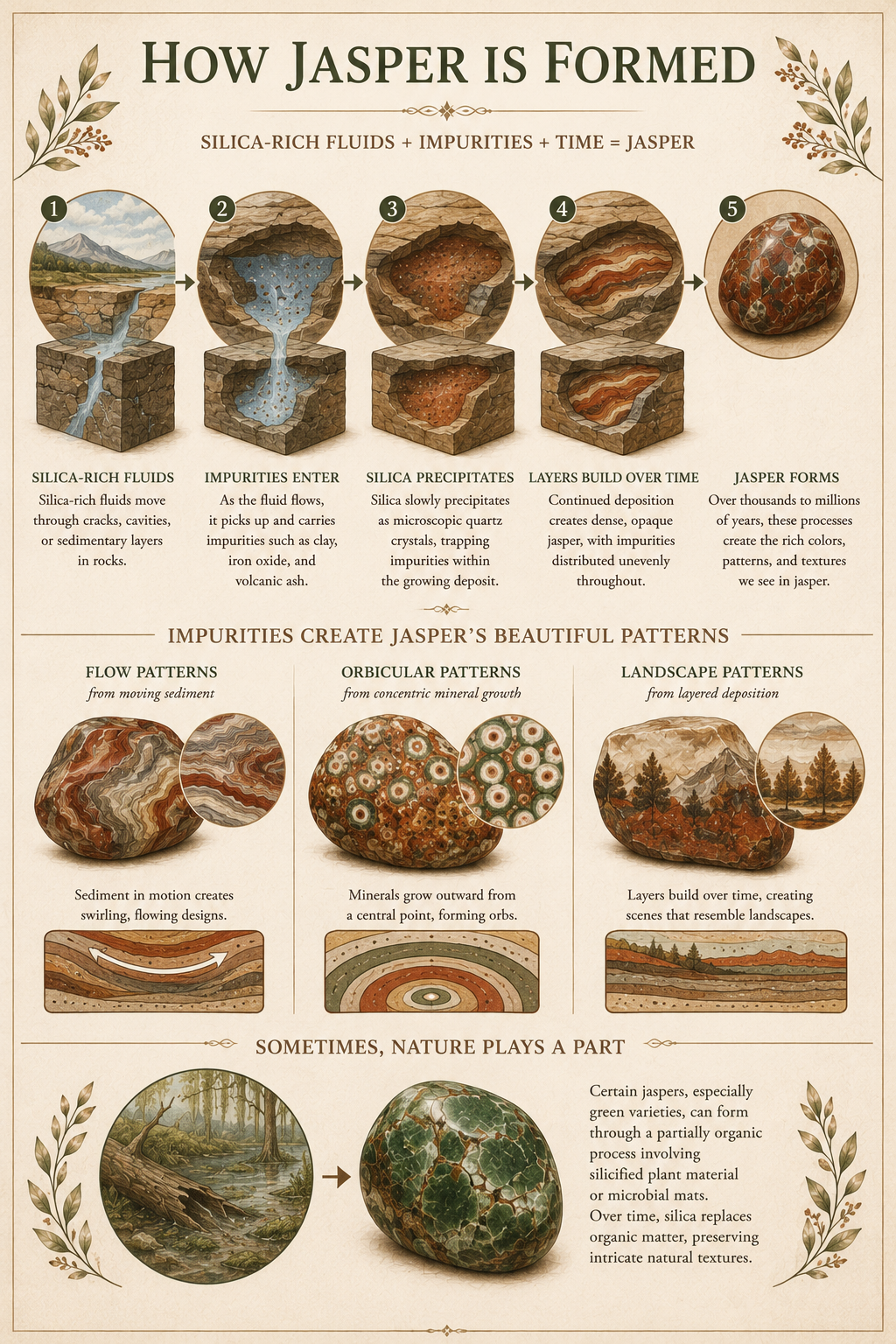
Jasper forms through the same broad silica-precipitation processes that produce other members of the chalcedony family, but its formation typically involves a greater volume of impurities, which is what gives it that signature opacity. Silica-rich fluids move through cracks, cavities, or sedimentary layers and slowly deposit microscopic quartz crystals, often incorporating clay, iron oxide, and volcanic ash along the way.
Because these impurities are often deposited unevenly, jasper frequently develops striking visual effects: swirling “flow” patterns from moving sediment, orbicular circles from concentric mineral growth around a central point, or landscape-like scenes from layered deposition over time. Some varieties, like certain green jaspers, form through a partially organic process involving silicified plant material or microbial mats, adding yet another layer to the stone’s geological story.
Did you know?
Ocean Jasper was only discovered at its famous Madagascan source in the late 20th century. The original deposits are exposed only at low tide, making collection unusually difficult.
Spiritual Beliefs and Symbolism
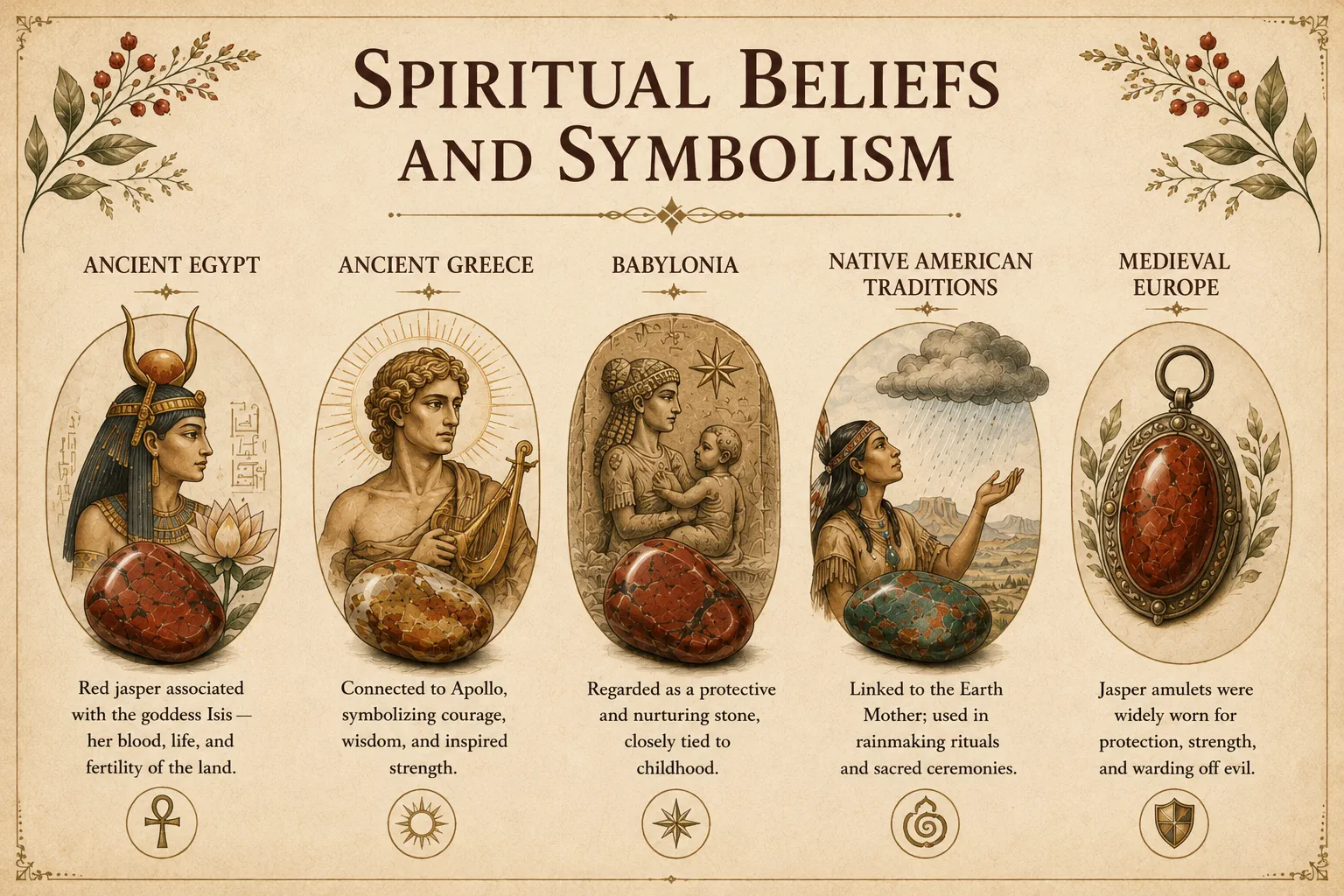
Jasper’s long, cross-cultural history has given it one of the richest symbolic legacies of any stone. In ancient Egypt, red jasper was associated with the goddess Isis and believed to represent her blood, thought to fertilize the land and support fertility. Ancient Greeks connected the stone to Apollo, associating it with courage and wisdom, while Babylonians regarded it as a protective, nurturing stone tied to childhood. Native American traditions, including those of the Hopi people, linked jasper to the Earth Mother and used it in rainmaking rituals, and in medieval Europe, jasper amulets were widely worn for protection.
Its appearance in several historical religious texts further strengthened its symbolic importance over the centuries — appearing both as the final stone in the high priest’s breastplate and as a foundation stone of the New Jerusalem, jasper became closely tied to ideas of permanence, faith, and spiritual foundation.
Astrological Associations
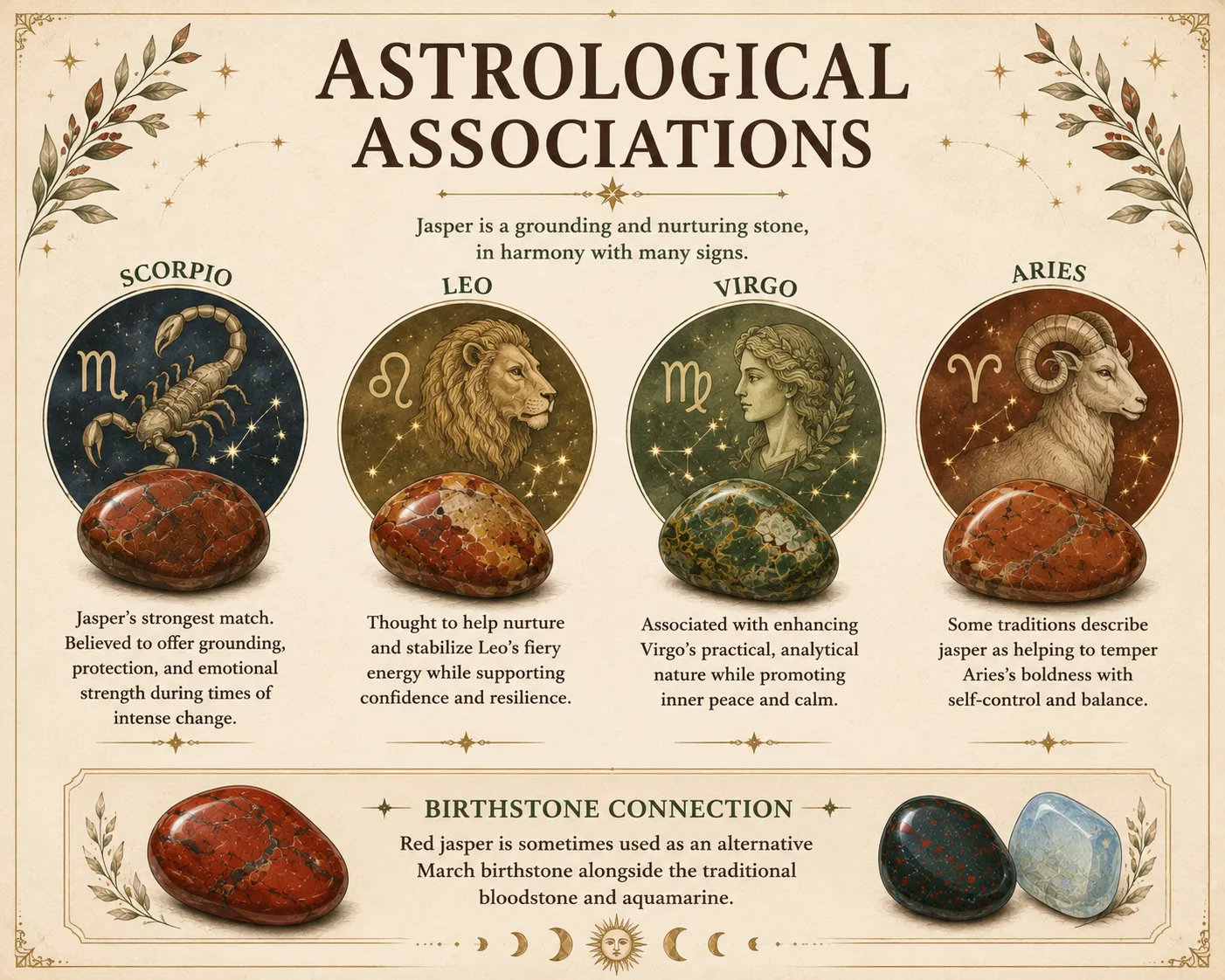
Jasper is one of the more broadly compatible stones in crystal astrology, though it’s most strongly linked to a handful of signs:
- Scorpio — widely considered jasper’s strongest match, believed to offer grounding, protection, and emotional strength during times of intense change
- Leo — thought to help nurture and stabilize Leo’s fiery energy while supporting confidence and resilience
- Virgo — associated with enhancing Virgo’s practical, analytical nature while promoting inner peace and calm
- Aries — some traditions describe jasper as helping to temper Aries’s boldness with self-control and balance
Certain varieties carry their own specific associations — for example, red jasper is sometimes used as an alternative March birthstone alongside the traditional bloodstone and aquamarine.
Healing and Meditation Practices
In modern crystal healing traditions, jasper is often called the “Supreme Nurturer,” valued less for dramatic transformation and more for steady, sustaining support through difficult times.
Common practices associated with jasper include:
- Grounding and stability — widely considered one of the most reliable grounding stones, believed to provide strength and endurance during periods of stress or change
- Root Chakra work — red jasper in particular is closely tied to the root chakra, associated with security, physical vitality, and connection to the earth
- Meditation — often held during meditation to encourage a slow, steady sense of calm and to support extended focus
- Emotional balance — many traditions describe jasper as helping to soothe mood swings and foster inner peace, particularly during times of transition
- Protection — long associated with shielding against negative energy, echoing its ancient use in protective amulets
(Note: these are traditional folk beliefs and metaphysical claims, not scientifically established properties.)

Qualities Jasper Is Said to Improve
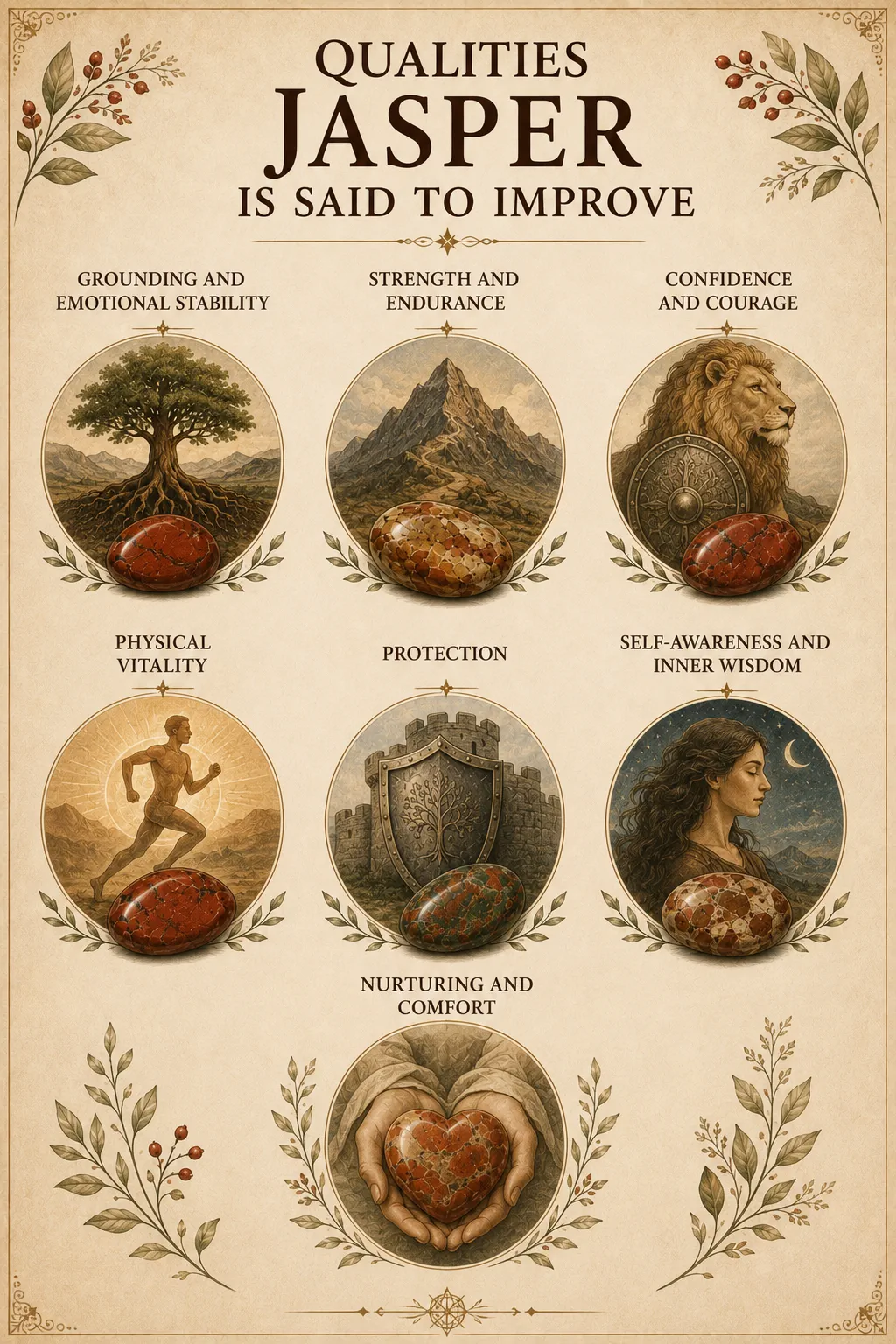
According to crystal healing traditions, jasper is thought to support:
- Grounding and emotional stability — helping to reduce stress and foster a stronger connection to the present moment
- Strength and endurance — believed to provide steady support through prolonged challenges rather than short bursts of energy
- Confidence and courage — echoed in its long historical association with warriors and protective amulets
- Physical vitality — particularly associated with red jasper, believed to support stamina and energy
- Protection — a consistent theme across nearly every culture that has used the stone
- Self-awareness and inner wisdom — said to support reflection, patience, and a broader perspective
- Nurturing and comfort — reflected in jasper’s frequent nickname, “the Supreme Nurturer”
Interesting Facts About Jasper
- Although jasper comes in an astonishing range of colours and patterns, it is composed mainly of silica (SiO₂). Different mineral inclusions give each variety its unique appearance.
- Jasper’s name comes from an unusually long linguistic chain — passing through Old French, Latin, Greek, and Hebrew — and possibly reaching even further back into ancient Persian and Assyrian languages.
- The “jasper” described by ancient writers like Pliny the Elder doesn’t always match today’s stone — some ancient jasper was described as green and translucent, suggesting the term once covered a broader range of materials than it does now.
- Ocean jasper, one of the most sought-after varieties among collectors, was only discovered at its primary source in Madagascar in 1990, and the original mining location has reportedly been submerged much of the year, making fresh material extremely limited.
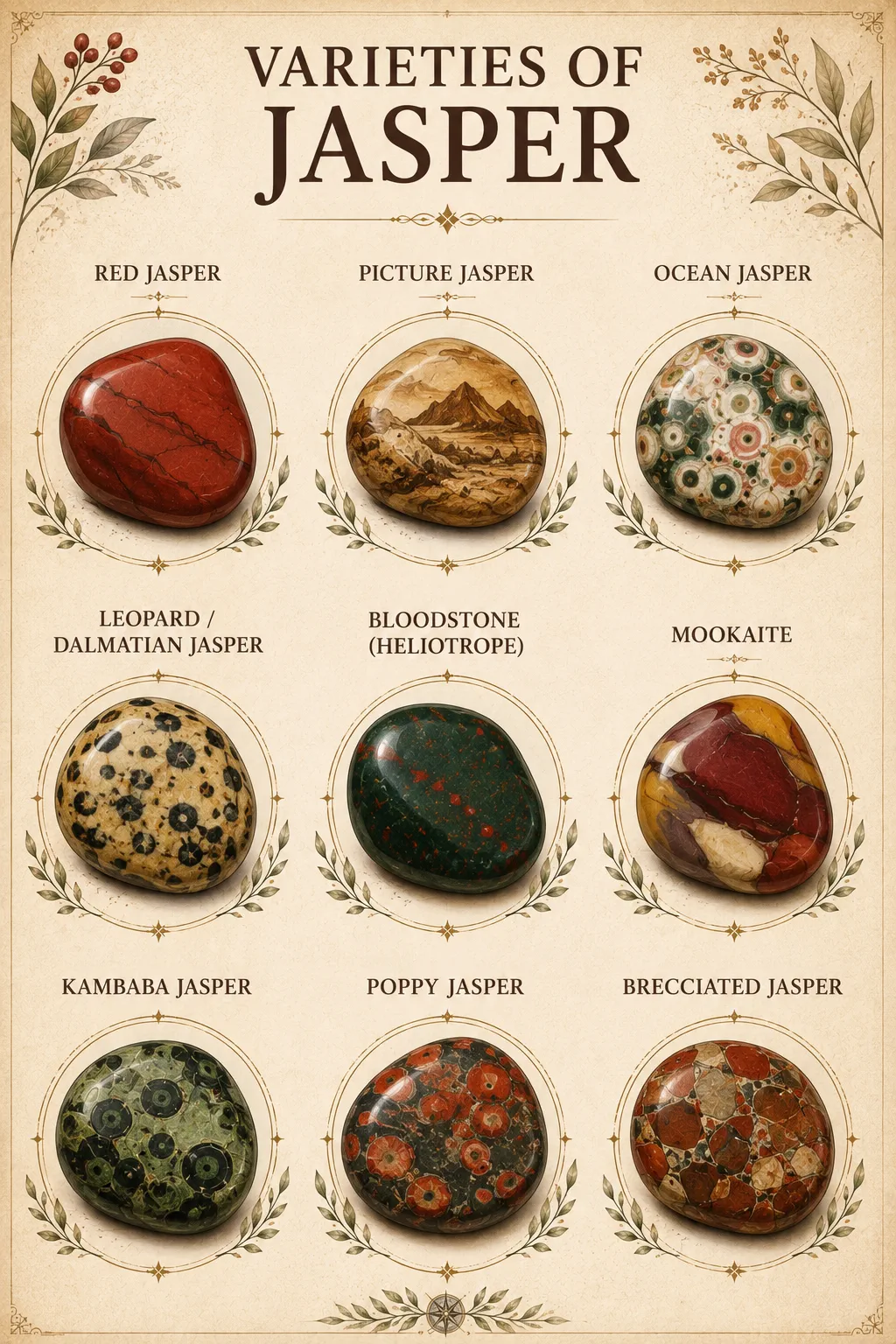
- Leopard and dalmatian jasper aren’t technically true jaspers in the strictest mineralogical sense — their spotted patterns form through a related process called orbicularization, though they’re commonly grouped with jasper due to their opacity and appearance.
- Because jasper is so widespread and richly patterned, lapidaries have given individual varieties wonderfully specific, sometimes poetic names tied to their place of origin or appearance — from “Bruneau” (named for a canyon) to simply “rainforest” or “porcelain.”
A Moment of Wonder
The piece of jasper in a pendant may have begun forming tens or even hundreds of millions of years before humans existed. Every band, speck and colour variation records ancient volcanic activity, mineral-rich water and immense geological timescales. Holding a stone like this is, in a very real sense, holding a fragment of Earth’s history.