Amethyst: The Royal Purple Stone of Clarity and Calm
| Property | Information |
|---|---|
| Mineral family | Quartz |
| Chemical formula | SiO₂ (silicon dioxide) |
| Crystal system | Trigonal |
| Hardness | 7 on the Mohs scale |
| Colour | Pale lilac to deep violet, sometimes with reddish or bluish tones |
| Transparency | Transparent to translucent |
| Lustre | Vitreous (glass-like) |
| Fracture | Conchoidal (smooth, curved fracture) |
| Typical crystal shape | Six-sided prisms with pointed, pyramid-shaped ends |
| Colouring agent | Trace amounts of iron, natural irradiation and crystal lattice defects |
| Birthstone | February |
Hidden within an ordinary rock, millions of tiny crystals quietly grew in darkness before anyone knew they existed.
Amethyst is one of the world’s most recognisable gemstones, admired for its beautiful shades of purple that range from delicate lilac to rich violet. For thousands of years, it has been carved into jewellery, treasured by royalty, and surrounded by stories and traditions. Yet its greatest story is the one written by nature, long before people ever discovered it.
Despite its rich, jewel-toned appearance, amethyst is chemically identical to ordinary quartz — proof that sometimes all it takes is a trace of iron and a long, slow process buried underground to turn something plain into something extraordinary. Here’s a full look at where it comes from, how it forms, and why it’s held onto its reputation for calm, clarity, and quiet power for thousands of years.
Where Amethyst Is Found
Amethyst is found in many parts of the world. Because it forms in volcanic rocks, deposits occur wherever the right geological conditions existed millions of years ago. Today, a handful of countries account for most of the world’s gem-quality amethyst.
- Brazil — the world’s largest producer, particularly the state of Minas Gerais, famous for its enormous crystal-lined geodes.
- Uruguay — especially the Artigas region, renowned for exceptionally deep, saturated purple crystals.
- Zambia — a major modern source of high-quality amethyst, valued for its rich violet-blue colour and excellent clarity.
- South Africa
- Madagascar
- Russia — historically significant, particularly the Ural Mountains.
- South Korea
Before the discovery of the vast deposits in South America during the nineteenth century, much of the finest amethyst came from regions such as Egypt and Russia. The Brazilian and Uruguayan discoveries transformed the gemstone trade, making beautiful amethyst far more abundant and accessible than ever before.

History of Amethyst
People have admired amethyst for thousands of years. Archaeological discoveries show that it was already being used in ancient Egypt and Mesopotamia over 4,000 years ago, where it was carved into beads, amulets and seals. The Ancient Greeks and Romans also prized the gemstone, believing it could protect its wearer from drunkenness. In fact, the name amethyst comes from the Ancient Greek word amethystos, meaning “not intoxicated”.
Throughout the Middle Ages and the Renaissance, amethyst remained one of Europe’s most highly valued gemstones. Its rich purple colour, long associated with wealth, authority and wisdom, made it popular among royalty, nobles and religious leaders. It was often set into crowns, rings and other ceremonial objects, becoming a symbol of prestige as well as beauty.
Until the nineteenth century, fine amethyst was considered one of the world’s most valuable gemstones, comparable in prestige to ruby, sapphire and emerald. This changed after vast deposits were discovered in Brazil and Uruguay, greatly increasing its availability. Today, amethyst remains one of the most popular gemstones, admired not only for its beauty but also for the remarkable geological story behind every crystal.

How Amethyst Is Formed
Amethyst begins its journey deep beneath the Earth’s surface, often in regions that experienced volcanic activity millions of years ago. As lava cools, gases trapped inside it create hollow spaces known as vesicles. These cavities can range from just a few centimetres across to enormous chambers large enough for a person to stand inside.
Over time, groundwater rich in dissolved silica slowly seeps into these cavities. As temperatures and pressure change, the silica begins to crystallise, forming layer upon layer of quartz on the inner walls. The process is incredibly slow, with crystals growing little by little over thousands or even millions of years.
What makes quartz become amethyst is the presence of tiny amounts of iron within the crystal structure. During its long formation underground, the crystal is also exposed to natural radiation from surrounding rocks. This changes the way some of the iron atoms are arranged, creating the beautiful purple colour for which amethyst is famous. The exact amount of iron and radiation, together with the temperature at which the crystals formed, determines whether the colour is a delicate lilac or a rich, deep violet.
Many amethyst crystals grow inside rounded volcanic cavities known as geodes. From the outside, a geode often looks like an ordinary rock, but when broken open it reveals a sparkling interior lined with countless purple crystals. Some of the largest amethyst geodes found in Brazil and Uruguay are over five metres tall, providing a spectacular glimpse into geological processes that have unfolded over immense periods of time.

Varieties of Amethyst
While amethyst is defined by its purple hue, it appears in a range of shades and distinctive forms.
- Purple Amethyst — the classic variety, ranging from pale lilac to rich violet. The finest gemstones display a deep, even purple with subtle red or blue flashes.
- Siberian Amethyst — originally referring to exceptionally rich purple crystals from Russia’s Ural Mountains. Today, the name describes a highly prized colour grade rather than the stone’s place of origin.
- Rose de France — a pale, delicate lilac variety, appreciated for its soft pastel colour and elegant appearance in jewellery.
- Ametrine — a rare natural combination of purple amethyst and golden citrine within a single crystal. The two colours develop because different parts of the crystal formed under slightly different temperature conditions.
- Chevron Amethyst — recognised by its distinctive V-shaped bands of purple amethyst and white quartz, formed as alternating layers grew over time.
- Prasiolite — a green variety of quartz usually produced by heating certain pale amethyst. Naturally occurring prasiolite is extremely rare.
- Green Amethyst — a common trade name for prasiolite. Although widely used in the jewellery industry, the term is considered misleading because amethyst, by definition, is purple.

Similar Stones
Several gemstones resemble amethyst at first glance, particularly those with shades of purple or violet. Although they may look similar, their composition and physical properties can be quite different.
| Stone | How it differs from Amethyst |
|---|---|
| Purple Fluorite | Softer than amethyst (Mohs 4) and often shows colour zoning or banding. |
| Purple Sapphire | Much harder (Mohs 9), usually more brilliant and considerably more valuable. |
| Purple Spinel | Similar colour but higher brilliance and different crystal structure. |
| Purple Glass | Often lacks the natural colour variations and inclusions seen in genuine amethyst. Air bubbles may be visible under magnification. |
| Dyed Quartz or Chalcedony | Artificially coloured to imitate amethyst. The colour may appear unnaturally bright or concentrated in cracks. |
One of the easiest ways to distinguish amethyst from imitations is to examine its colour. Natural amethyst usually displays gentle variations in tone rather than a perfectly uniform purple, and many crystals contain small natural inclusions that reflect their geological origin.

Amethyst in Jewellery
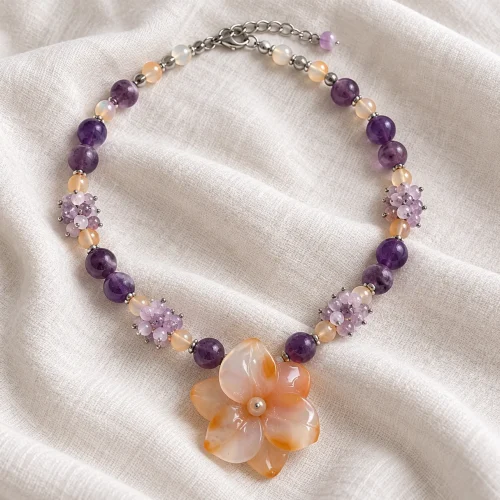
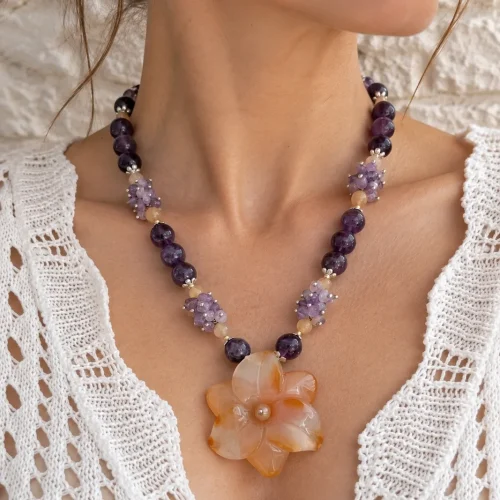
Amethyst has been used in jewellery for thousands of years and remains one of the world’s most popular coloured gemstones. Its attractive purple colour, good durability and relatively affordable price make it suitable for everything from everyday rings and pendants to high-end designer pieces.
With a hardness of 7 on the Mohs scale, amethyst is resistant to everyday wear, although it can still be scratched by harder gemstones such as sapphire or diamond. Jewellers often cut amethyst into oval, round, emerald, pear and cushion shapes to maximise its colour and brilliance, while larger crystals are frequently carved into decorative ornaments and sculptures.
Natural amethyst is generally untreated, although some stones may be gently heated to improve or alter their colour. Reputable jewellers will usually disclose any treatments. To keep amethyst jewellery looking its best, clean it with warm soapy water and a soft cloth or brush. Avoid prolonged exposure to high temperatures or strong sunlight, as these may gradually fade the stone’s colour over many years.
From antique royal collections to contemporary jewellery, amethyst continues to be appreciated for its elegance, versatility and timeless appeal.

Did you know?
- Amethyst is chemically identical to citrine — the only difference between the two is the oxidation state of the trace iron impurities inside the quartz, meaning heat treatment can turn one into the other.
- Some of the world’s largest amethyst geodes, found in Brazil and Uruguay, are thought to have crystallized at surprisingly mild temperatures inside ancient cooled lava flows, rather than under intense heat.
- Despite its “ancient legend” feel, the romantic myth linking amethyst to Dionysus and a transformed maiden may actually date back only to the 1500s, credited to a French poet rather than to genuine Greco-Roman mythology.
- Amethyst was historically considered as precious as diamonds and rubies, and only became widely affordable after massive deposits were discovered in Brazil and Uruguay in the 19th century.
- Amethyst is piezoelectric, sharing this property with other quartz varieties — meaning it generates a small electrical charge when placed under mechanical stress.
- The Hebrew word associated with amethyst, achlamah, is sometimes translated as “dream stone,” linking the gem to intuition and the subconscious mind long before modern crystal healing traditions popularized the same idea.
Spiritual Traditions and Symbolism
For thousands of years, amethyst has been more than a beautiful gemstone. Many cultures have associated it with wisdom, protection and inner peace, while modern crystal healing traditions often describe it as a stone of calmness and spiritual awareness.
These beliefs are part of cultural and spiritual traditions rather than scientifically established properties. While many people find personal meaning in working with crystals, there is no scientific evidence that amethyst possesses healing or supernatural powers.
(Note: these are traditional folk beliefs and metaphysical claims, not scientifically established properties.)
Traditional Symbolism
Throughout history, amethyst has symbolised a variety of qualities depending on the culture and period.
Common traditional associations include:
- Wisdom — often linked with clear thinking and sound judgement.
- Peace and tranquillity — believed to encourage a calm and balanced mind.
- Protection — carried as a talisman or amulet in many ancient cultures.
- Sincerity and humility — qualities often associated with its rich purple colour.
- Sobriety — inspired by the Ancient Greek belief that amethyst could protect against intoxication.
Crystal Healing Traditions
According to modern crystal healing practices, amethyst is one of the most widely used stones for relaxation and spiritual wellbeing.
It is traditionally believed to support:
- emotional balance
- mental clarity
- stress reduction
- restful sleep
- meditation and mindfulness
- spiritual growth and self-reflection
Many practitioners place amethyst in bedrooms, use it during meditation, or carry small polished stones throughout the day as a reminder to remain calm and centred.
Astrological Associations
In crystal astrology, amethyst is most commonly associated with:
- Pisces — believed to encourage intuition, compassion and emotional balance.
- Aquarius — traditionally linked with creativity, insight and independent thinking.
Some traditions also associate amethyst with Virgo, Capricorn or Sagittarius, although these connections are less widely recognised.
Chakra Associations
Within chakra traditions, amethyst is most strongly connected with the:
- Crown Chakra — associated with spiritual awareness, wisdom and a sense of connection with something greater than oneself.
Some practitioners also associate amethyst with the:
- Third Eye Chakra — linked with intuition, imagination and inner perception.
Meditation Practices
Amethyst is one of the stones most frequently used during meditation.
According to crystal traditions, people may:
- hold an amethyst crystal while meditating
- place it nearby to create a peaceful environment
- use it as a visual point of focus during breathing exercises
- keep a geode or crystal cluster in a quiet space intended for reflection
Many people simply enjoy the calming appearance of amethyst, regardless of whether they hold spiritual beliefs about the stone.

A Moment of Wonder
An amethyst geode may look like an ordinary rock from the outside, yet hidden within it can be thousands of perfectly formed crystals that have spent millions of years growing in darkness. Long before they were admired in jewellery or displayed in museums, these crystals were quietly shaped by volcanic activity, mineral-rich water and the steady passage of geological time.
Perhaps that is what makes amethyst so captivating. It reminds us that some of nature’s most remarkable creations are not the result of sudden events, but of countless small changes unfolding patiently over immense spans of time. Every amethyst crystal is a reminder that even the most ordinary-looking stone can conceal an extraordinary story, waiting patiently to be discovered.