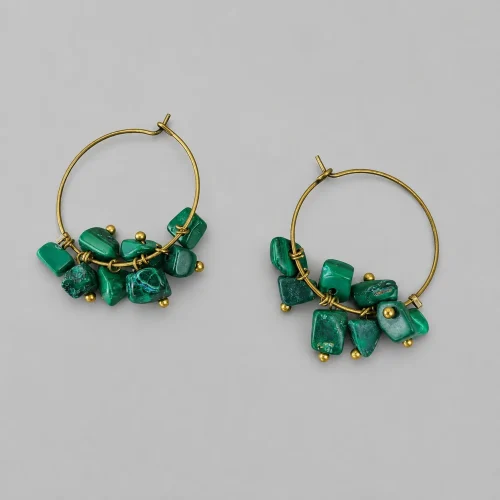
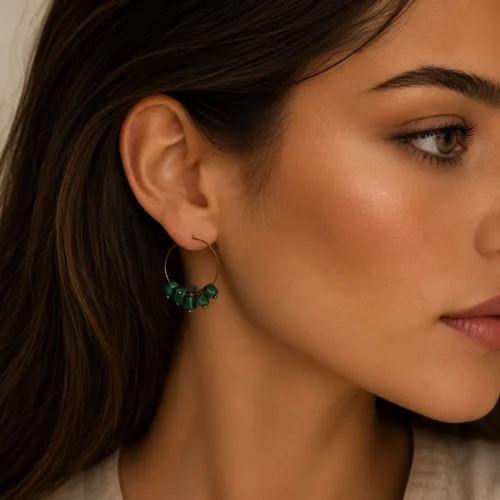
Malachite: The Vivid Green Stone of Transformation
| Property | Value |
|---|---|
| Colour | Green |
| Chemical Formula | Cu₂CO₃(OH)₂ |
| Mohs Hardness | 3.5–4 |
| Crystal System | Monoclinic |
| Chakra (traditional) | Heart |
| Zodiac (traditional) | Scorpio, Capricorn |
| Birthstone | Not a traditional birthstone |
Few stones announce themselves quite like malachite. With its swirling bands of light and dark green, often compared to the concentric rings of a peacock’s eye, it’s a mineral that has been catching human attention for thousands of years — first as a source of copper and pigment, and later as one of the most recognizable ornamental stones in the world. Here’s a full look at where it comes from, how it forms, and why it still holds such a strong place in crystal folklore today.
Major Sources of Malachite
Malachite occurs in copper-rich regions all over the globe, but a handful of locations have historically produced the finest specimens:
- Democratic Republic of the Congo — currently one of the largest and most important sources of high-quality malachite
- Russia’s Ural Mountains — historically famous for enormous malachite masses, some reportedly weighing over 50 tonnes, which were used to decorate the palaces of Russian tsars
- Zambia and Namibia — significant modern producers
- Australia
- Morocco
- The United States — notably Bisbee, Arizona
- Israel (the Timna Valley, near Eilat)
It typically forms near the surface, in the upper, oxidized zones of copper ore deposits, which is why so many of the classic sources sit in or near historic copper mining regions.

When Was Malachite First Discovered?
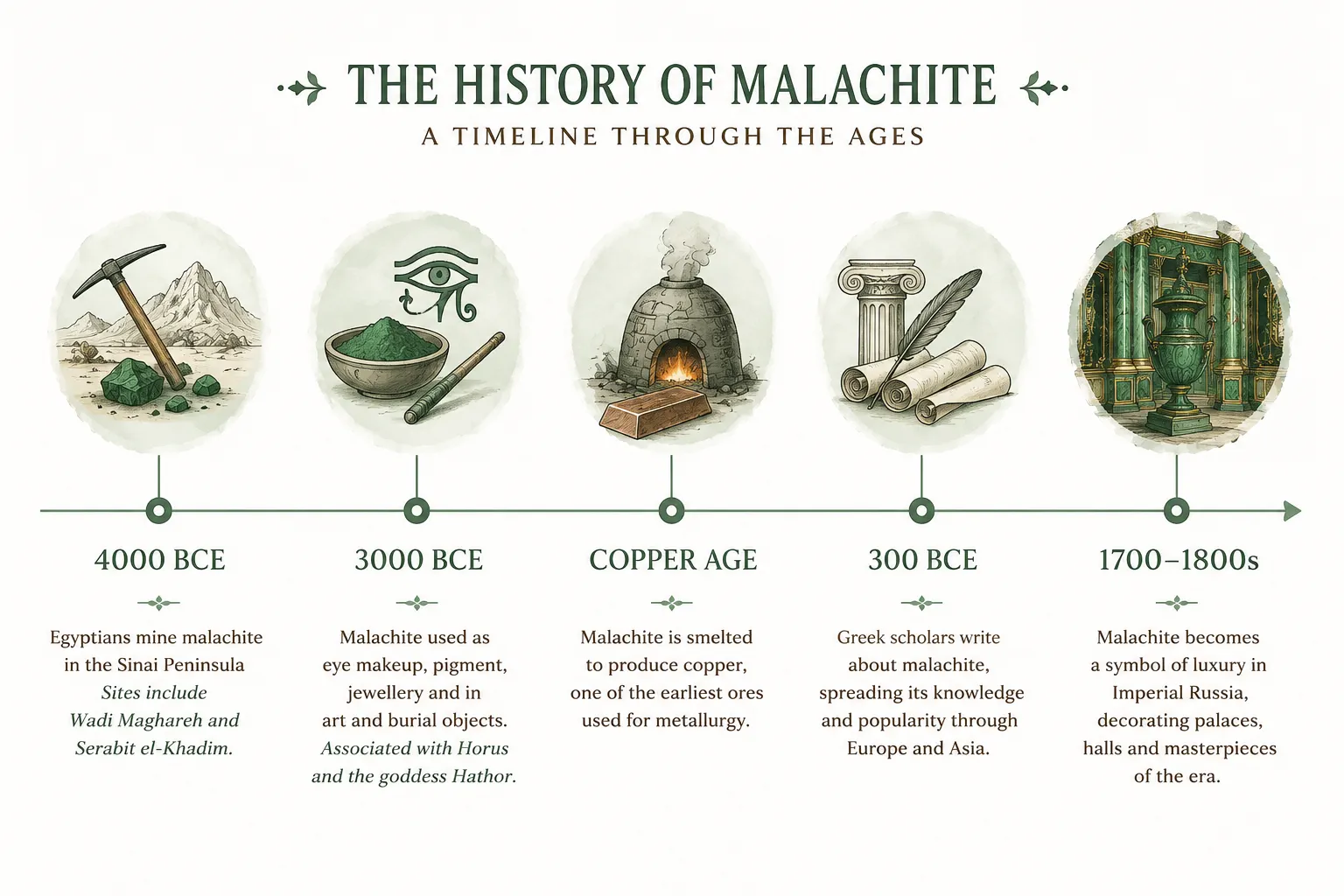
Malachite has one of the longest documented histories of any mineral used by humans. It’s believed to have been mined as early as 4000 BCE in the Sinai Peninsula, where ancient Egyptians extracted it alongside turquoise at sites like Wadi Maghareh and Serabit el-Khadim. This makes it, quite possibly, one of the earliest ores ever used to produce copper metal — an achievement that predates most other known metallurgical practices.
Its uses were far from purely industrial. Egyptian hieroglyphs and tomb paintings show malachite ground into powder and used as green eye cosmetics, meant to evoke the falcon-headed god Horus. It appeared in wall paintings, glazes, and burial artifacts, and was closely associated with the goddess Hathor. By around 300 BCE, Greek scholars were writing about the stone, helping spread its popularity through Europe and eventually Asia — a fame that would culminate centuries later in the malachite-clad halls of Imperial Russia.
Chemical Composition and Hardness
Malachite is a copper carbonate hydroxide mineral, with the chemical formula Cu₂CO₃(OH)₂. Its signature green color comes directly from its copper content, which makes up roughly 57% of the pure mineral.
Key physical properties include:
- Hardness: 3.5 to 4 on the Mohs scale — quite soft, similar to a fingernail-scratchable material, which is why it’s rarely used in rings and is often sealed with resin for jewelry
- Crystal system: Monoclinic
- Specific gravity: Roughly 3.6 to 4.05
- Luster: Silky to vitreous when polished
- Streak: Light green
- Cleavage: Perfect in one direction, making it sensitive to impact
Interestingly, malachite reacts with weak acids (including diluted hydrochloric acid) by fizzing, or effervescing — a distinctive trait that helps distinguish it from other green minerals.
How Malachite Is Formed
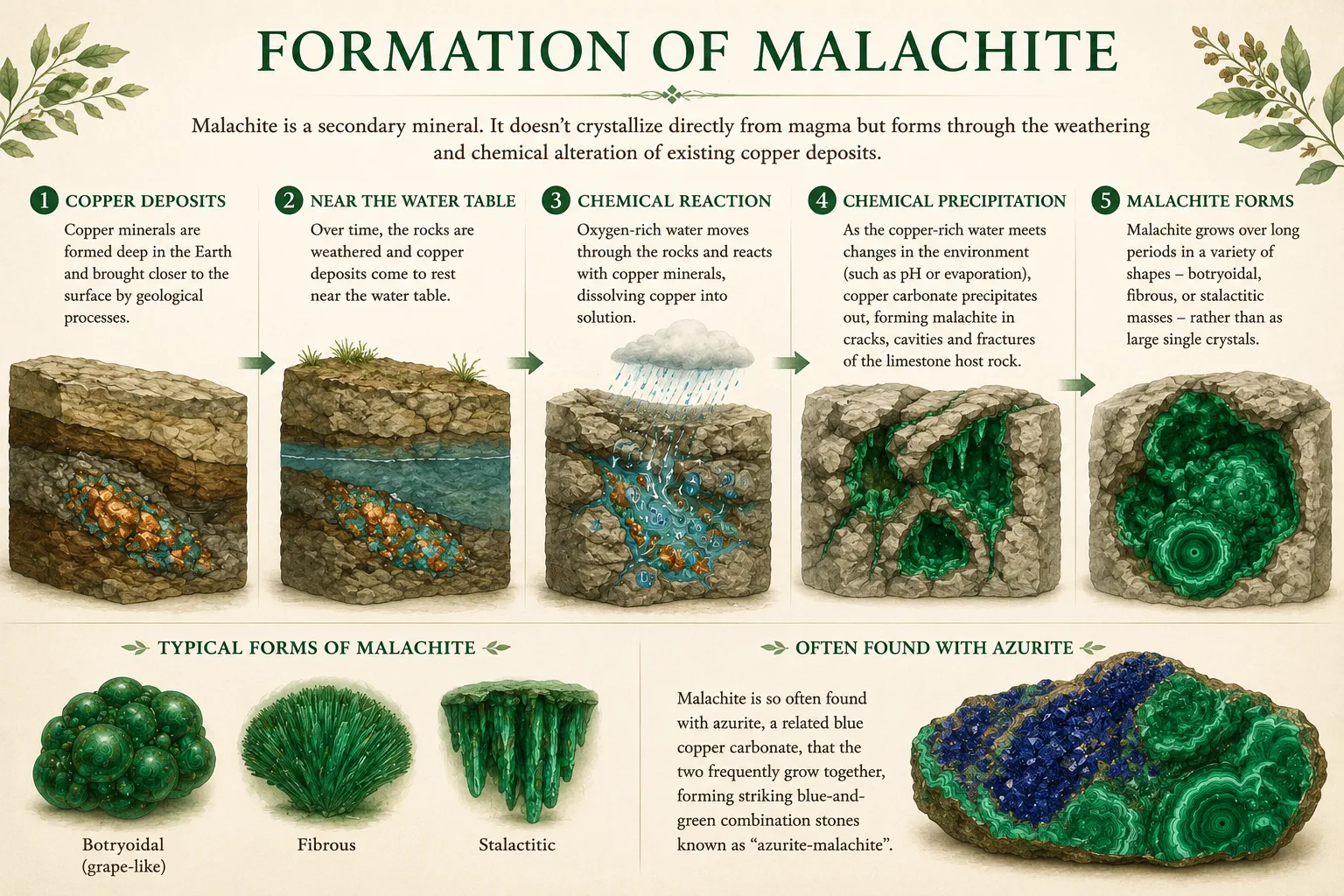
Malachite is a secondary mineral, meaning it doesn’t crystallize directly from magma but instead forms through the weathering and chemical alteration of existing copper deposits. When copper ore sits near the water table, oxygen-rich water reacts with the copper minerals, and over time, chemical precipitation produces malachite in the cracks, cavities, and fractures of surrounding limestone.
This process explains why malachite is so often found intertwined with azurite, a related blue copper carbonate — the two frequently grow together, sometimes forming striking blue-and-green combination stones known as “azurite-malachite.” It also explains malachite’s signature look: rather than growing as large single crystals, it typically forms in botryoidal (grape-like, rounded), fibrous, or stalactitic masses, with the banded, ringed patterns collectors prize so highly.
Spiritual Beliefs and Symbolism
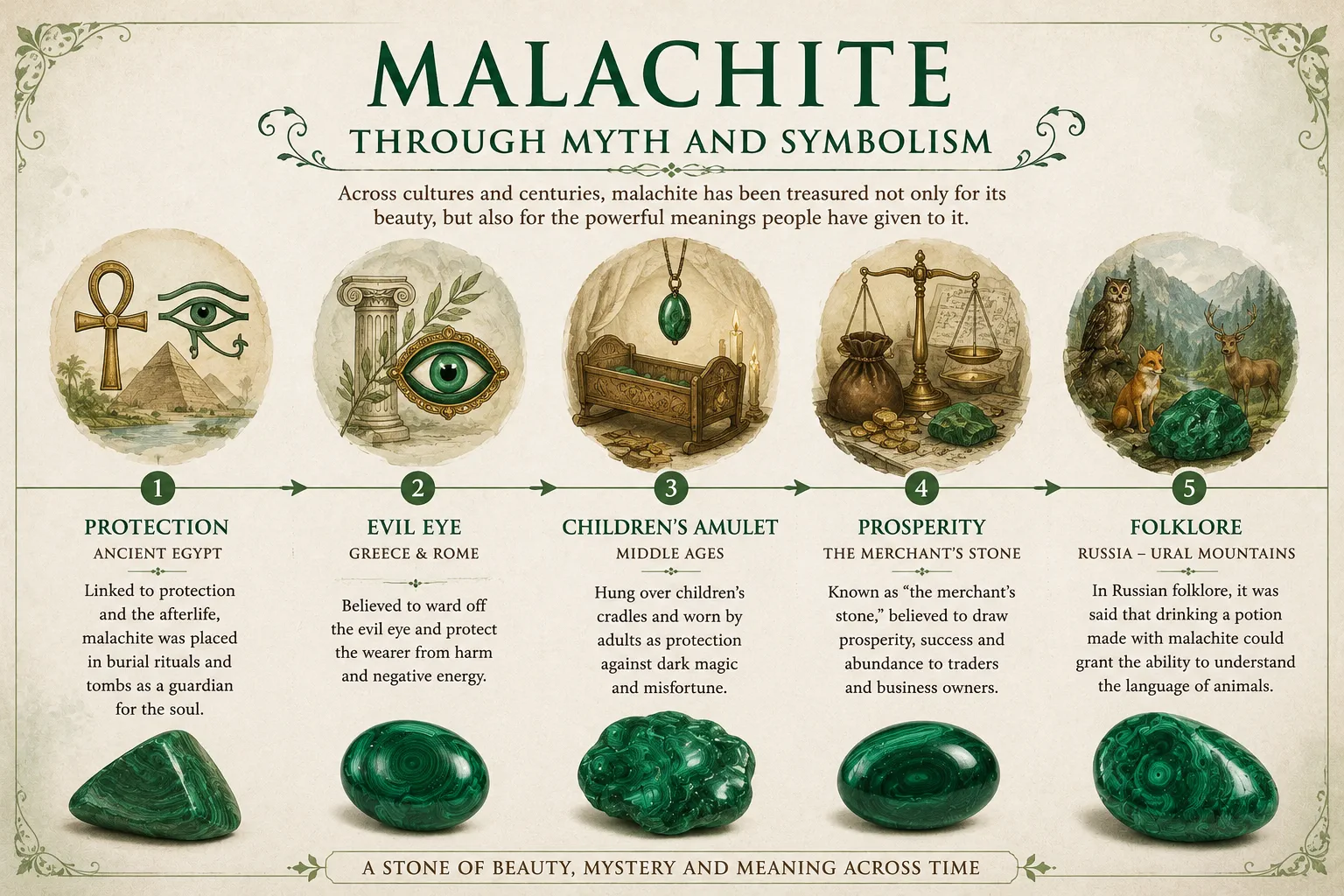
Across history, malachite has picked up a rich and varied symbolic reputation. Ancient Egyptians linked it to protection and the afterlife, often placing it in burial rituals. Ancient Greeks and Romans believed it warded off the evil eye, and in Rome it was known as the “peacock stone,” associated with the goddess Juno. In the Middle Ages, it was hung over children’s cradles and worn by adults as protection against dark magic and misfortune.
Malachite has also long carried a reputation as “the merchant’s stone,” believed to draw prosperity and success to traders and business owners. In Russian folklore, it was said that drinking a concoction made with malachite could grant the ability to understand the language of animals — a charming, if unverified, piece of legend tied to the stone’s long association with the Ural Mountains.
Malachite in Astrology
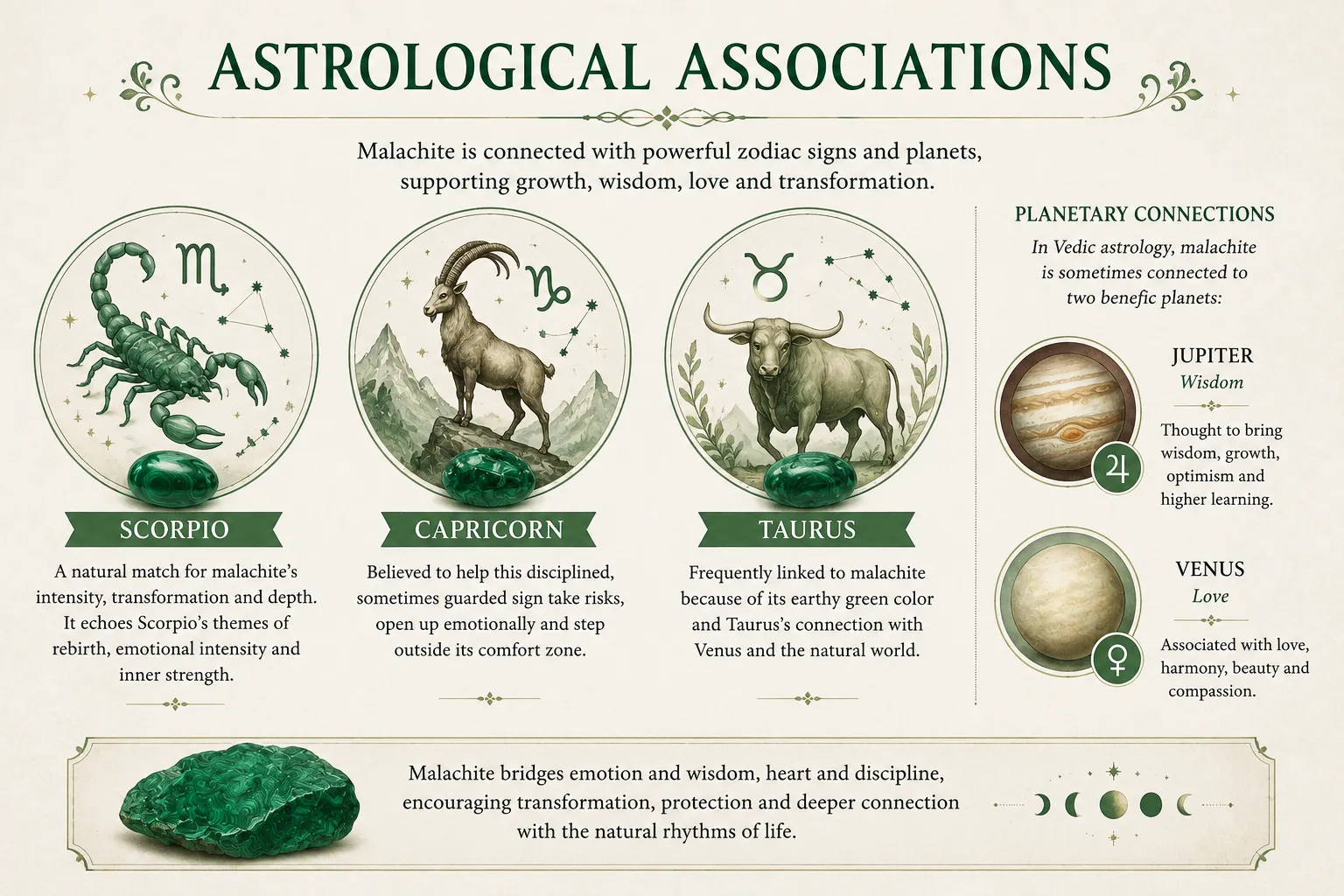
Malachite is most closely associated with two zodiac signs:
- Scorpio — seen as a natural match for malachite’s intensity, transformation, and depth, echoing Scorpio’s own themes of rebirth and emotional intensity
- Capricorn — believed to help this disciplined, sometimes guarded sign take risks, open up emotionally, and step outside its comfort zone
Taurus is also frequently linked to malachite, largely thanks to the stone’s earthy green color and Taurus’s association with Venus and the natural world. In Vedic astrology, malachite is sometimes connected to the planets Jupiter and Venus, thought to bring wisdom and love respectively when the stone is worn.
Healing and Meditation Practices
In modern crystal healing traditions, malachite is often referred to as the “Stone of Transformation.” Practitioners describe it as an intense stone — one that doesn’t offer gentle comfort so much as it pushes for honest self-examination, said to help “break down the ego to rebuild the soul.”
Common practices associated with malachite include:
- Heart Chakra work — malachite is most strongly linked to the heart chakra, believed to support emotional healing, compassion, and the release of grief, trauma, or long-held emotional baggage
- Solar Plexus Chakra — secondarily tied to personal power, confidence, and willpower
- Meditation — often held or placed on the chest during meditation to encourage emotional release and inner clarity
- Protective use — some traditions describe it as absorbing negative energy from a space or person, which practitioners say means it needs regular cleansing (commonly by rinsing under cool water or leaving it under moonlight)
(Note: these are traditional folk beliefs and metaphysical claims, not scientifically established properties.)

Because raw, unsealed malachite contains copper and can be mildly toxic if ingested or inhaled as dust, practitioners are advised never to make a “crystal elixir” by soaking it in drinking water — a rare case where the metaphysical guidance and the practical safety advice line up.
According to crystal healing traditions, malachite is thought to support:
- Emotional release — helping process grief, anger, and long-buried trauma
- Courage and risk-taking — encouraging people to step outside their comfort zones
- Protection — shielding against negative energy and, in some traditions, electromagnetic interference
- Business success — its long history as “the merchant’s stone” ties it to prosperity and sound decision-making
- Emotional boundaries — said to help guard against manipulation in relationships
- Concentration and clarity — considered useful for focusing the mind on practical goals
- Connection to nature — symbolically tied to growth, renewal, and fresh starts
Interesting Facts About Malachite
- Malachite gets its name from the Greek word malachē or molochitis, meaning “mallow,” after the green mallow plant leaves it resembles in color.
- A single malachite mass in St. Petersburg’s Hermitage Museum reportedly used about 16 tons of the stone to decorate one hall — a legacy of Russian tsars’ fascination with the mineral.
- Malachite was likely one of the very first ores humans used to smelt copper metal, making it historically significant not just as a gem but as a foundational material in early metallurgy.
- The ancient Egyptians didn’t typically carve malachite into beads or statues — instead, they ground it into a fine powder for cosmetics and pigments, which is why it appears so often in tomb paintings but rarely as standalone jewelry from that era.
- Because natural malachite is soft and rare in large polished pieces, ancient Egyptian artisans developed a ceramic substitute called faience, glazed to mimic malachite’s iconic green.
- Malachite’s banding is essentially a geological timestamp — each ring reflects subtle shifts in the mineral-rich fluids that shaped it, meaning no two pieces of malachite are ever truly identical.