Carnelian: The Fiery Stone That Has Never Gone Out of Fashion
| Quick Fact | Carnelian |
|---|---|
| Mineral Family | Quartz family — a variety of chalcedony |
| Chemical Formula | SiO₂ — silicon dioxide, coloured by iron oxides |
| Typical Colours | Pale orange, vivid orange-red, reddish brown and deep brick red |
| Hardness | 6.5–7 on the Mohs scale |
| Lustre | Waxy to vitreous when polished |
| Transparency | Translucent to nearly opaque |
| Special Feature | Its warm colour comes from iron oxides; heating can deepen pale orange material to a stronger red |
| Main Sources | India, Brazil, Uruguay and Madagascar |
| Associated Zodiac Signs | Leo, Aries, Virgo and Taurus; sometimes Scorpio |
| Traditionally Associated With | Courage, vitality, creativity, motivation, confidence and protection |
There’s something almost sunlit about carnelian. Its warm orange-to-reddish glow looks like it’s caught a little bit of the evening sky and held onto it, which might explain why this stone has stayed in near-constant use for over five thousand years without ever quite falling out of favour. Kings, seal-makers, and jewellers have all reached for it across an extraordinary span of history, drawn to a colour that seems to radiate warmth even in polished, unmoving stone.
Where Carnelian Is Found
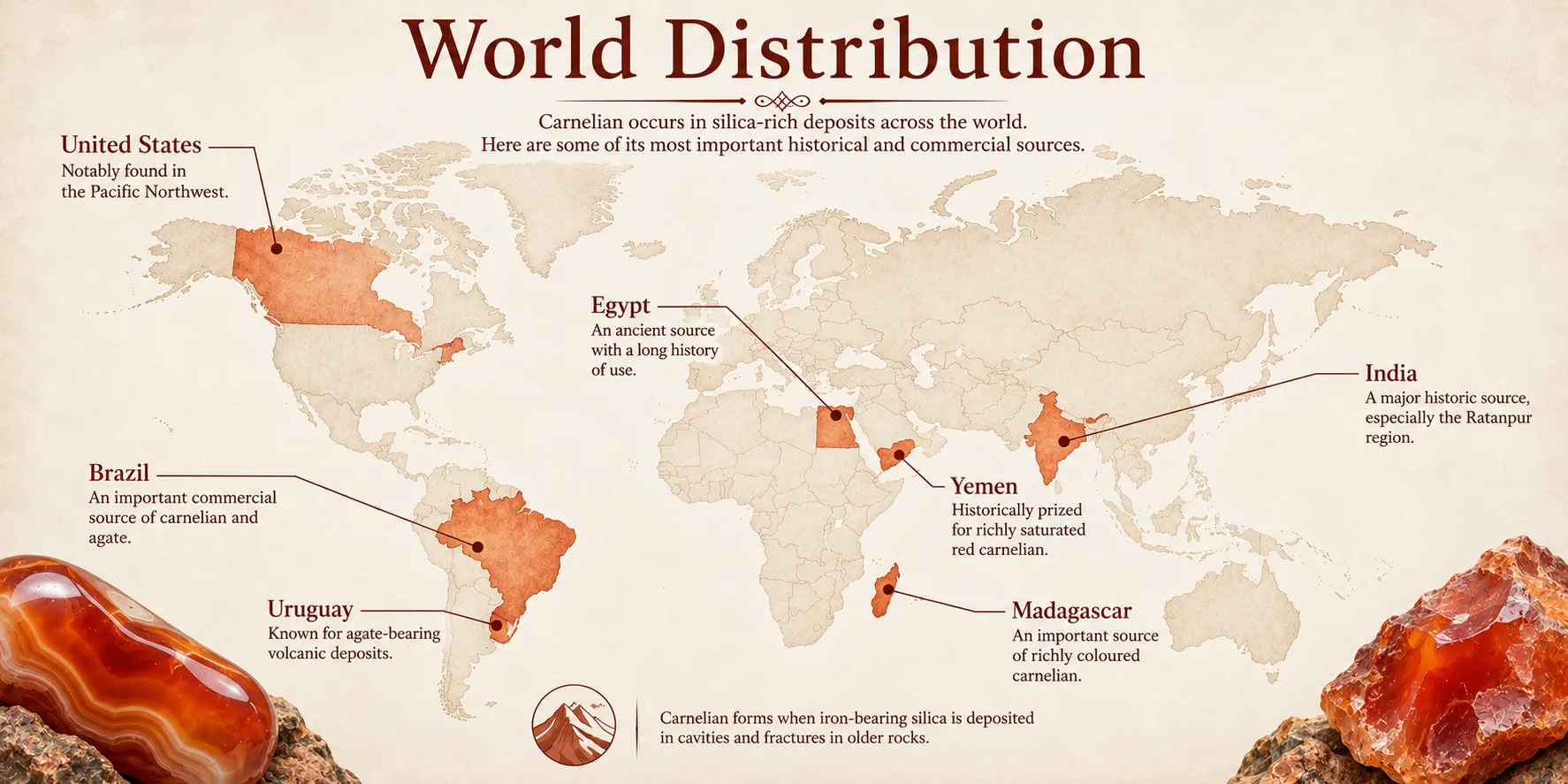
Carnelian occurs in silica-rich deposits scattered across the globe, with a few sources standing out for their historical or commercial importance:
- India — long one of the most significant sources, particularly the Ratanpur region
- Brazil
- Uruguay
- Madagascar
- Egypt
- Yemen — historically prized for a particularly rich, saturated red variety
- United States — notably the Pacific Northwest
Because carnelian forms as a variety of chalcedony rather than a rare, isolated mineral, it tends to appear wherever the right combination of iron-rich groundwater and silica has moved through cracks and cavities in older rock.
History of Carnelian
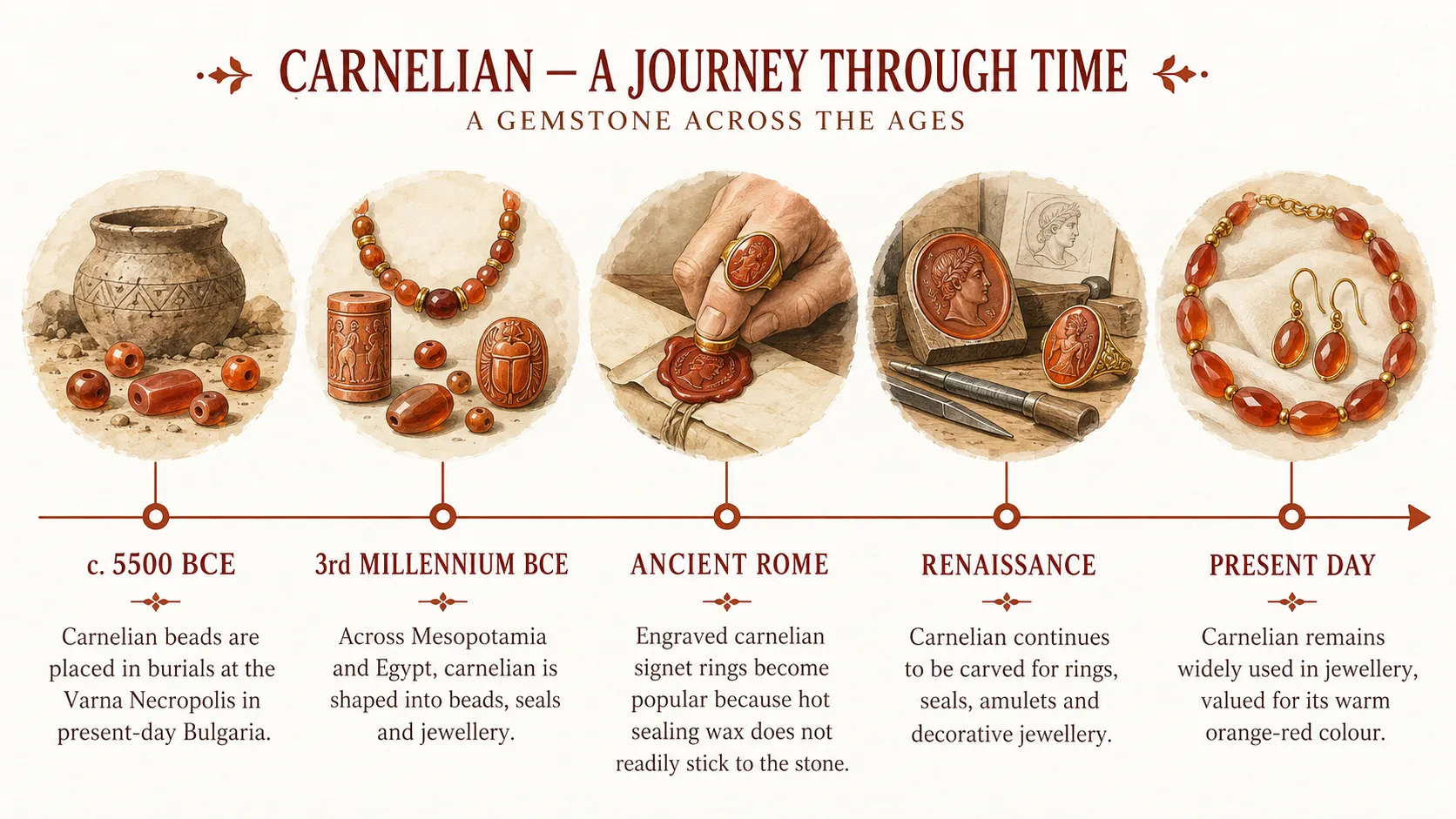
Carnelian’s story stretches back further than almost any other gemstone in regular use today. Beads carved from it have been recovered from the Varna Necropolis in Bulgaria, dated to around 5500 BCE, showing that Bronze Age lapidaries were already shaping and faceting the stone thousands of years before more familiar cutting techniques were developed elsewhere. By the third millennium BCE, carnelian was firmly established across Mesopotamia and Egypt, worked into beads, seals, and jewellery for royalty and everyday wearers alike.
Its name likely comes from one of two Latin roots: carnis, meaning flesh, a nod to the pale, fleshy tone of some specimens, or cornum, referring to the cornel cherry, whose deep red-orange fruit closely matches the stone’s more vivid shades. Both origins point to the same idea — a colour drawn straight from something warm and alive. Ancient Roman craftsmen found carnelian especially useful for an entirely practical reason: its smooth, slightly waxy surface resists sticking to hot sealing wax, which made it a favourite material for engraved signet rings used to stamp official documents and letters. That same durability and workability has kept carnelian in continuous production ever since, through the Renaissance and into the present day, where it remains one of the most widely available and affordably priced semi-precious stones on the market.
How Carnelian Forms
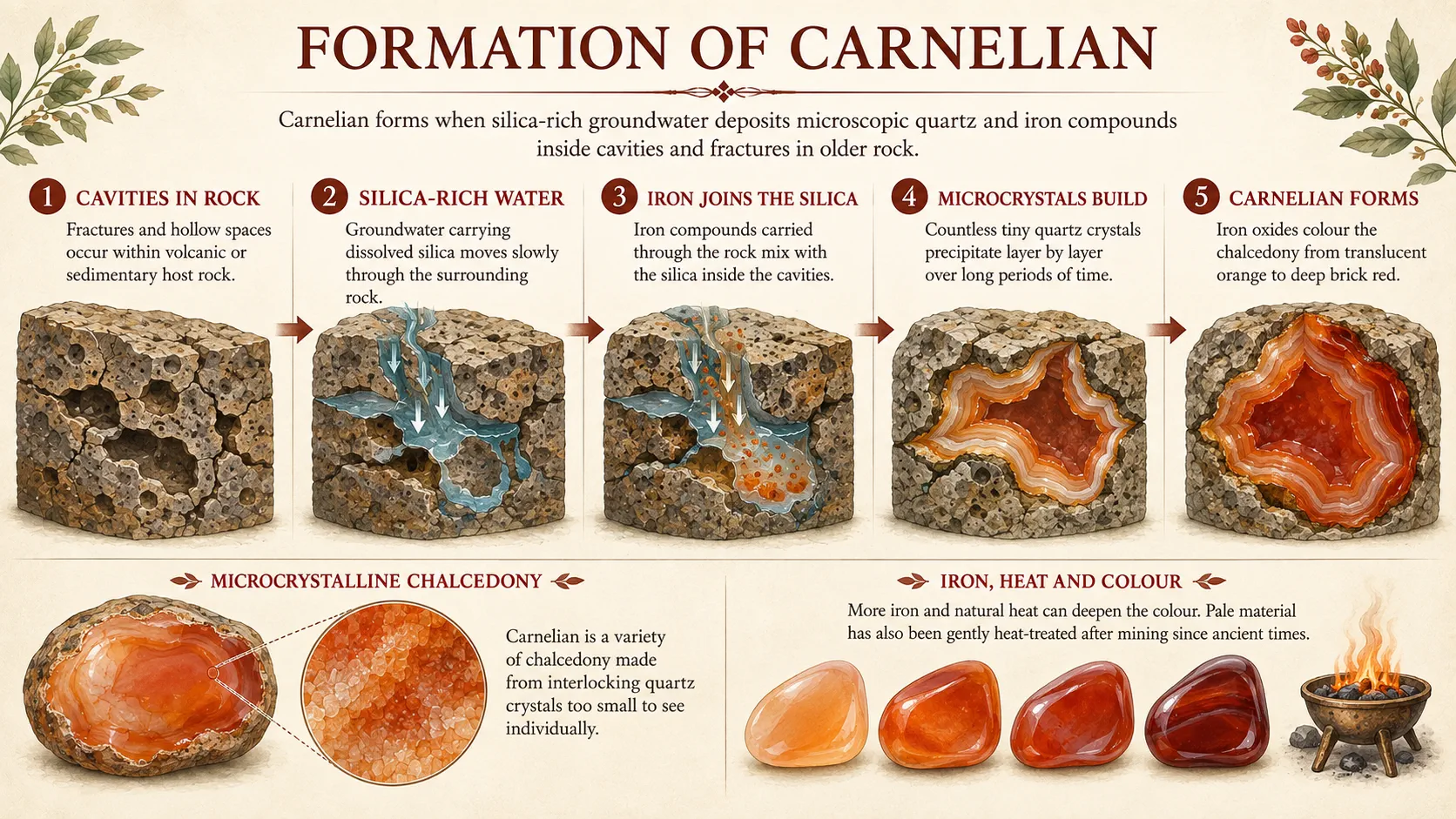
Carnelian is a variety of chalcedony, itself a microcrystalline form of quartz, meaning it’s built from countless tiny interlocking crystals far too small to see individually rather than a single large crystal structure. It typically forms as a secondary deposit within cavities and fractures in volcanic or sedimentary rock, where silica-rich groundwater slowly precipitates layer upon layer of microscopic quartz over long stretches of geological time.
What sets carnelian apart from its many chalcedony relatives is the presence of iron oxide impurities woven through the silica as it forms. These iron compounds are responsible for carnelian’s entire colour range, from pale, translucent orange through to a deep, almost brick-red brown, with the exact shade depending on both the concentration of iron present and the amount of natural heat the stone experienced underground during formation. Historically, lighter specimens were sometimes gently heat-treated to intensify their colour, a practice that traces back to ancient times and continues in the trade today.
Varieties of Carnelian
Carnelian’s range comes down mainly to shifts in tone and clarity, though a few related terms are worth knowing:
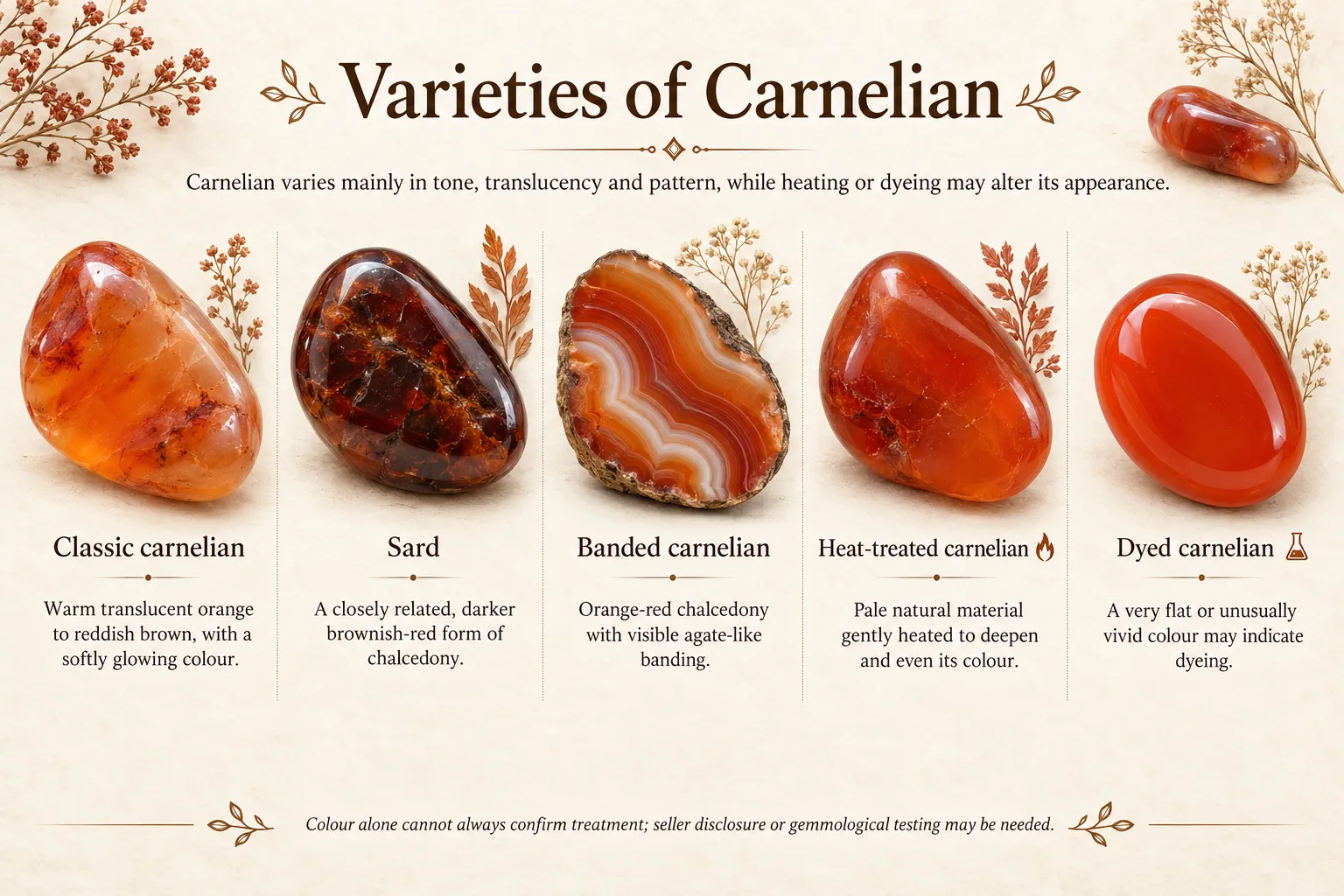
- Classic carnelian — the familiar warm orange to reddish-brown stone, prized for its even, glowing colour
- Sard — a closely related, generally darker brownish-red variety, distinguished from carnelian mostly by convention rather than any meaningful difference in composition
- Banded carnelian — displaying visible agate-like banding, a sign of carnelian’s close family relationship with banded agate
- Heat-treated carnelian — lighter natural material gently warmed to deepen and even out its colour, a practice with a history stretching back thousands of years
Because carnelian is so widely used in beaded jewellery today, it’s also sometimes dyed to achieve a more uniform or vivid colour, particularly in lower-cost material where the natural iron content produces a paler or patchier tone. As with other porous, softer ornamental stones, a suspiciously flat, perfectly even colour with no natural variation at all can be a sign of dyeing rather than an especially fine natural specimen.
Did You Know?
Carnelian beads recovered from a Bulgarian burial site date back to roughly 5500 BCE, making the stone one of the oldest gem materials worked by human hands. Ancient Roman signet rings were frequently carved from carnelian specifically because hot sealing wax doesn’t stick to its smooth, slightly waxy surface, making it remarkably practical as well as beautiful. Carnelian and the closely related stone sard are chemically and physically almost identical; the difference between the two names is largely a matter of historical convention rather than genuine mineralogy.
Traditional Beliefs and Folklore
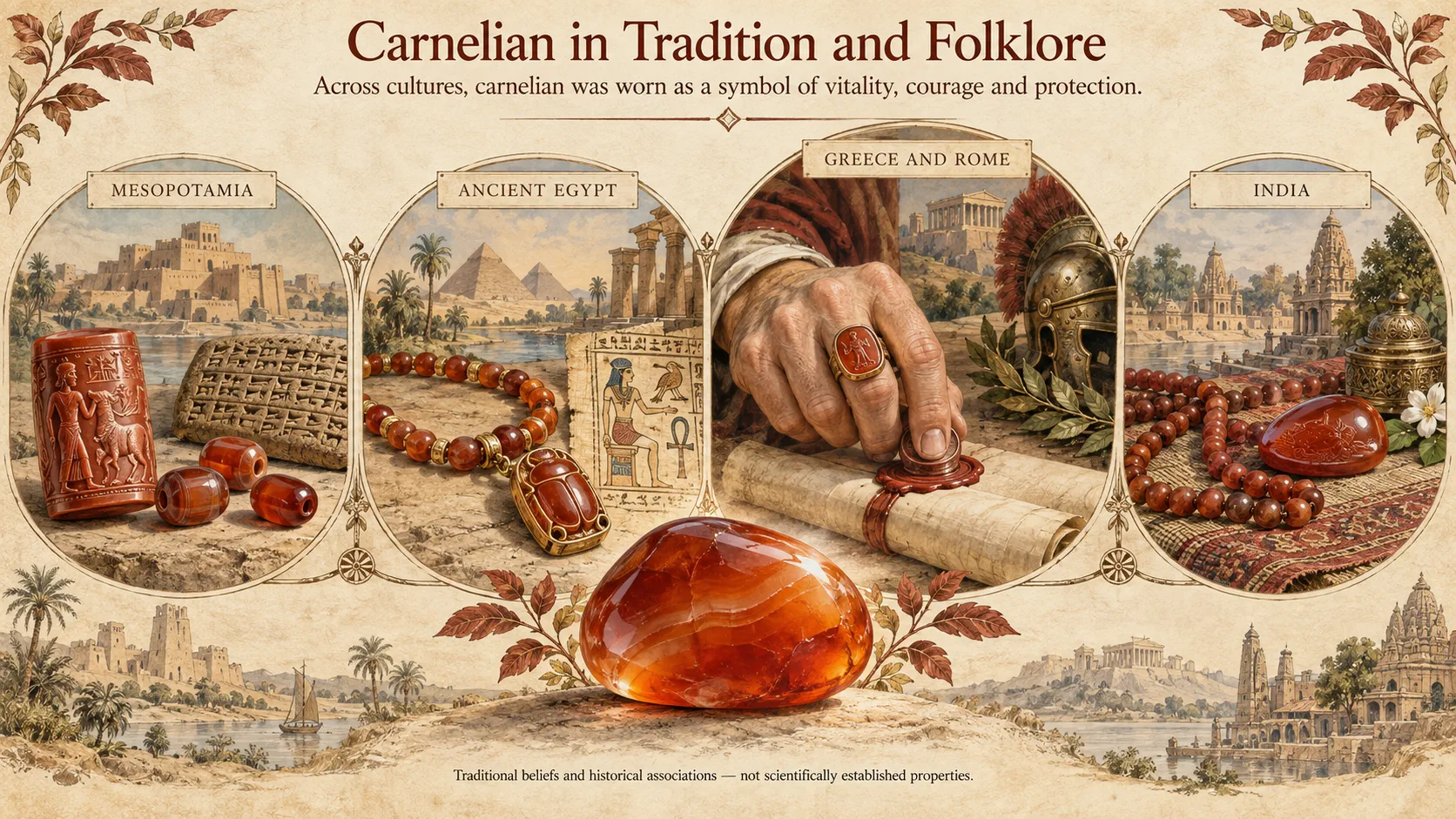
Carnelian’s long and widespread use across so many ancient civilisations has given it one of the richest folkloric legacies of any gemstone. Across Mesopotamia, Egypt, Greece, and Rome, it was consistently linked to vitality, courage, and protection, prized as both a beautiful adornment and a meaningful personal talisman. Roman soldiers and officials favoured carnelian signet rings not only for their practicality but for the sense of confidence and authority the stone was believed to lend its wearer. In parts of India, carnelian has long carried a reputation as a grounding, energising stone, closely tied to stability and courage.
That enduring reputation for vitality and confidence has followed carnelian in an almost unbroken line from antiquity into the modern crystal community, where it remains one of the most consistently recommended stones for anyone seeking a boost of energy or resolve.
(Note: these are traditional folk beliefs and metaphysical claims, not scientifically established properties.)
Astrological Associations
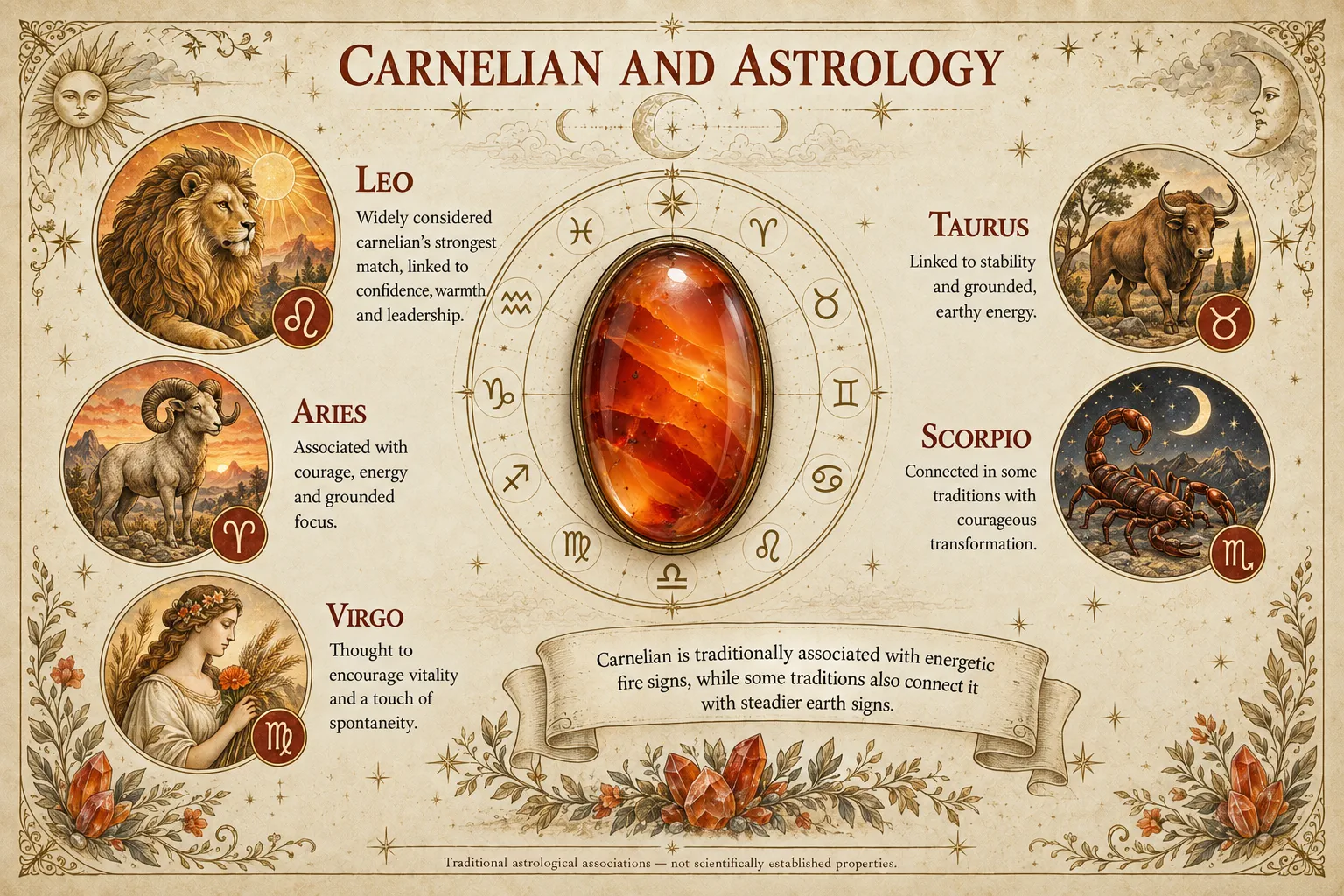
Carnelian is associated with a cluster of energetic, fire-aligned zodiac signs:
- Leo — widely considered carnelian’s strongest match, since both are linked to the sun; believed to amplify Leo’s natural confidence, warmth, and leadership
- Aries — associated with carnelian’s bold, energising qualities, believed to support courage and grounded focus during turbulent times
- Virgo — thought to help balance this detail-oriented sign’s more serious tendencies with a touch of spontaneity and vitality
- Taurus — linked to carnelian’s stabilising, earthy energy
Some traditions also connect carnelian to Scorpio, particularly in relation to its association with gentle, courageous transformation.
Healing and Meditation Practices
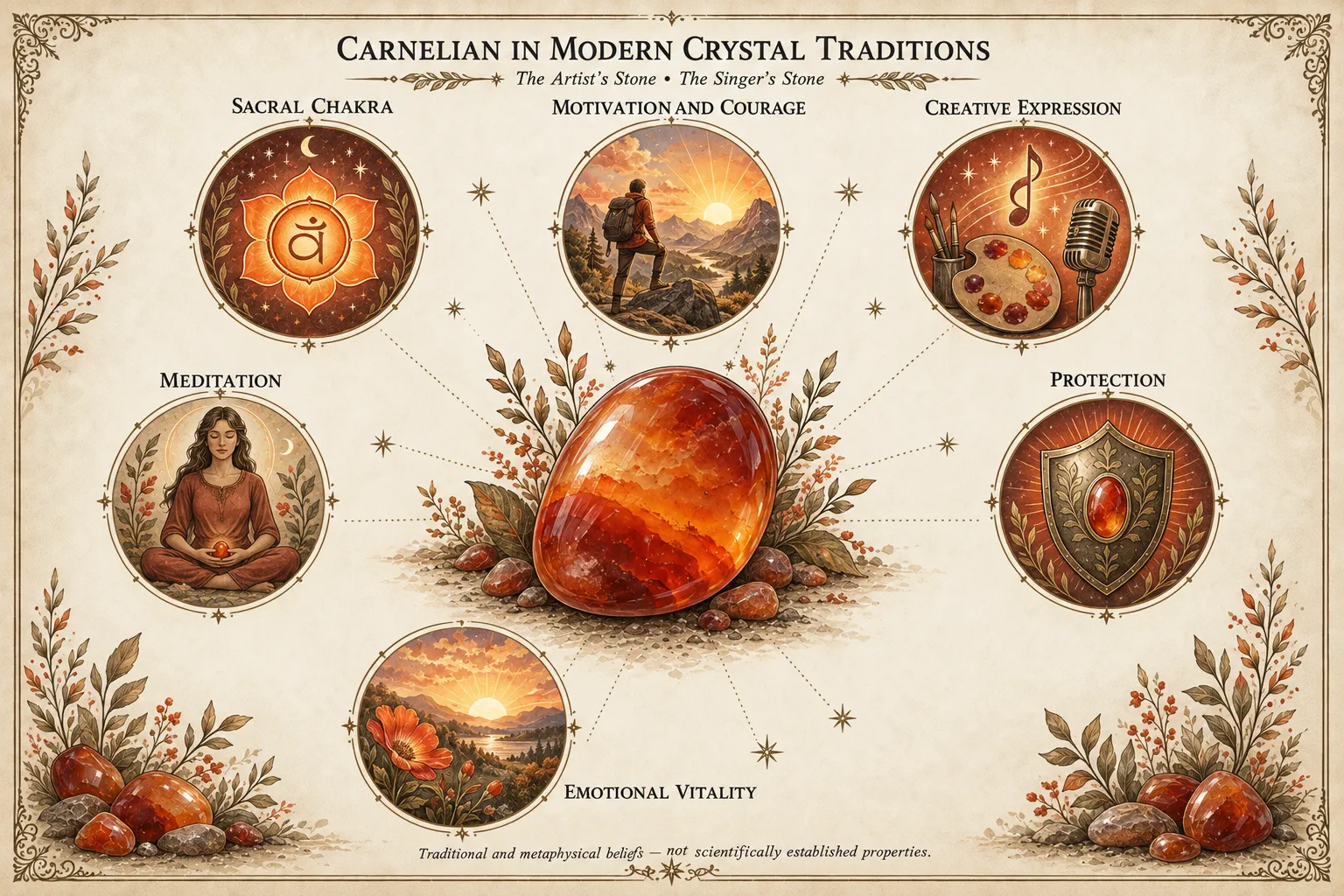
IIn modern crystal traditions, carnelian is often nicknamed “the Artist’s Stone” or “the Singer’s Stone,” valued for unlocking confident self-expression, creativity, and motivation.
Common beliefs and practices associated with carnelian include:
- Sacral Chakra work — carnelian’s primary association, tied to creativity, emotion, and a healthy sense of vitality
- Motivation and courage — one of its most widely cited qualities, believed to help push past hesitation and self-doubt
- Creative expression — closely tied to its nicknames as the artist’s and singer’s stone, believed to help unlock imagination and confident communication
- Meditation — often held near the lower abdomen during meditation, said to support a grounded, energised sense of focus
- Emotional vitality — believed to help counter low energy, apathy, or emotional stagnation, encouraging a more engaged, present mindset
- Protection — echoing its long ancient history, carnelian is still associated by some with a sense of steady, quiet protection
A Moment of Wonder
Carnelian has spent more than five thousand years doing exactly what it does best: catching the eye with a colour that seems to hum with warmth, all while quietly proving itself durable enough for royal seals, everyday jewellery, and everything in between. It’s a stone that has never needed to be rare to be treasured, a reminder that sometimes the materials that stay with us the longest are the ones woven into daily life rather than locked away as something precious and untouchable.