
Tourmaline: The Stone That Comes in Every Colour Imaginable
| Property | Details |
|---|---|
| Mineral Group | Tourmaline Group (boron silicate minerals) |
| Chemical Formula | Complex boron silicate (composition varies between species) |
| Typical Colours | Black, green, pink, red, blue, yellow, brown, colourless and multicoloured |
| Hardness | 7–7.5 on the Mohs scale |
| Crystal System | Trigonal |
| Lustre | Vitreous (glassy) |
| Transparency | Transparent to opaque |
| Special Feature | One of the few gemstones found in almost every colour; often naturally colour-zoned and both piezoelectric and pyroelectric |
| Main Sources | Brazil, Madagascar, Mozambique, Nigeria, Afghanistan, Pakistan, Sri Lanka, Tanzania, Kenya, United States, Italy |
| Birthstone | October |
| Traditionally Associated With | Protection, grounding, emotional balance, creativity and personal growth |
If any mineral deserves the nickname “the rainbow gemstone,” it’s tourmaline. Few gems can match its extraordinary colour range — vivid pinks, deep greens, electric blues, and sunny yellows, sometimes all within a single crystal. This astonishing variety comes down to a genuinely complicated chemistry, one so varied that tourmaline isn’t really a single mineral at all, but an entire family of closely related ones. It’s October’s birthstone, a longstanding favourite of jewellers and collectors alike, and a gemstone whose story is every bit as colourful as the stone itself.
Where Tourmaline Is Found
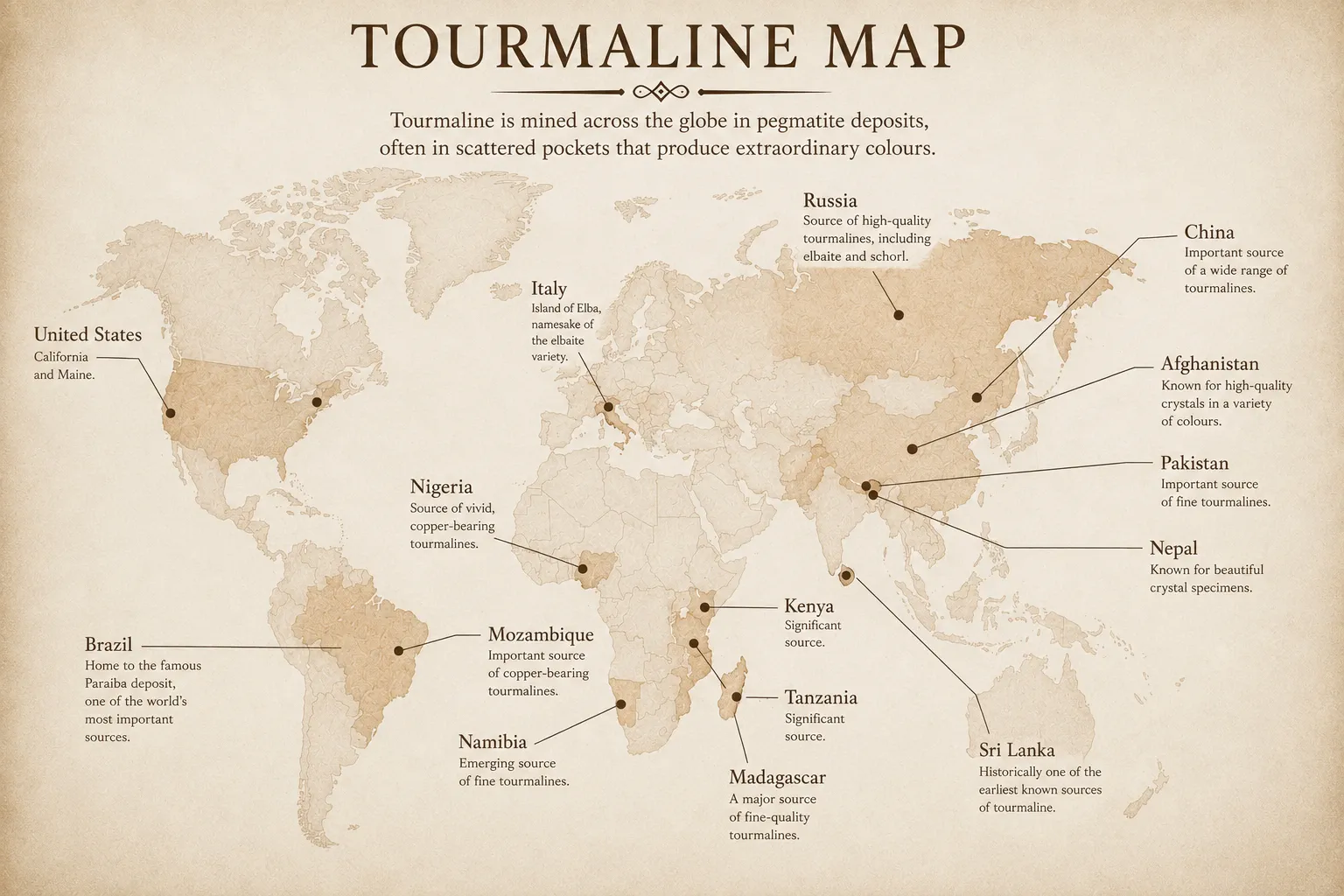
Tourmaline is mined across a genuinely impressive spread of countries, reflecting just how many pegmatite deposits around the world contain this remarkably diverse gemstone.
Major sources include:
- Brazil — historically and commercially one of the world’s most important producers, home to the famous Paraíba deposit
- Madagascar — renowned for producing a wide range of colourful gem-quality tourmalines
- Mozambique and Nigeria — important modern sources of vivid, copper-bearing material similar to Paraíba tourmaline
- Afghanistan, Pakistan, and Nepal — celebrated for exceptionally well-formed crystal specimens in many colours
- Kenya and Tanzania — significant East African producers of gem-quality tourmaline
- Sri Lanka — one of the earliest recorded sources of tourmaline, long known for its gem gravels
- United States — particularly California and Maine, famous for historic gem-bearing pegmatites
- Italy — the island of Elba, which gave its name to elbaite, the most important gem-quality tourmaline species
- Namibia — an established African source of attractive green, pink, and multicoloured tourmalines
- Russia — known for producing high-quality tourmaline from the Ural Mountains and Siberian pegmatites
- China — home to several pegmatite deposits that yield a variety of tourmaline colours, particularly for the domestic gemstone market
Because tourmaline forms in a very specific type of rock known as pegmatite, it tends to occur in scattered pockets rather than broad mineral belts. As a result, a relatively small number of famous mines and pegmatite districts have played an outsized role in shaping the gemstone’s history, rarity, and reputation among jewellers and collectors.
When Was Tourmaline First Discovered?
Tourmaline’s story is full of cases of mistaken identity. As early as the 1500s, a Spanish conquistador is said to have found a green tourmaline crystal in Brazil and, quite understandably, mistaken it for an emerald — a mix-up that would repeat itself for centuries, since tourmaline was frequently confused with emerald, ruby, and other established gemstones long before anyone realised it was something entirely new.
Its more formal introduction to Europe came in the early 1700s, when Dutch traders brought multicoloured, water-worn pebbles back from the gem gravels of Ceylon, present-day Sri Lanka. Unsure quite what they’d found, they adopted the local Sinhalese word turmali, meaning “mixed gems,” a wonderfully fitting name for a stone whose true identity would remain unresolved for another century. It wasn’t until the 1800s that scientists finally recognised tourmaline as a distinct mineral species in its own right, rather than a confusing jumble of other known gems.
The 19th century also brought new deposits in Brazil and California, dramatically expanding the range of colours available and helping tourmaline build its reputation as one of the most versatile coloured gemstones on the market. Its story took a dramatic modern turn in 1989, when a striking, intensely coloured copper-bearing variety was discovered near the village of São José da Batalha in the Brazilian state of Paraíba. These vivid neon blues and greens caused an immediate sensation in the gem trade, and demand soon far outstripped the tiny original mine’s limited supply — a scarcity that continues to make genuine Paraíba tourmaline one of the most valuable coloured gemstones in the world today.

Chemical Composition and Hardness
Tourmaline isn’t a single mineral but a large group of closely related boron silicate minerals, all sharing a similar crystal structure while varying considerably in exact chemical make-up. Its general formula is often written as (Na,Ca)(Li,Mg,Fe,Mn,Al)₃Al₆(BO₃)₃Si₆O₁₈(OH,F)₄, though the precise mix of elements shifts from one variety to the next, which is exactly why tourmaline displays such an enormous range of colours.
Key physical properties include:
- Hardness: 7 to 7.5 on the Mohs scale, making it a durable choice for everyday jewellery
- Crystal system: Trigonal, typically forming long, striated prismatic crystals
- Specific gravity: Approximately 3.0 to 3.1
- Luster: Vitreous
- Cleavage: Indistinct; tourmaline fractures conchoidally rather than splitting cleanly
- Pleochroism: Many tourmalines appear to shift shade or even colour when viewed from different angles, an optical effect used deliberately by cutters to bring out the richest tone in a finished gem
- Piezoelectricity: Like quartz, tourmaline generates a small electrical charge under pressure — a property that fascinated 18th-century scientists long before its cause was properly understood
Tourmaline’s varied chemistry is organised by mineralogists into more than thirty recognised species, though only a handful — chiefly elbaite, schorl, and dravite — account for the vast majority of gem-quality material. its clearest form, Iceland spar, where a single beam of light entering the crystal splits cleanly into two.
How Tourmaline Forms
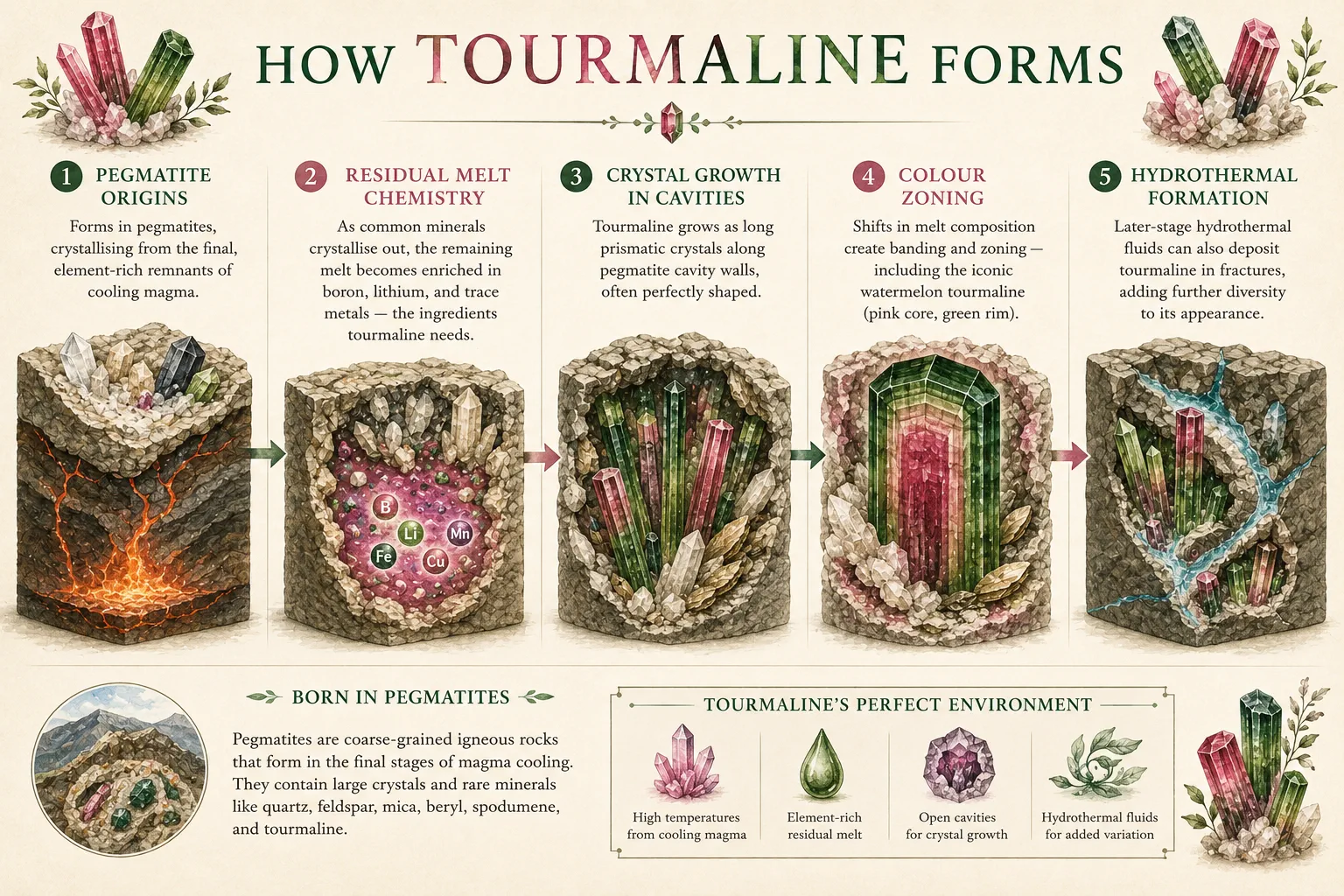
Tourmaline typically begins its life deep underground, in pegmatites — coarse-grained igneous rocks that crystallise from the last, mineral-rich remnants of cooling magma. As magma slowly solidifies, most common minerals crystallise out early, leaving behind a residual melt enriched in rarer elements such as boron, lithium, and various trace metals. It’s from this concentrated leftover soup that tourmaline crystallises, often growing as long, well-formed prismatic crystals lining the walls of cavities within the pegmatite.
Because this residual melt can shift in composition as crystallisation proceeds, a single tourmaline crystal can display dramatic colour zoning, banding, or a gradual shift from one hue to another along its length — the striking effect seen in watermelon tourmaline, where a pink core is wrapped in a green outer layer. Tourmaline can also form later, through hydrothermal fluids moving through cracks and fractures in existing rock, adding yet another layer of variety to how and where it’s found.interlocked crystals.
Varieties of Tourmaline
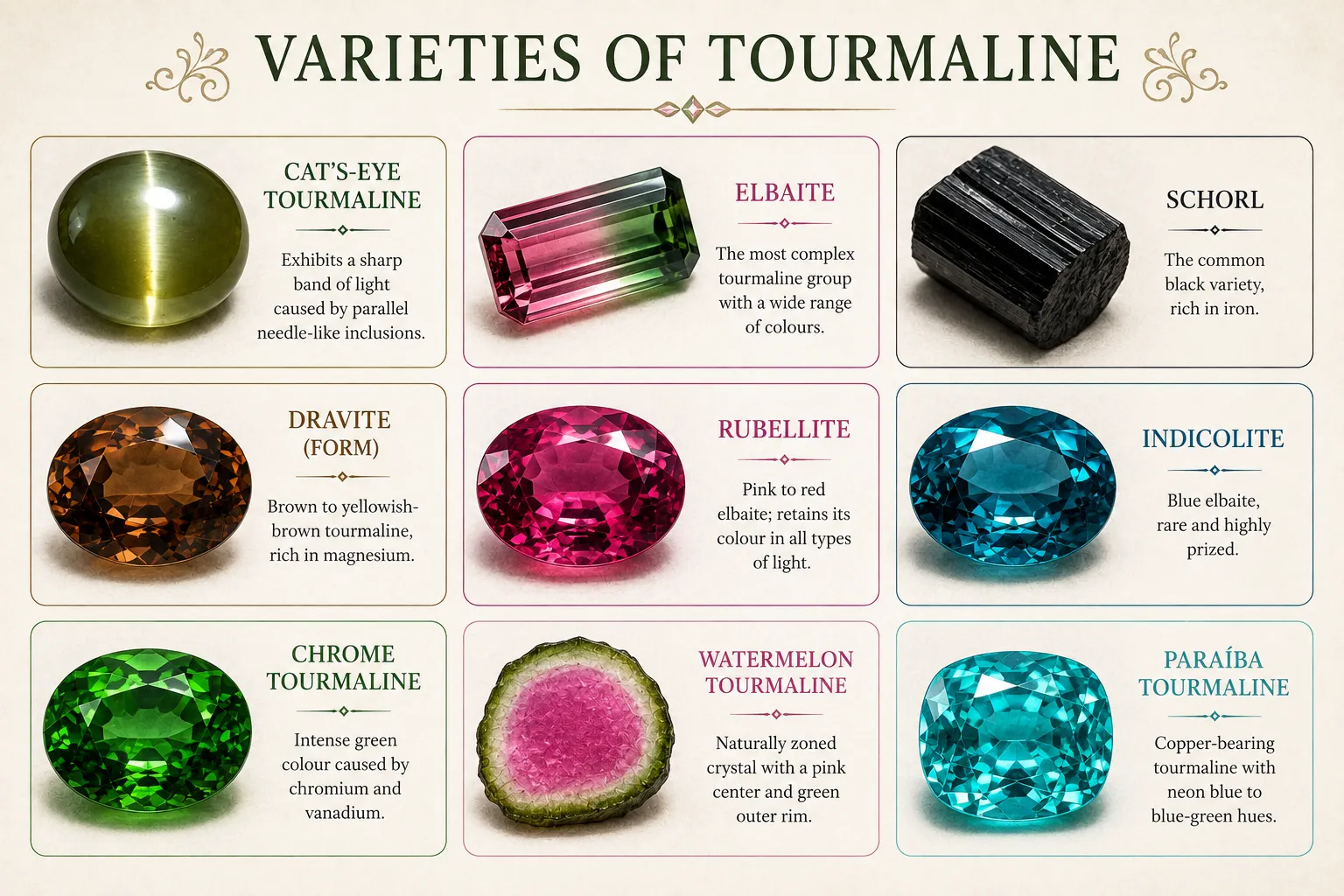
With over thirty recognised species and a colour range spanning almost the entire visible spectrum, tourmaline has more named varieties than most gemstones:
| Variety | Description |
|---|---|
| Cat’s-eye Tourmaline | Cut as a cabochon to display a narrow, moving band of light (chatoyancy) caused by tiny parallel internal growth tubes or needle-like inclusions. |
| Elbaite | The most important gem-quality species, producing the vast majority of tourmaline used in jewellery. Named after the Italian island of Elba. |
| Schorl | A black, iron-rich variety and by far the most common form of tourmaline, although transparent gem-quality specimens are relatively uncommon. |
| Dravite | A magnesium-rich variety ranging from yellow and honey-brown to dark brown. Bright yellow material is sometimes marketed as Canary Tourmaline. |
| Rubellite | A vivid pink, purplish-red, or red variety that retains its colour under different lighting conditions. It has often been mistaken for ruby. |
| Indicolite | A rare and highly prized blue variety, ranging from pale blue to deep sapphire-blue. |
| Chrome Tourmaline | An intensely green variety coloured by chromium and sometimes vanadium, known for its rich emerald-like colour. |
| Watermelon Tourmaline | A naturally colour-zoned crystal with a pink or red centre surrounded by a green outer layer, resembling the cross-section of a watermelon. |
| Paraíba Tourmaline | An exceptionally vivid neon blue to blue-green variety coloured by traces of copper (and often manganese). Among the rarest and most valuable coloured gemstones in the world. |
Did You Know?
Paraíba tourmaline, first discovered in Brazil in 1989, caused such intense demand that the original mine was exhausted within just a few years, helping make genuine Paraíba material one of the most valuable coloured gemstones by weight in the world today.
Tourmaline’s name comes from the Sinhalese word turmali, meaning “mixed gems,” a nod to the confusion early Dutch traders felt when faced with such a colourful, unfamiliar assortment of stones.
A single tourmaline crystal can contain several different colours at once, an effect caused by shifts in the chemistry of the molten fluid it crystallised from over time.
Traditional Beliefs and Folklore
Tourmaline’s extraordinary colour range has inspired its own share of folklore, most famously an old belief attributing its rainbow of hues to a rather poetic origin: the stone was said to have travelled up from deep within the earth along the path of a rainbow, absorbing each of its colours along the way. This vivid image helped tourmaline earn a long-standing reputation as a stone of creativity and inspiration, closely tied to its sheer visual variety.
Its confusing early history, so often mistaken for other well-known gems, also gave it an association with balance and clarity of identity — fitting, perhaps, for a stone that took Europeans the better part of two centuries to properly recognise for what it truly was. In more recent tradition, tourmaline has also picked up a reputation as a stone of friendship and enduring affection, a sentiment often echoed in its continued popularity for gifts and personal jewellery.
(Note: these are traditional folk beliefs and metaphysical claims, not scientifically established properties.)
Healing and Meditation Practices
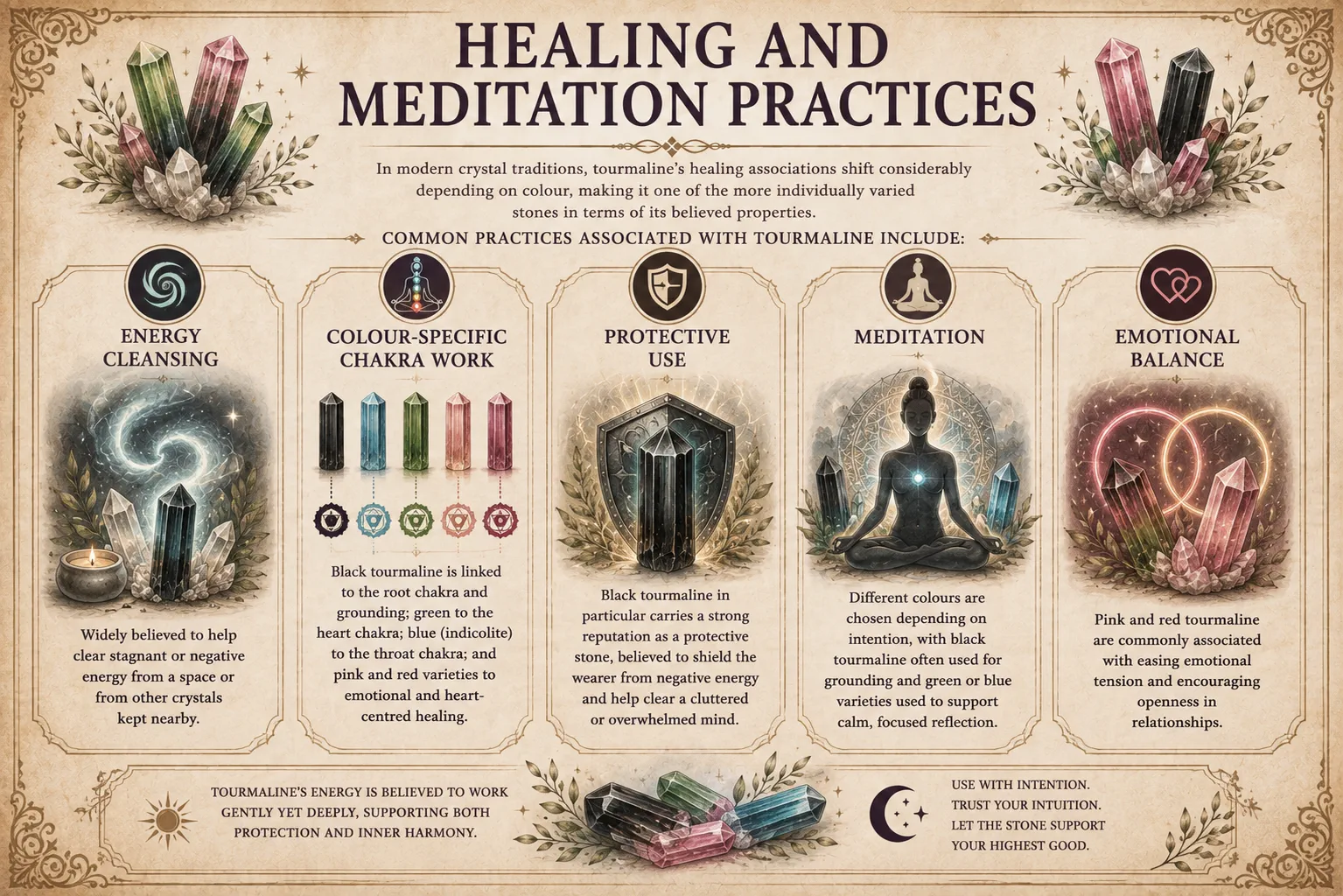
In modern crystal traditions, tourmaline’s healing associations shift considerably depending on colour, making it one of the more individually varied stones in terms of its believed properties.
Common practices associated with tourmaline include:
Energy cleansing — widely believed to help clear stagnant or negative energy from a space or from other crystals kept nearby
Colour-specific chakra work — black tourmaline is linked to the root chakra and grounding; green tourmaline to the heart chakra; blue tourmaline (indicolite) to the throat chakra; and pink and red varieties to emotional and heart-centred healing
Protective use — black tourmaline in particular carries a strong reputation as a protective stone, believed to shield the wearer from negative energy and help clear a cluttered or overwhelmed mind
Meditation — different colours are chosen depending on intention, with black tourmaline often used for grounding and green or blue varieties used to support calm, focused reflection
Emotional balance — pink and red tourmaline are commonly associated with easing emotional tension and encouraging openness in relationships
Qualities Tourmaline Is Said to Improve
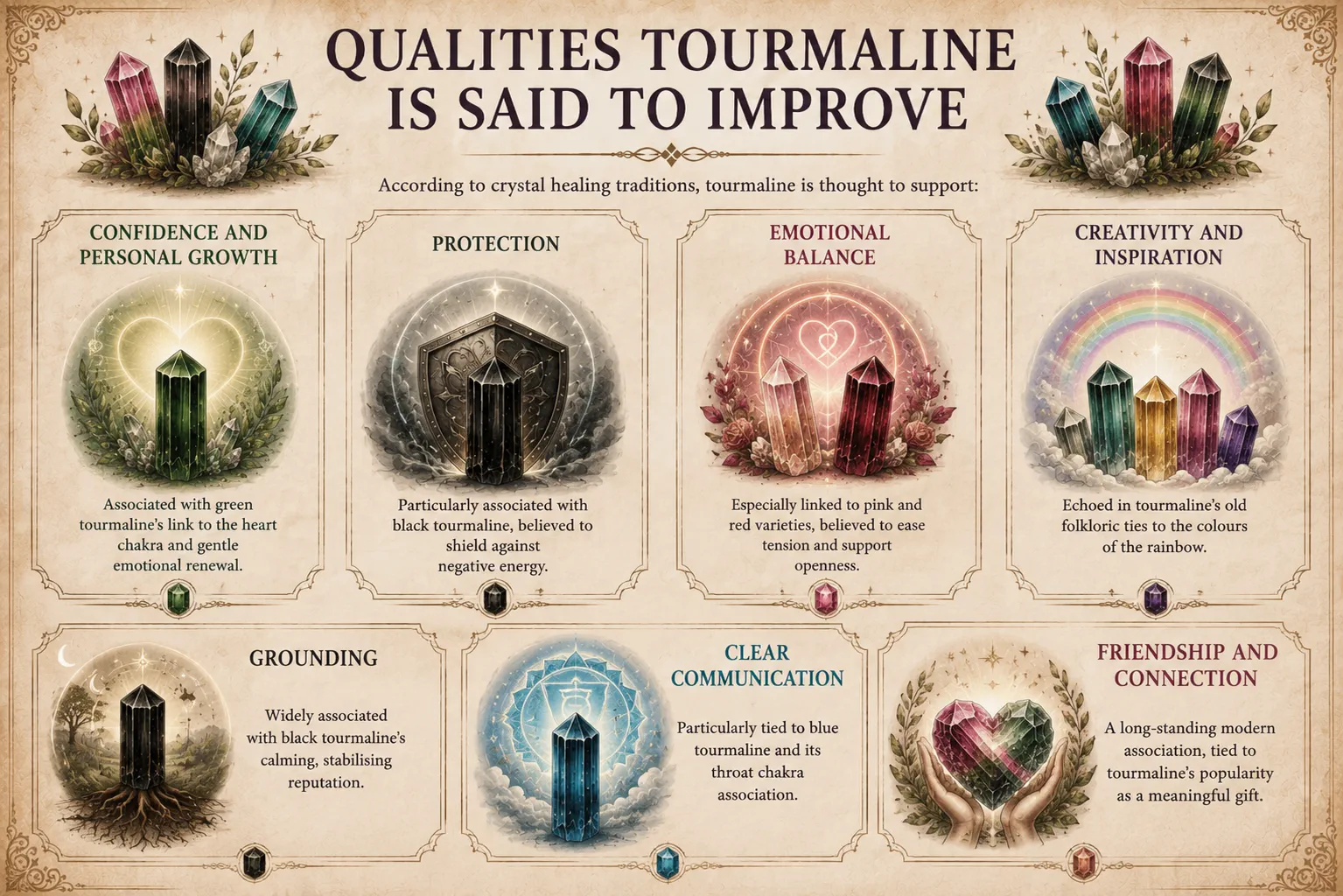
According to crystal healing traditions, tourmaline is thought to support:
Confidence and personal growth — associated with green tourmaline’s link to the heart chakra and gentle emotional renewal
Protection — particularly associated with black tourmaline, believed to shield against negative energy
Emotional balance — especially linked to pink and red varieties, believed to ease tension and support openness
Creativity and inspiration — echoed in tourmaline’s old folkloric ties to the colours of the rainbow
Grounding — widely associated with black tourmaline’s calming, stabilising reputation
Clear communication — particularly tied to blue tourmaline and its throat chakra association
Friendship and connection — a long-standing modern association, tied to tourmaline’s popularity as a meaningful gift
Astrological Associations
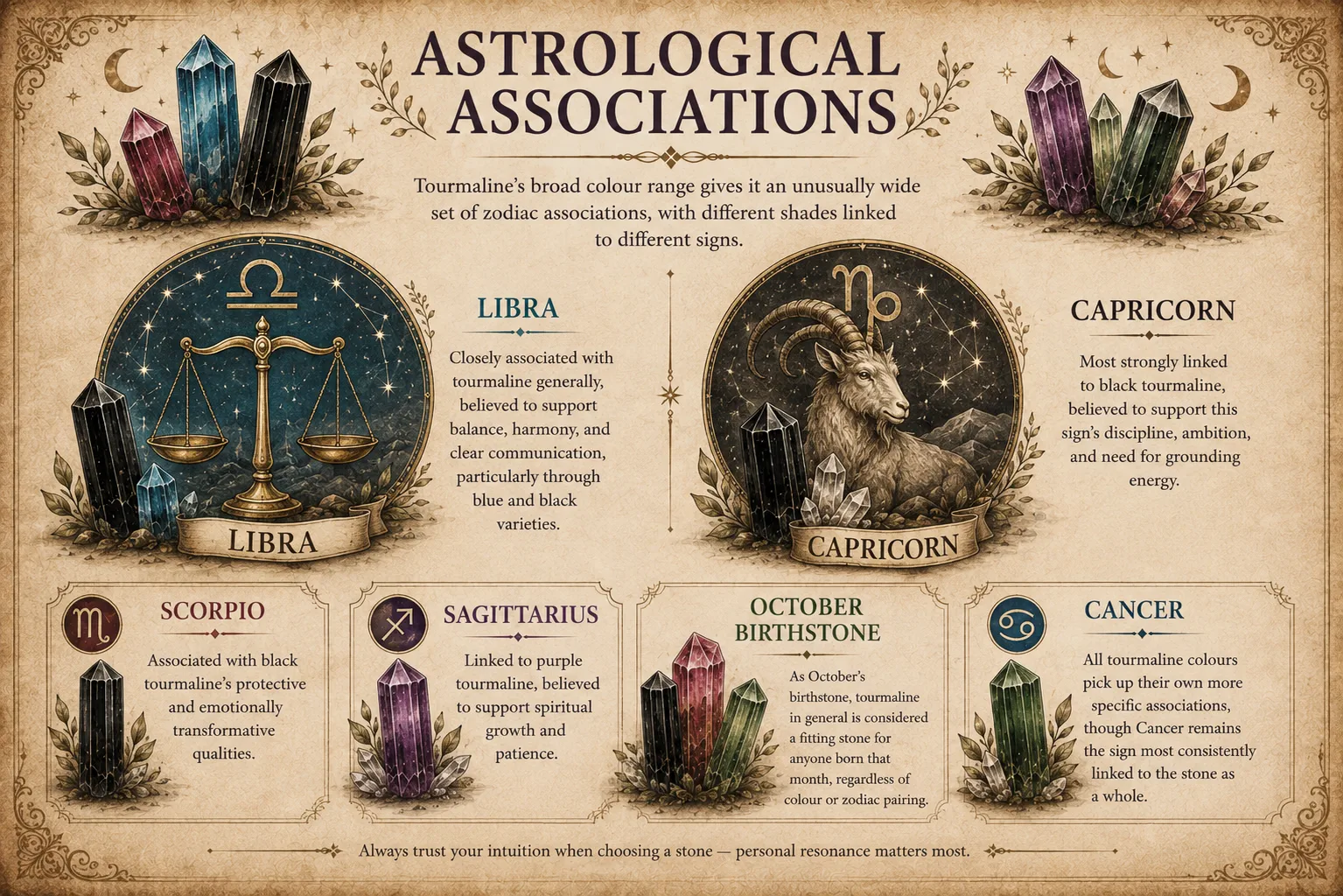
Tourmaline’s broad colour range gives it an unusually wide set of zodiac associations, with different shades linked to different signs:
- Libra — closely associated with tourmaline generally, believed to support balance, harmony, and clear communication, particularly through blue and black varieties
- Capricorn — most strongly linked to black tourmaline, believed to support this sign’s discipline, ambition, and need for grounding energy
- Scorpio — associated with black tourmaline’s protective and emotionally transformative qualities
- Sagittarius — linked to purple tourmaline, believed to support spiritual growth and patience
As October’s birthstone, tourmaline in general is considered a fitting stone for anyone born that month, regardless of which particular colour or zodiac pairing resonates most.es pick up their own more specific associations, though Cancer remains the sign most consistently linked to the stone as a whole.
A Moment of Wonder
Few stones capture nature’s sheer inventiveness quite like tourmaline. Born from the last, mineral-rich dregs of cooling magma, it manages to pack an entire rainbow of possibility into a single crystal family — sometimes, remarkably, into a single crystal. It’s a fitting reminder that even geology has room for a little flair, and that some of the world’s most dazzling colours were never painted or dyed at all, simply grown, patiently, in the quiet dark beneath our feet.


