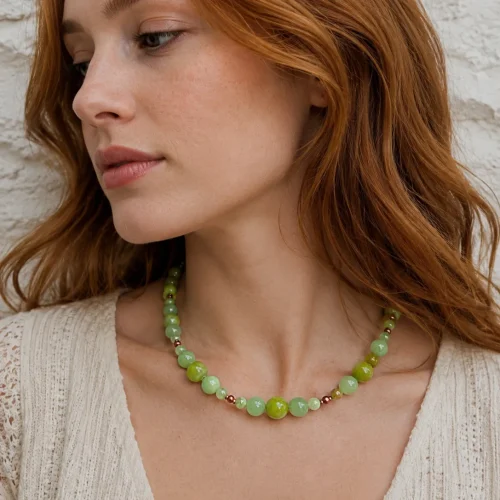
Calcite: The Quiet Mineral Behind Cathedrals, Caves and Clarity
| Property | Details |
|---|---|
| Mineral Family | Carbonate |
| Chemical Formula | CaCO₃ (Calcium Carbonate) |
| Crystal System | Trigonal |
| Typical Colours | Colourless, white, honey, yellow, orange, green, blue, pink, brown, black |
| Hardness | 3 on the Mohs scale |
| Lustre | Vitreous to pearly |
| Transparency | Transparent to opaque |
| Cleavage | Perfect rhombohedral cleavage in three directions |
| Special Features | Reacts with weak acids; exhibits double refraction in the clear variety known as Iceland spar; some specimens fluoresce under ultraviolet light |
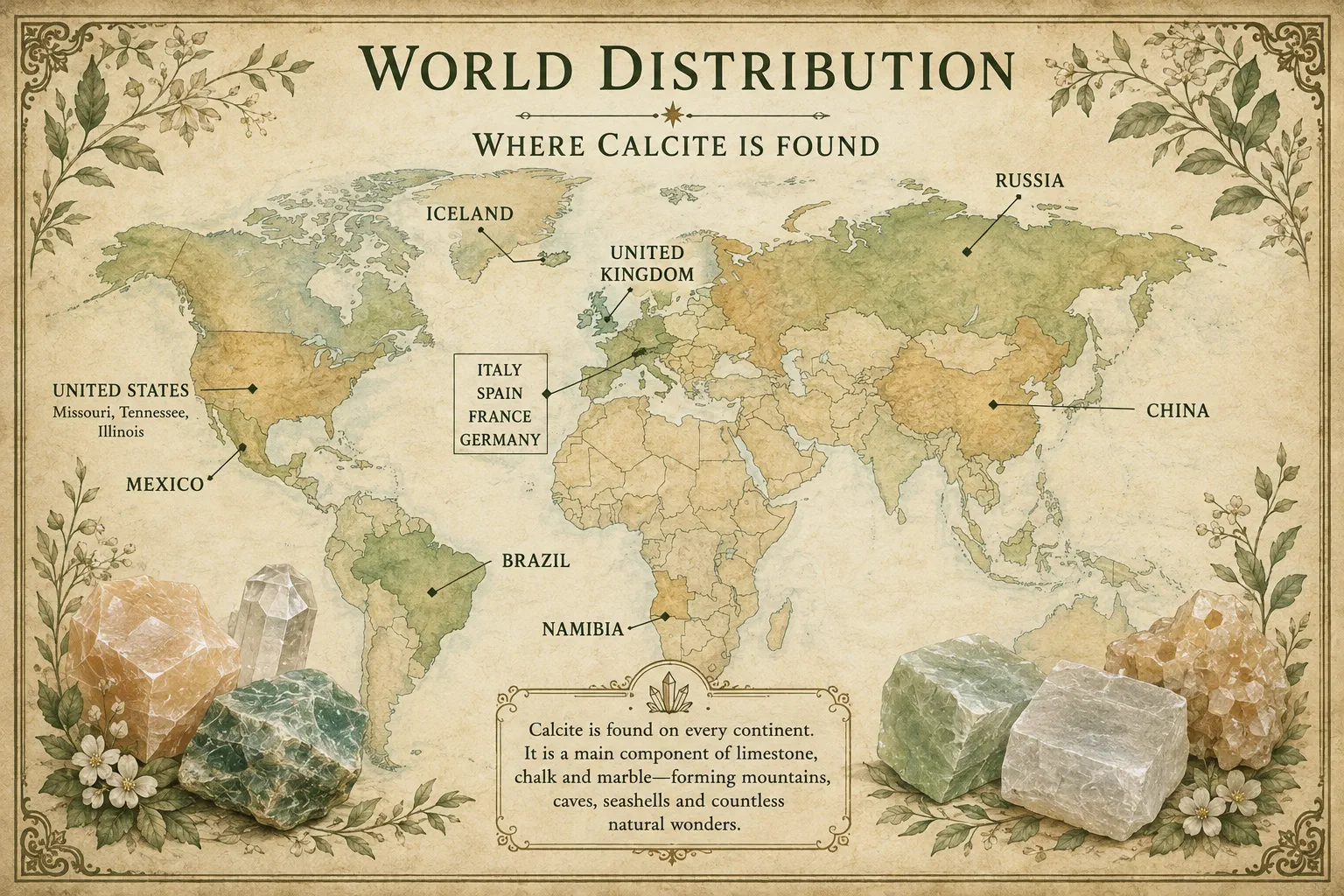
| Main Sources | Mexico, Iceland, United Kingdom, United States, Brazil, China, Russia, Namibia, Italy, Spain, Germany and France |
| Associated Zodiac Signs | Cancer, Virgo, Sagittarius, Aquarius (traditional associations) |
| Traditionally Associated With | Mental clarity, emotional balance, confidence, motivation, calm, creativity and energy cleansing (traditional beliefs) |
Calcite rarely gets the fanfare given to flashier gemstones, yet it is one of the most important minerals on Earth, quietly shaping landscapes, buildings and even life itself. It builds limestone cliffs, marble statues, cave formations, and even the shells on a beach, all while occasionally forming into strikingly clear or richly coloured crystals prized by collectors and healers alike. It’s a stone of contradictions: soft enough to scratch with a fingernail, yet found holding up entire mountain ranges. Here’s a closer look at where it comes from, how it forms, and why such a humble mineral has earned such a devoted following.
- Where Calcite Is Found
- When Was Calcite First Discovered?
- Chemical Composition and Hardness
- How Calcite Forms
- Varieties of Calcite
- Did You Know?
- Traditional Beliefs and Folklore
- Healing and Meditation Practices
- Qualities Traditionally Associated With Calcite
- Astrological Associations
- Caring for Calcite Jewellery
Where Calcite Is Found
Calcite is one of the most abundant minerals on the planet, and turns up in enormous quantities almost everywhere:
- Mexico — a major source of fine specimen-quality crystals, particularly honey and orange calcite
- Iceland — historically significant, home to the famous clear variety known as Iceland spar
- United Kingdom — calcite is common throughout Britain, particularly in limestone regions such as the Peak District, the Mendip Hills, and parts of Derbyshire
- United States — notably Missouri, Tennessee, and Illinois
- China
- Russia
- Brazil
- Namibia
Because calcite is the main mineral in limestone, chalk, and marble, it’s genuinely difficult to travel far without encountering it in some form, whether underfoot, in a building’s façade, or lining the walls of a cave.formation.s.ction, and much of the material found in jewelry and mineral shops worldwide can be traced back to the region’s iron-rich rock formations. Large deposits also occur throughout continental Europe, particularly in Italy, Spain, Germany and France, where limestone and marble have been quarried for centuries.
When Was Calcite First Discovered?
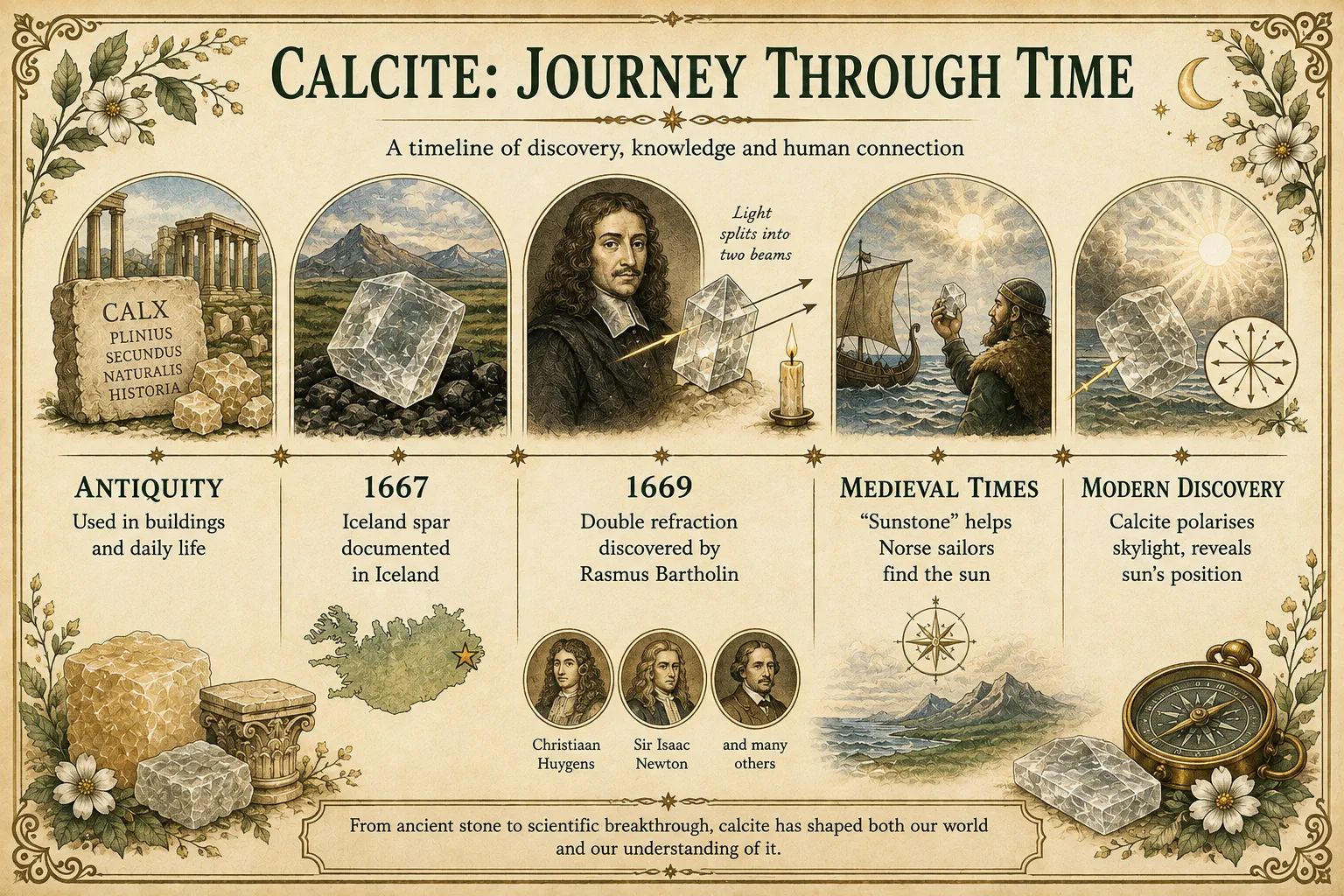
Calcite has been recognised and used since antiquity, largely because it makes up so much of the limestone and marble that ancient civilisations relied upon for building and sculpture. The word ultimately derives from the Latin calx, meaning lime, a term used by Pliny the Elder in the first century AD. The modern mineral name ‘calcite’ was introduced many centuries later.
One particular variety, however, has its own remarkable story. Iceland spar, a flawlessly clear form of calcite, was formally documented by a Danish geological survey in 1667, after being sourced from what later became the Helgustadir mine in eastern Iceland. In 1669, Danish scientist Rasmus Bartholin published the first scientific account of the crystal’s strange optical behaviour: light passing through it split into two separate beams, an effect now known as double refraction, or birefringence. This discovery helped kick-start the entire field of optical science, drawing the attention of figures including Christiaan Huygens and Sir Isaac Newton.
Iceland spar’s story reaches back even further, however, according to a compelling modern theory. Medieval Icelandic texts refer to a “sunstone” used by Norse sailors to locate the sun’s position even in overcast or foggy conditions, long before the compass reached Northern Europe. Researchers have since demonstrated that a piece of calcite really can reveal the sun’s position by polarising skylight, lending real weight to the idea that Viking navigators may have relied on this very mineral centuries before science understood why it worked.and marble, it’s genuinely difficult to travel far without encountering it in some form, whether underfoot, in a building’s façade, or lining the walls of a cave.
Chemical Composition and Hardness
Calcite is a carbonate mineral composed of calcium, carbon, and oxygen, with the chemical formula CaCO₃ (calcium carbonate). It’s the most common and most stable of three minerals that all share this exact formula, the other two being aragonite and vaterite.
Key physical properties include:
- Hardness: 3 on the Mohs scale, soft enough to be scratched with a fingernail or a knife blade
- Crystal system: Trigonal, capable of forming an enormous range of crystal shapes, from simple rhombohedrons to elaborate scalenohedrons
- Specific gravity: Approximately 2.71
- Cleavage: Perfect in three directions, meaning calcite breaks cleanly into neat rhombohedral blocks when struck
- Colour: Colourless or white when pure, though trace impurities can produce red, pink, yellow, green, blue, lavender, brown, or black tones
- A simple identifying test: Calcite reacts vigorously with weak acids such as vinegar, fizzing as it releases carbon dioxide gas — a quick and reliable way to distinguish it from harder look-alike minerals
- Fluorescence: some calcite specimens glow red, pink, blue or white under ultraviolet light.
Calcite’s most famous physical quirk, though, is the double refraction seen in its clearest form, Iceland spar, where a single beam of light entering the crystal splits cleanly into two.
How Calcite Forms
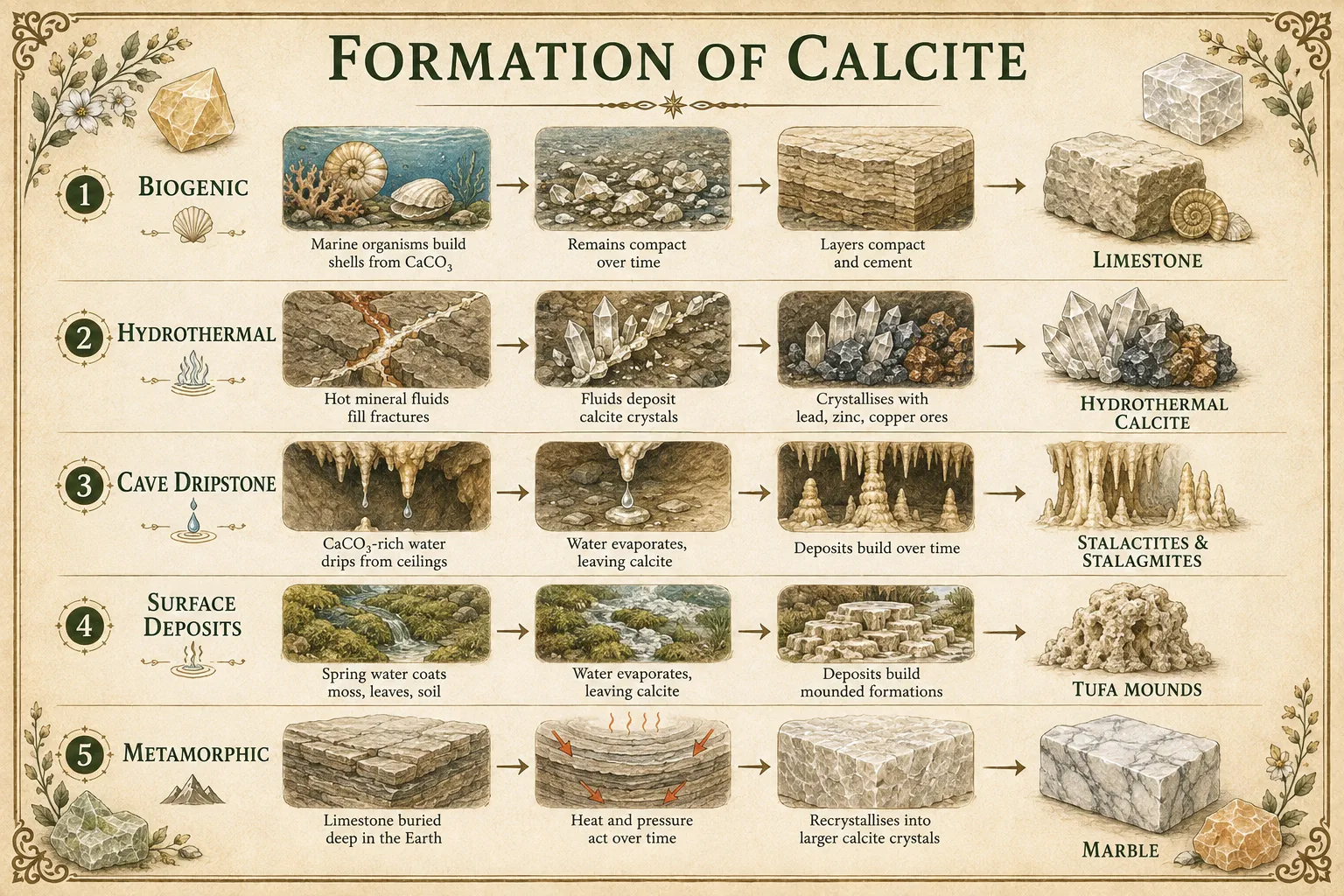
Calcite forms through several different natural processes, which helps explain why it’s so extraordinarily widespread. In the oceans, countless marine organisms — corals, molluscs, and various shelled creatures — draw dissolved calcium carbonate from seawater to build their shells and skeletons. When these organisms die, their remains settle on the seafloor and, compacted over vast stretches of geological time, form limestone, a rock made overwhelmingly of calcite.
Calcite also crystallises from hot, mineral-rich fluids circulating through cracks and fractures deep within the Earth’s crust. These hydrothermal veins often contain spectacular calcite crystals growing alongside valuable ore minerals such as lead, zinc, and copper, making calcite a familiar sight in many historic mining districts.
Calcite also forms directly from mineral-rich water closer to the Earth’s surface. In caves, water saturated with dissolved calcium carbonate drips slowly from ceilings, and as it evaporates, it leaves behind tiny deposits of calcite that gradually build into stalactites hanging from above and stalagmites rising from below. On the surface, calcium-rich spring water can coat moss, leaves, and soil as it evaporates, building up mounded deposits known as tufa. Under heat and pressure, limestone can also recrystallise entirely into marble, a metamorphic rock still fundamentally built from calcite, simply reorganised into larger, more tightly interlocked crystals.
| Formation | Jewellery Use |
|---|---|
| Hydrothermal | ⭐ Main jewellery source |
| Metamorphic (Marble) | Occasional carvings & beads |
| Cave Dripstone | Rare collectors’ material |
| Biogenic (Limestone) | Not typically used |
| Surface Deposits (Tufa) | Not used |
Varieties of Calcite
Calcite is remarkable for the enormous variety of colours and crystal shapes it can display. Pure calcite is colourless or white, but tiny amounts of other elements can produce a wide range of colours. Some names refer to colour varieties, while others describe the crystal’s shape rather than a different type of calcite.
Colour Varieties
- Honey Calcite — warm golden-yellow crystals, among the most popular varieties for carvings and decorative objects.
- Orange Calcite — bright orange to amber in colour, widely used in jewellery and ornamental carvings.
- Yellow Calcite — a cheerful lemon to golden-yellow variety, sometimes difficult to distinguish from honey calcite.
- Blue Calcite — typically pale blue with a soft, cloudy appearance.
- Green Calcite — ranging from pale mint green to deeper apple-green shades, although some brightly coloured material on the market has been dyed.
- Pink (Mangano) Calcite — coloured by trace amounts of manganese, producing delicate pale pink to rose tones, often with a gentle glow under ultraviolet light.
- White Calcite — one of the most common forms, found in limestone, marble, and many mineral veins.
- Black Calcite — a much less common variety, coloured by inclusions of carbonaceous material or other dark minerals.
Distinctive Crystal Forms
- Iceland Spar (Optical Calcite) — an exceptionally clear variety famous for its remarkable double refraction, which causes objects viewed through the crystal to appear doubled. It played an important role in the development of optical science.
- Dogtooth Calcite — recognised by its long, pointed crystals that resemble canine teeth. This is a crystal habit rather than a separate mineral variety.
- Nailhead Calcite — forms short, flat-topped crystals resembling the head of an old-fashioned nail, another example of a distinctive crystal habit rather than a colour variety.
Because calcite is relatively soft and porous, it readily absorbs dyes. As a result, vividly coloured calcite is common in the jewellery trade, where it may be dyed to imitate more expensive gemstones or simply to create brighter decorative colours. When buying calcite jewellery, it’s worth asking whether the stone is natural or colour-enhanced, as dyed pieces may gradually fade with prolonged exposure to sunlight or wear, and in some cases the colour may slowly wear away, revealing the paler natural stone beneath.
| Variety | Description |
|---|---|
| Classic Unakite | Balanced mix of green epidote and pink feldspar |
| Green-rich Unakite | Contains a higher proportion of epidote, producing deeper green tones |
| Pink-rich Unakite | Dominated by salmon-pink feldspar with smaller green areas |
| Quartz-rich Unakite | Displays more visible quartz throughout the stone |
| Coarse-grained Unakite | Larger visible mineral crystals |
| Fine-grained Unakite | More even, finely textured appearance |
| Trade names | No widely recognised geological varieties; commercial names usually describe colour or pattern only |

How to distinguish calcite from quartz
| Calcite | Quartz |
|---|---|
| Hardness 3 | Hardness 7 |
| Easily scratched by a copper coin or knife | Much harder to scratch |
| Reacts with dilute acid | Does not react |
| Perfect rhombohedral cleavage | Conchoidal fracture |
| Often feels softer or waxier | Glassy lustre |
Did You Know?
A clear crystal of Iceland spar placed over printed text makes every letter appear doubled.
Despite being soft enough to scratch with a fingernail, calcite is one of the most abundant minerals on Earth, forming the backbone of limestone, chalk, and marble across the planet.
Calcite’s most famous variety, Iceland spar, is believed to be the very “sunstone” used by Viking sailors to navigate by polarised sunlight, long before the magnetic compass reached Northern Europe.
Calcite’s discovery of double refraction in the 17th century helped launch the entire modern field of optics, and the mineral is still used today in specialist polarising equipment.
Traditional Beliefs and Folklore
Calcite’s long relationship with human building and craft has given it a somewhat different symbolic legacy compared with more overtly “magical” stones. Because it forms the basis of so much limestone and marble architecture, calcite has often been linked, at least indirectly, to ideas of permanence, stability, and structure — the very qualities that allowed ancient builders to raise lasting monuments from stone made largely of this mineral. The Viking sunstone legend has added its own layer of folklore, casting calcite as a quiet guide through uncertainty, capable of revealing direction even when the way ahead seems obscured by cloud and mist.
In more recent folk traditions, calcite’s soft, gentle colour palette has earned it a reputation as an easy, approachable stone, often recommended to those newer to crystal work thanks to its calm, unintimidating energy.
(Note: these are traditional folk beliefs and metaphysical claims, not scientifically established properties.)
Healing and Meditation Practices
In modern crystal traditions, calcite is often considered a gentle, energising stone, valued for cleansing and revitalising rather than for dramatic transformation.
Common practices associated with calcite include:
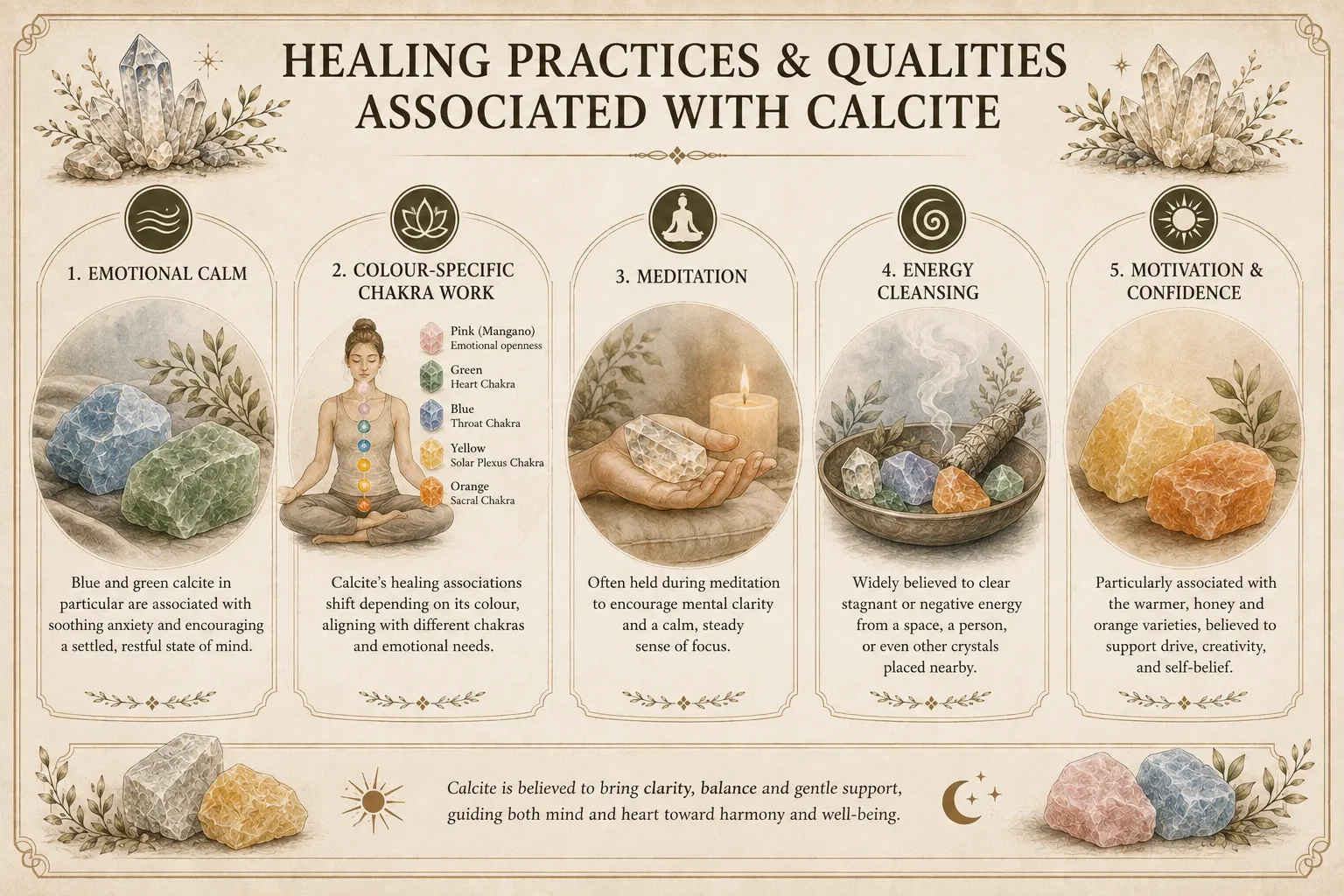
Emotional calm — blue and green calcite in particular are associated with soothing anxiety and encouraging a settled, restful state of mind
Colour-specific chakra work — calcite’s healing associations shift depending on its colour; yellow and orange varieties are typically linked to the solar plexus and sacral chakras, blue calcite to the throat chakra, green to the heart, and pink (mangano) calcite to matters of emotional openness
Meditation — often held during meditation to encourage mental clarity and a calm, steady sense of focus
Energy cleansing — widely believed to clear stagnant or negative energy from a space, a person, or even other crystals placed nearby
Motivation and confidence — particularly associated with the warmer, honey and orange varieties, believed to support drive, creativity, and self-belief
Qualities Traditionally Associated With Calcite
According to crystal healing traditions, calcite is thought to support:
Memory and learning — particularly linked to golden and honey calcite in some traditions
Mental clarity — helping to sharpen focus and cut through confusion
Emotional balance — particularly associated with the cooler-toned blue and green varieties
Confidence and motivation — closely tied to the warmer honey and orange varieties
Energy cleansing — believed to clear stagnant or negative energy from people, spaces, and other crystals
Calm and relaxation — associated with easing anxiety and encouraging restful sleep
Creativity — said to stimulate imagination and a more open, flexible mindset
Astrological Associations
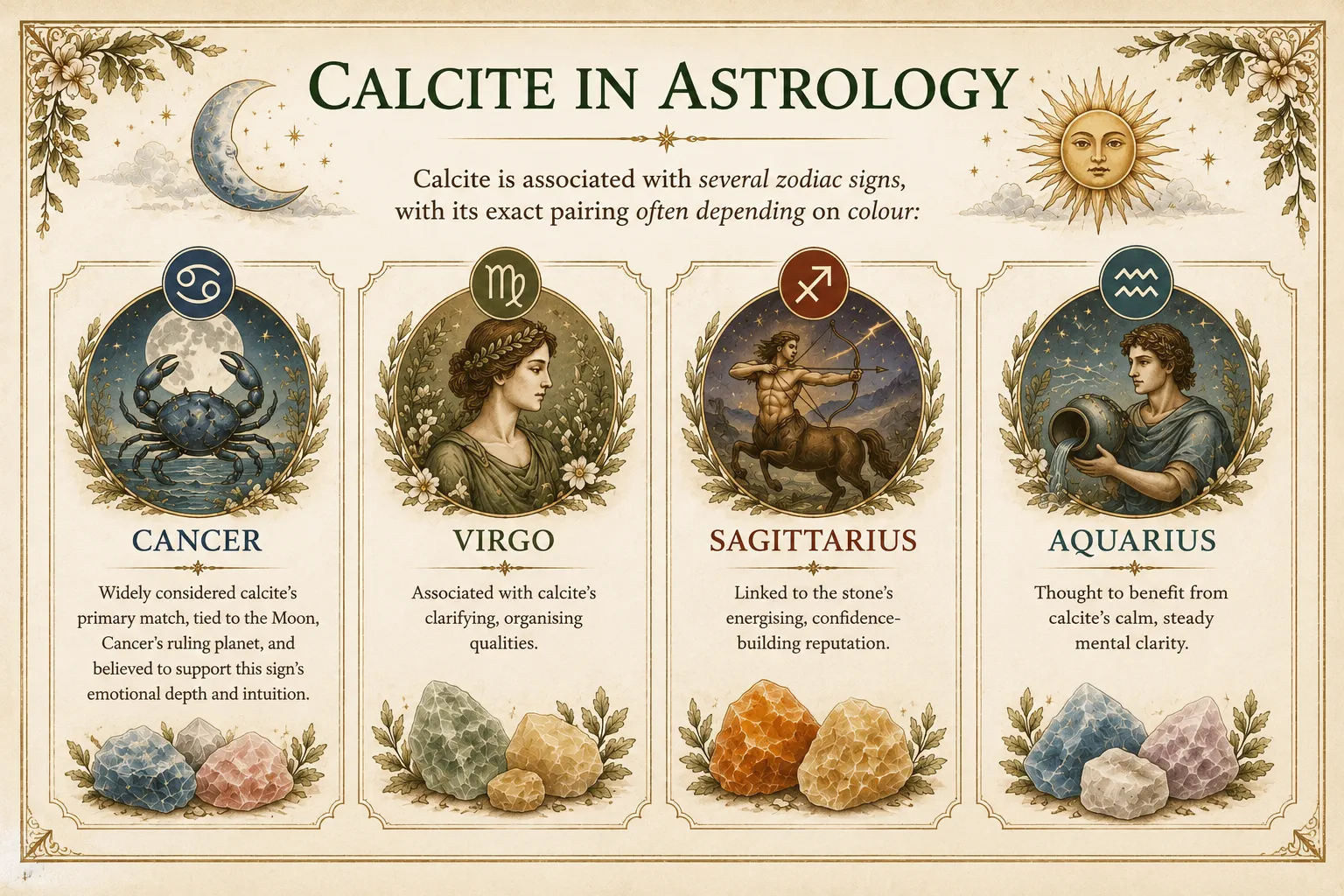
Calcite is associated with several zodiac signs, with its exact pairing often depending on colour:
- Cancer — widely considered calcite’s primary match, tied to the Moon, Cancer’s ruling planet, and believed to support this sign’s emotional depth and intuition
- Virgo — associated with calcite’s clarifying, organising qualities
- Sagittarius — linked to the stone’s energising, confidence-building reputation
- Aquarius — thought to benefit from calcite’s calm, steady mental clarity
Because calcite occurs in so many colours, individual varieties sometimes pick up their own more specific associations, though Cancer remains the sign most consistently linked to the stone as a whole.
Caring for Calcite Jewellery
Calcite is a beautiful but relatively soft mineral, making it better suited to occasional wear than everyday jewellery. With a Mohs hardness of just 3, it can be scratched by harder gemstones and even some everyday objects, so it’s best to store calcite pieces separately in a soft pouch or lined jewellery box.
To keep calcite looking its best, avoid prolonged contact with water, perfumes, cosmetics, and household cleaning products. Because calcite reacts with acids, even mild acidic substances such as lemon juice or vinegar can damage its polished surface. Clean your jewellery gently with a soft, dry, or slightly damp cloth, and avoid ultrasonic cleaners, steam cleaning, or harsh chemicals.
If your calcite jewellery has been dyed or colour-enhanced, keeping it away from prolonged direct sunlight and excessive moisture can help preserve its colour. With a little care, calcite jewellery can retain its gentle beauty and natural charm for many years.
Buying Tip: Because calcite is relatively soft and porous, some jewellery beads are colour-enhanced and may also be stabilised with wax or resin to improve their durability and polish. These treatments are common in the gemstone trade and do not mean the stone itself is not genuine calcite.

A Moment of Wonder
Calcite may never dazzle in quite the way a sapphire or an emerald does, yet it quietly shapes more of the world around us than almost any other mineral. It forms the cliffs we walk beneath, the caves we wander through, the marble beneath our feet, and, in its clearest form, once helped sailors find their way home across an empty grey sea. It’s a gentle reminder that some of the most remarkable materials in nature aren’t the rarest or the hardest, but the ones patient enough to shape an entire landscape, one quiet layer at a time.