Goldstone: The Glittering Glass with a Remarkable History
| Property | Details |
|---|---|
| Material Type | Man-made aventurescent glass |
| Composition | Primarily soda-lime glass with metallic crystals (traditionally copper, with other metals used in some varieties) |
| Typical Colours | Reddish-brown, blue, green, and less commonly purple |
| Hardness (Mohs) | Approximately 5.5–6 |
| Lustre | Vitreous (glassy) with metallic sparkle |
| Transparency | Opaque to slightly translucent at thin edges |
| Special Feature | Thousands of microscopic metallic crystals create a shimmering effect known as aventurescence |
| Manufacturing Origins | Traditionally associated with Murano (Italy); now produced mainly in China and other glassmaking centres |
| Associated Zodiac Signs | Traditionally associated with Sagittarius; colour-specific traditions may link other varieties with additional signs |
| Traditionally Associated With | Ambition, confidence, motivation, optimism, vitality, protection, and perseverance (traditional beliefs, not scientifically established) |
Goldstone doesn’t come from the earth the way most stones in this series do — it comes from a furnace. Despite its warm, glittering surface and the way it’s sold right alongside natural crystals in shops and markets, goldstone is a man-made glass, born in a Venetian workshop centuries ago rather than formed slowly underground. That doesn’t make it any less fascinating, though. If anything, its story — equal parts craftsmanship, chemistry, and legend — is one of the more entertaining ones in the crystal world.
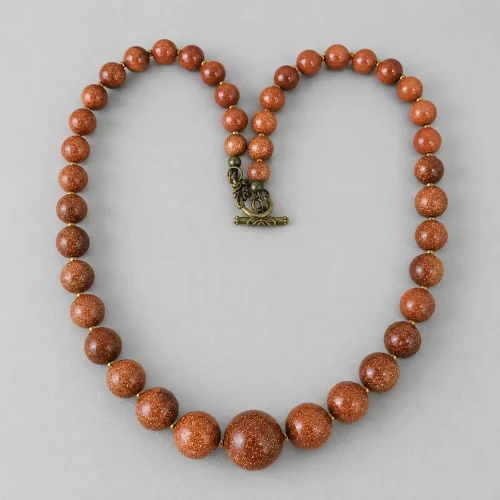
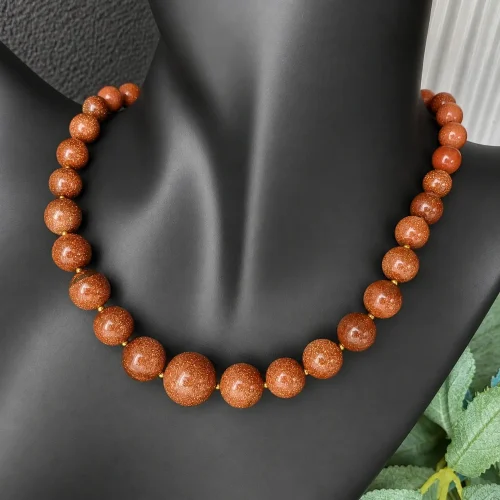
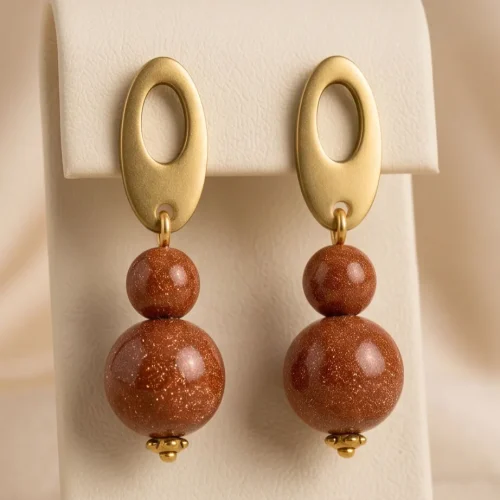
Unlike glitter, which sits on the surface, goldstone’s sparkle comes from countless microscopic crystals suspended throughout the glass itself. As light enters the material, those crystals catch and reflect it from different depths, giving goldstone its distinctive, starry appearance.
Where Goldstone Is Made
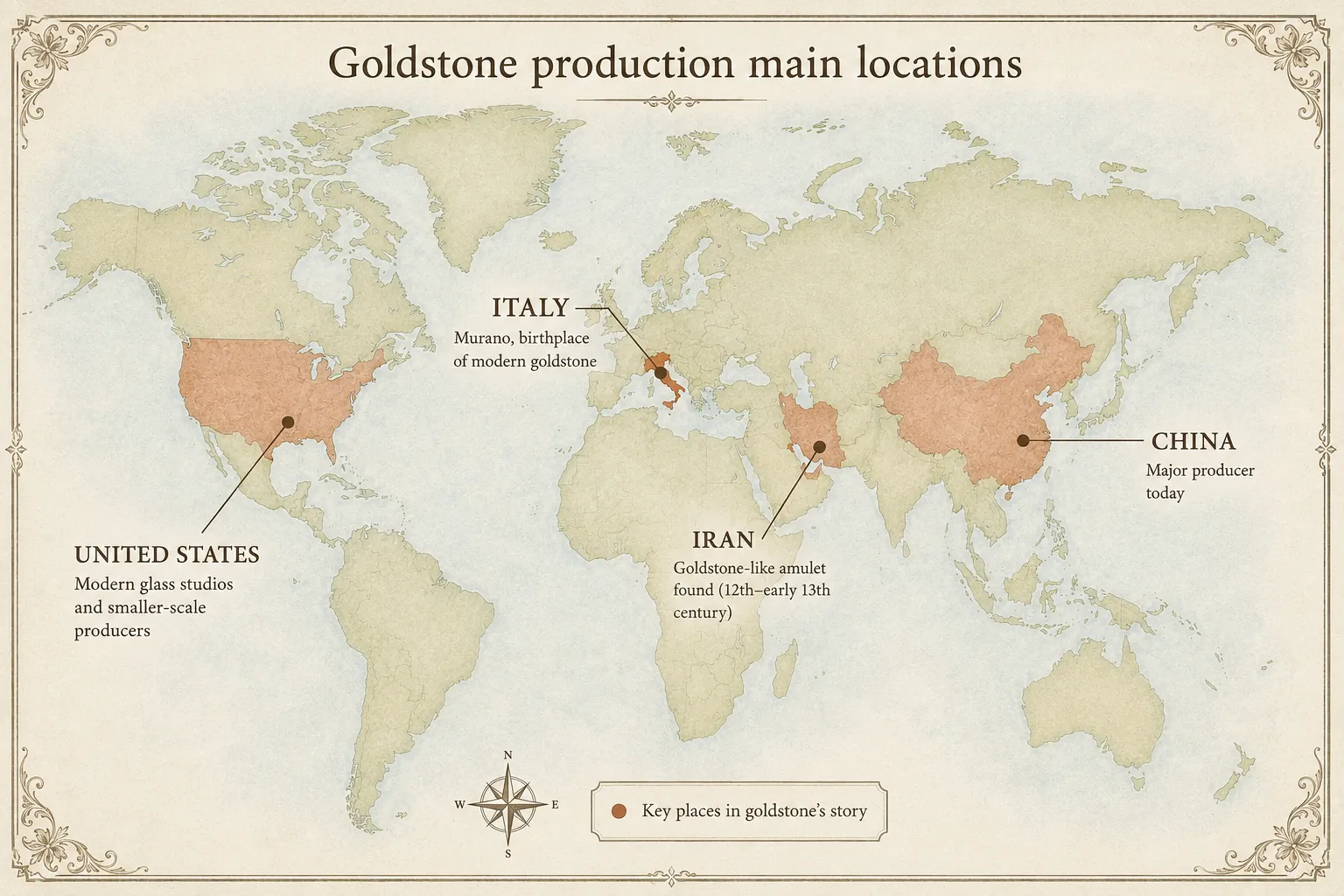
Because goldstone is manufactured rather than mined, it doesn’t have a “locale” in the geological sense — no mountain range or mine can claim it. Its story is tied instead to specific workshops and glassmaking traditions:
- Murano, Italy — the birthplace of modern goldstone, and still closely associated with the material today
- China — home to a long, independent glassmaking tradition producing aventurescent glass, and today the source of much of the goldstone sold commercially worldwide
- United States and other modern glass studios — smaller-scale producers continuing the craft today
Interestingly, archaeologists have also found a goldstone-like amulet in present-day Iran, dated to somewhere between the 12th and early 13th century — suggesting some version of this glittering glass may have been independently discovered long before its famous Venetian debut.
History of Goldstone
Goldstone’s most famous origin story is a delightful piece of folklore: as the tale goes, a glassmaker on the island of Murano accidentally spilled copper shavings into a pot of molten glass, and instead of ruining the batch, the mixture cooled into something glittering and beautiful. It’s a charming story — and, according to most glass historians, probably not quite true. The technical precision needed to produce goldstone’s even, well-distributed copper crystals makes a true accident unlikely; more probably, it was the result of careful, if secretive, experimentation by the skilled glassmakers of Murano, most closely tied to the Miotti family in the 17th century.
Whatever really happened, the result was a glass unlike anything else being made at the time, and the Miotti family guarded their formula closely, treating it as a valuable trade secret. Early goldstone was extremely difficult to work — the copper-rich batch resisted blowing into shapes, so glassmakers instead ground it down and used the resulting grains and canes to decorate blown glass and beads. Its original name, “aventurine glass,” came from the Italian phrase a ventura, meaning “by chance,” and it’s actually this glass — not the natural mineral — that gave the mineral aventurine its name, once naturalists noticed a similar sparkle in a certain quartz variety and simply borrowed the term. By the 19th century, goldstone had become popular well beyond Venice, exported across Europe, Africa, and the Americas, and it remains in production today, with China now a major modern source.

How Goldstone Is Made
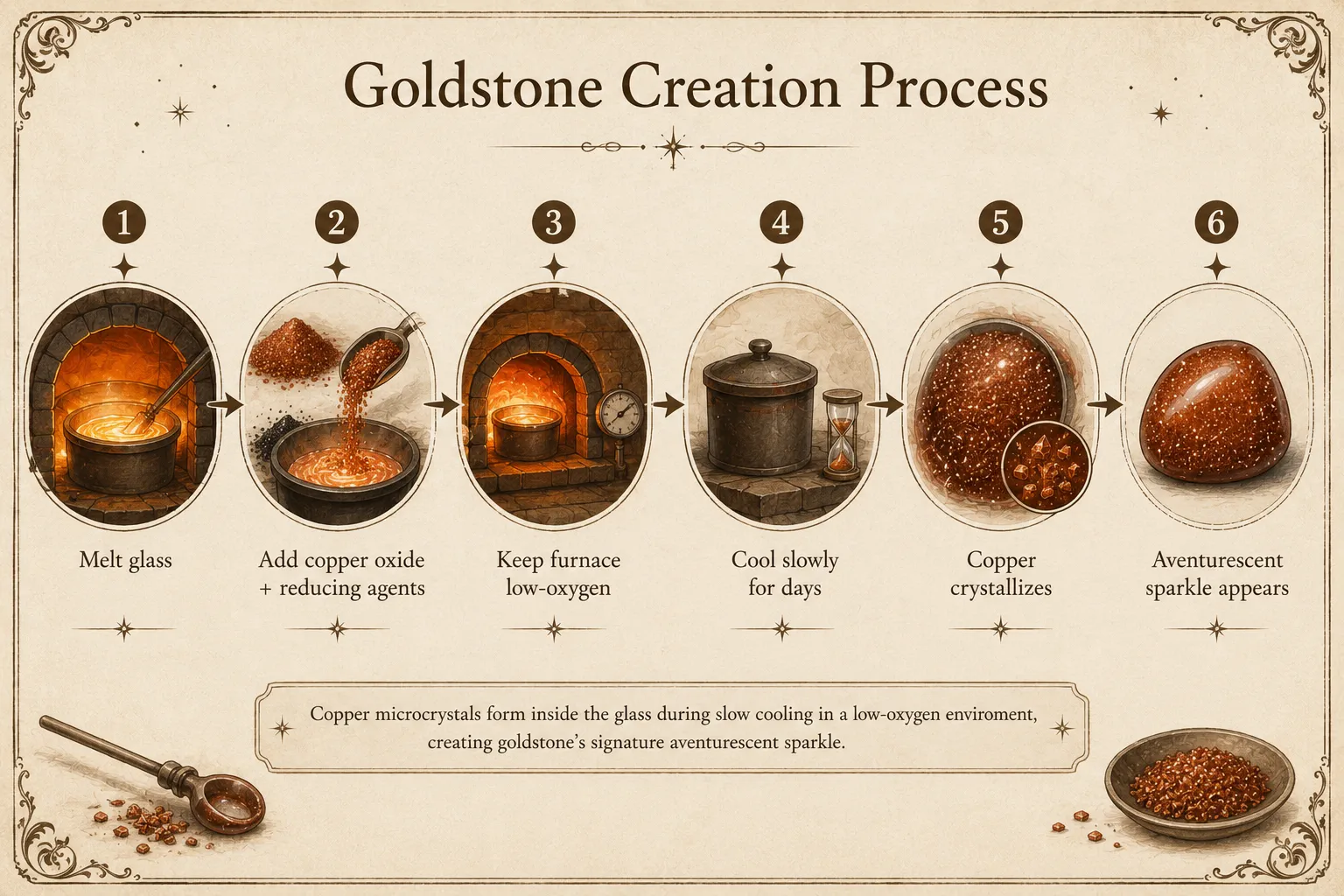
Making goldstone is a careful balancing act between chemistry and timing. The process begins with a base of soda-lime glass, melted down and combined with copper oxide, along with reducing agents that help draw oxygen out of the mixture. This entire process takes place in a low-oxygen furnace atmosphere — a critical detail, since too much oxygen would cause the copper to form a dull, uninteresting compound rather than the shimmering crystals goldstone is known for.
As the glass slowly cools over the course of several days, the copper within it crystallizes into tiny, flat, mirror-like particles, usually shaped like tiny octahedrons and often only a fraction of a millimeter across. These crystals catch and reflect light in exactly the same optical effect seen in natural aventurine, a phenomenon now formally known as aventurescence. Getting the timing, temperature, and furnace atmosphere just right is notoriously difficult, which is part of why goldstone’s formula was treated as such closely guarded trade secret for so long — even skilled glassmakers elsewhere struggled for decades to replicate it successfully.
Varieties of Goldstone
While reddish-brown remains the classic, most recognizable shade, goldstone actually comes in a handful of colours, each produced by swapping out the metal responsible for its sparkle:
- Red/brown goldstone — the original and most common variety, coloured by copper crystals
- Blue Goldstone — deep midnight blue glass coloured with cobalt and other metal compounds while retaining its characteristic sparkle
- Green Goldstone — emerald-green aventurescent glass produced using modified glass formulations and colouring agents
- Purple goldstone — a less common variety, blending elements to produce a violet base tone
Because colour depends entirely on which metal is used, goldstone offers a tidy little demonstration of chemistry in action — the same manufacturing process, with a different metallic ingredient, produces an entirely different-looking material.
| Variety | Appearance | Description |
|---|---|---|
| Brown (Red) Goldstone | Warm reddish-brown with dense golden sparkle | The original and most common variety. Its glitter comes from countless microscopic copper crystals suspended throughout the glass, giving it a rich, star-like appearance. |
| Blue Goldstone | Deep midnight blue with silvery or coppery sparkle | A popular modern variety with a dark blue glass base and shimmering metallic crystals. Its night-sky appearance makes it especially popular in jewellery. |
| Green Goldstone | Emerald to dark green with metallic sparkle | Produced using modified glass formulations and colouring agents to create a vibrant green aventurescent glass. Less common than the brown and blue varieties. |
| Purple Goldstone | Rich violet-purple with fine metallic sparkle | An uncommon decorative variety created using specialised colouring agents. It combines the familiar glittering effect with a distinctive purple base colour. |
Note: Unlike natural gemstones, these are not mineral varieties. The different colours are created during the glassmaking process by using different colouring agents and manufacturing techniques while preserving goldstone’s characteristic aventurescent sparkle.

Did You Know?
The popular story of goldstone being discovered by accident, when copper shavings supposedly fell into molten glass, is widely considered more legend than fact — most glass historians believe it was the product of careful, deliberate experimentation, kept secret for competitive advantage.
Goldstone contains no actual gold at all — its glittering flecks are entirely made of crystallized copper (or cobalt, chromium, and other metals in its other colours).
The natural gemstone aventurine was actually named after goldstone, not the other way around — a rare case of a man-made material lending its name to something found in nature.
Traditional Beliefs and Folklore
Because goldstone is a relatively young material compared to stones with genuinely ancient histories, it doesn’t come with centuries of deep-rooted mythology attached. What it does carry is a wonderfully persistent legend of its own creation — a story of chance, secrecy, and craftsmanship that has followed it since its earliest days in Venice. That “born by chance” origin story has quietly shaped how people think about the stone ever since, feeding into its later reputation as a symbol of luck, ambition, and turning an unexpected situation into something valuable.
As goldstone spread through Europe and beyond in the 19th century, it began to pick up its own folk associations, largely centered on themes of drive, opportunity, and quiet transformation — fitting, given a material that was itself transformed from a molten mistake into something considered worth treasuring.
Astrological Associations
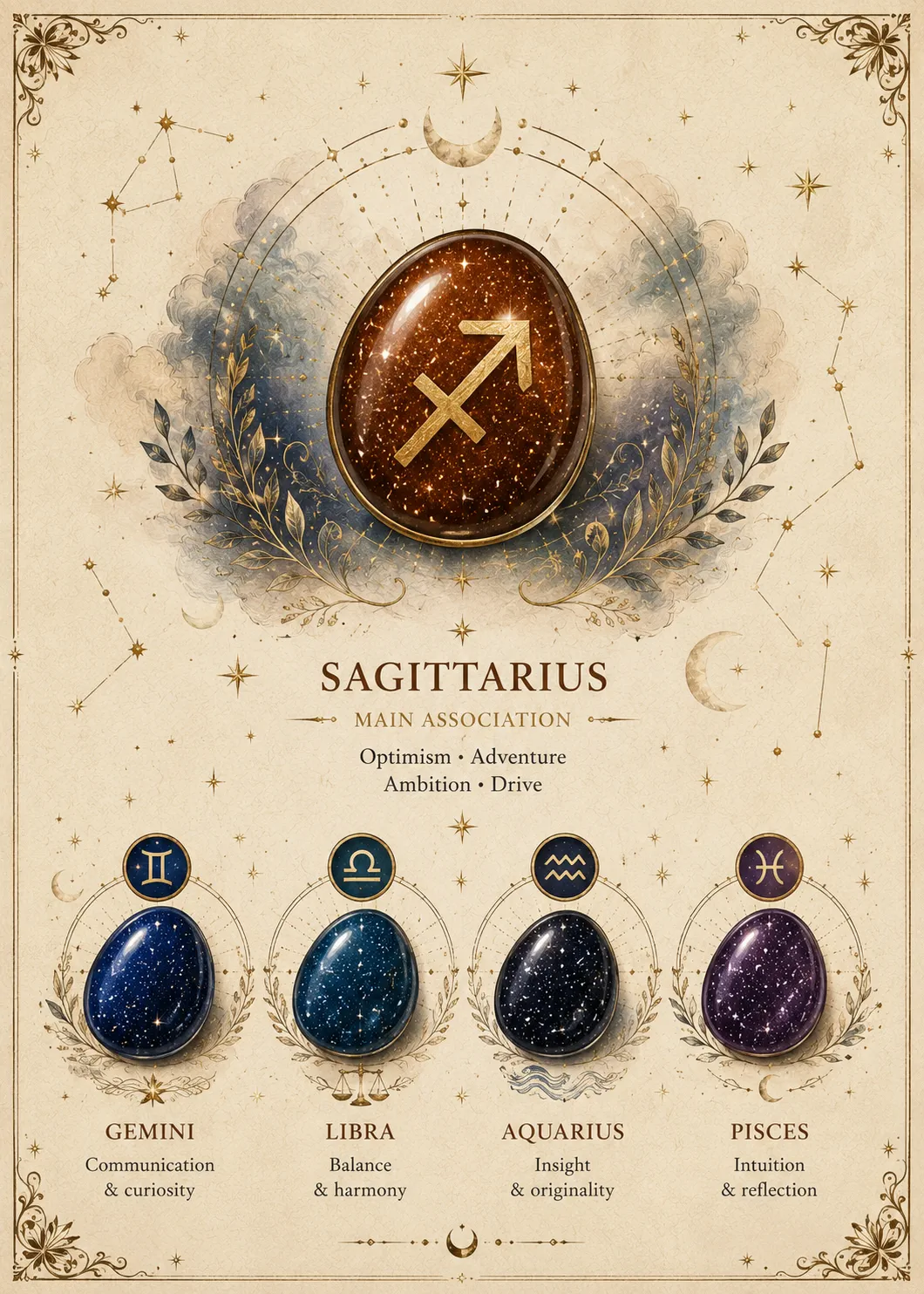
Goldstone is most commonly associated with one zodiac sign in particular:
- Sagittarius — widely considered goldstone’s strongest match, believed to complement this sign’s natural ambition, optimism, and drive toward new goals and adventures
Beyond Sagittarius, goldstone’s different colours are sometimes paired with other signs based on their individual associations — blue goldstone, for instance, is occasionally linked to more communicative, thoughtful signs, given its association with calm reflection rather than pure drive.
Magical Properties of Goldstone
In modern crystal traditions, goldstone has earned the nickname “the Stone of Ambition,” valued for its association with motivation, confidence, and turning determination into results.
Common beliefs and practices associated with goldstone include:
Vitality — some traditions credit goldstone’s copper content with supporting energy and circulation, borrowing loosely from copper’s long-standing folk reputation as a healthful metalutiful natural gemstone whose soft colour serves as a reminder of kindness, compassion and emotional well-being.
Sacral and Solar Plexus Chakra work — goldstone is most often linked to these two chakras, associated with creativity, personal power, and confident self-expression
Motivation and drive — its most widely cited quality, believed to help sharpen focus and push toward long-term goals rather than short bursts of energy
Protection — many practitioners describe goldstone as a shielding stone, believed to help deflect negative energy and strengthen one’s overall aura
Emotional stability — thought to help calm anxious or scattered energy while encouraging a more positive, optimistic outlook
Color-specific uses — blue goldstone is often associated with calm communication and self-acceptance, while green goldstone is sometimes linked to renewal and fresh starts
(Note: these are traditional folk beliefs and metaphysical claims, not scientifically established properties.)

Caring for Goldstone Jewellery
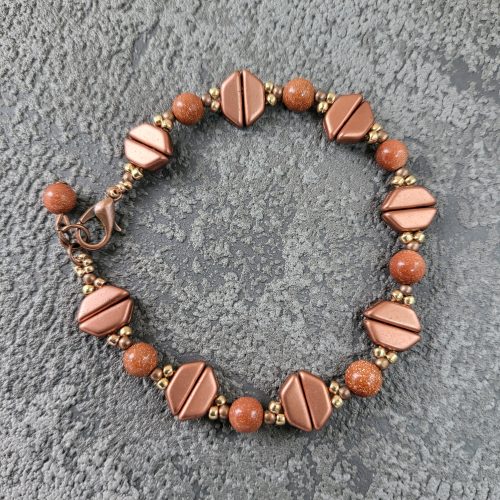
Although goldstone is durable enough for everyday wear, it is still a type of glass and can be scratched or chipped if knocked against hard surfaces. Store your jewellery separately in a soft pouch or jewellery box to help prevent scratches, and avoid dropping it onto hard floors. Clean goldstone with a soft cloth and, if needed, a little warm water with mild soap. Avoid harsh chemicals, abrasive cleaners, and prolonged exposure to extreme heat, which may damage the polished surface or the jewellery findings. With a little care, goldstone’s beautiful star-like sparkle can be enjoyed for many years.
A Moment of Wonder
Goldstone reminds us that wonder isn’t found only in nature. Sometimes it is created through patience, curiosity, and remarkable human skill. What begins as simple glass and carefully controlled chemistry becomes a material that seems to hold a night sky within it, sparkling with countless tiny points of light.
Although it wasn’t shaped by geological forces over millions of years, goldstone has earned its own place in the story of decorative stones. Its history blends craftsmanship, science, and enduring legend, proving that beauty can arise not only from the natural world, but also from the creativity of the people inspired by it.
Whether you admire it as a masterpiece of glassmaking, a fascinating piece of history, or simply for its warm, star-like shimmer, goldstone is a reminder that the most captivating stories are sometimes born in the hands of skilled artisans rather than deep beneath the earth.