
Labradorite: The Stone That Holds the Northern Lights
| Property | Details |
|---|---|
| Mineral Family | Feldspar (Plagioclase Feldspar) |
| Chemical Formula | (Ca,Na)(Al,Si)₄O₈ |
| Typical Colours | Smoky grey, grey-green, dark grey with flashes of blue, green, gold, orange or violet |
| Hardness (Mohs) | 6–6.5 |
| Lustre | Vitreous (glassy) |
| Transparency | Transparent to translucent, most commonly translucent |
| Special Feature | Displays labradorescence – a striking optical effect that produces flashes of iridescent colour as the stone is viewed from different angles |
| Main Sources | Canada (Labrador), Madagascar, Finland, Russia, Norway, Mexico, Australia, United States |
| Associated Zodiac Signs | Scorpio, Leo and Sagittarius (traditionally); also linked by some traditions to Libra, Cancer and Pisces |
| Traditionally Associated With | Transformation, intuition, protection, self-awareness, creativity, confidence and inner balance |
Some stones are pretty. Labradorite is something else entirely. Turn a piece in your hand and it can look almost lifeless — a dull, greyish rock with nothing much going on. Then, at just the right angle, it suddenly ignites: flashes of electric blue, gold, green, and violet ripple across the surface like light dancing on the edge of a wave. This dramatic shift has earned labradorite comparisons to the aurora borealis for centuries, and once you’ve seen it flash in person, it’s easy to understand why.
Where Labradorite Is Found
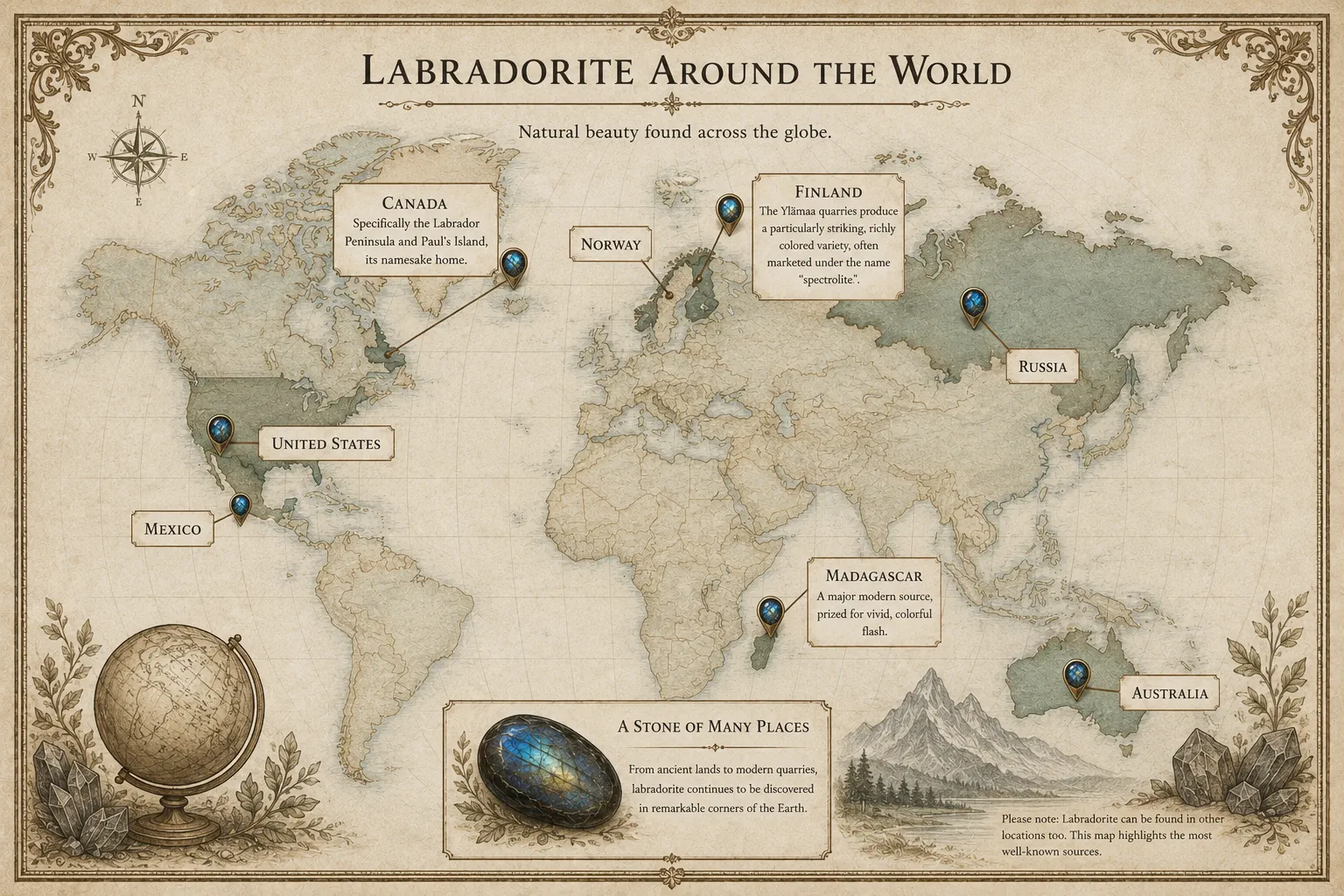
Labradorite takes its name from the place where it first captured the world’s attention, but it’s since turned up in scattered pockets across the globe:
- Canada — specifically the Labrador Peninsula and Paul’s Island, its namesake home
- Madagascar — a major modern source, prized for vivid, colourful flash
- Finland — the Ylämaa quarries produce a particularly striking, richly coloured variety, often marketed under the name “spectrolite”
- Russia
- Norway
- Mexico
- Australia
- United States
Interestingly, even though it’s named after a small stretch of Canadian coastline, labradorite is anything but rare or geographically limited — it turns out that wherever the right kind of slow-cooling volcanic rock exists, this stone tends to follow.as large individual crystals, aventurine usually occurs as solid masses, making it ideal for beads, cabochons, carvings and decorative objects.
When Was Labradorite First Discovered?
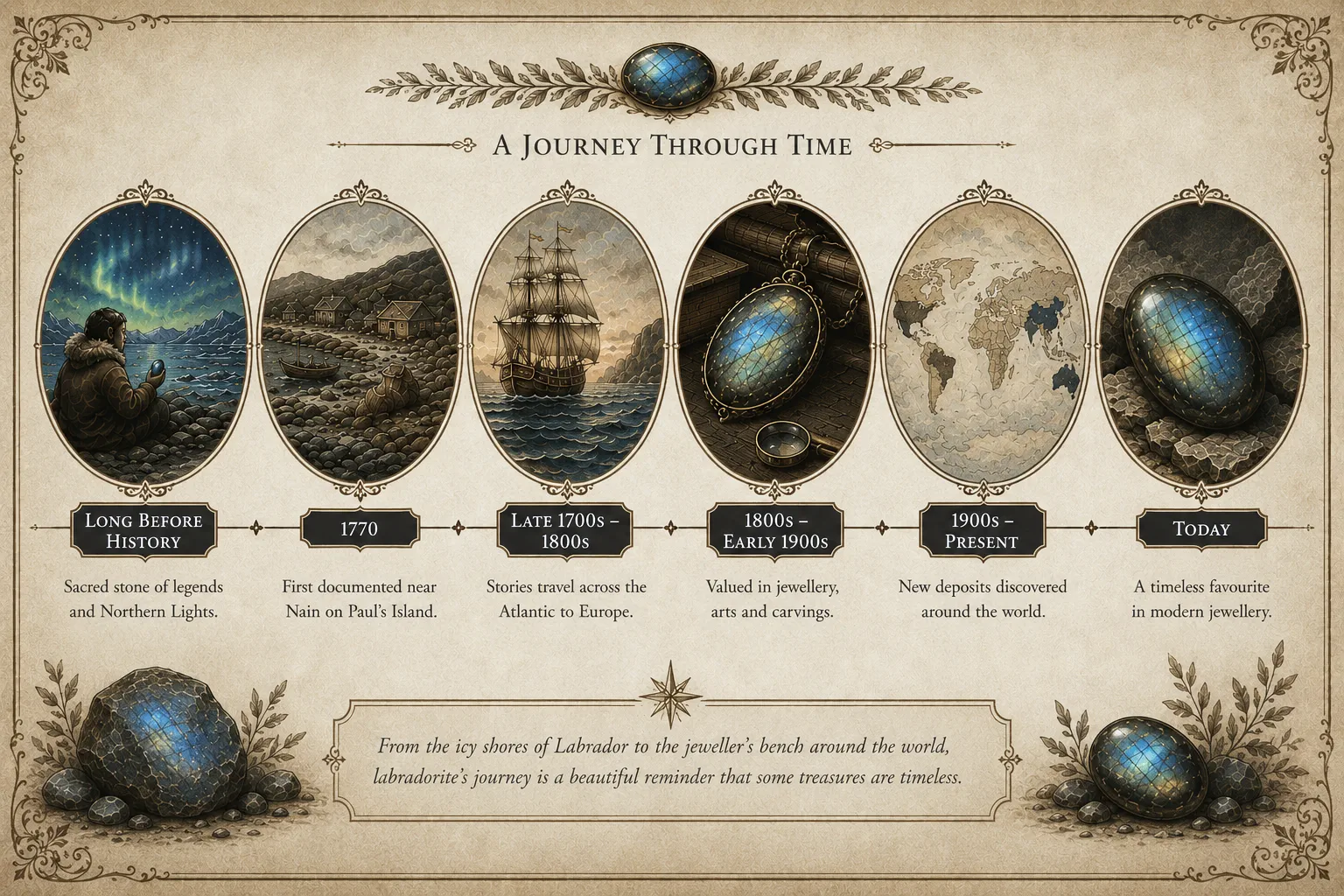
Long before it had a name, labradorite was already deeply woven into the culture of the Inuit peoples along the Labrador coast. According to legend, the Northern Lights were once trapped inside the coastal rocks. An Inuit warrior stumbled upon them and, hoping to set the lights free, struck the stone with his spear. Most of the light escaped and now dances across the winter sky as the aurora — but some remained sealed inside the rock forever, which is why, according to the story, labradorite still flickers with colour to this day.
The stone’s more formal introduction to the wider world came much later, in 1770, when it was documented near the settlement of Nain on Paul’s Island in Labrador. Word of its strange, shifting colours spread quickly, and specimens soon made their way across the Atlantic, where labradorite became a fashionable curiosity among jewelers and collectors in France and England throughout the following decades.
How Labradorite Forms
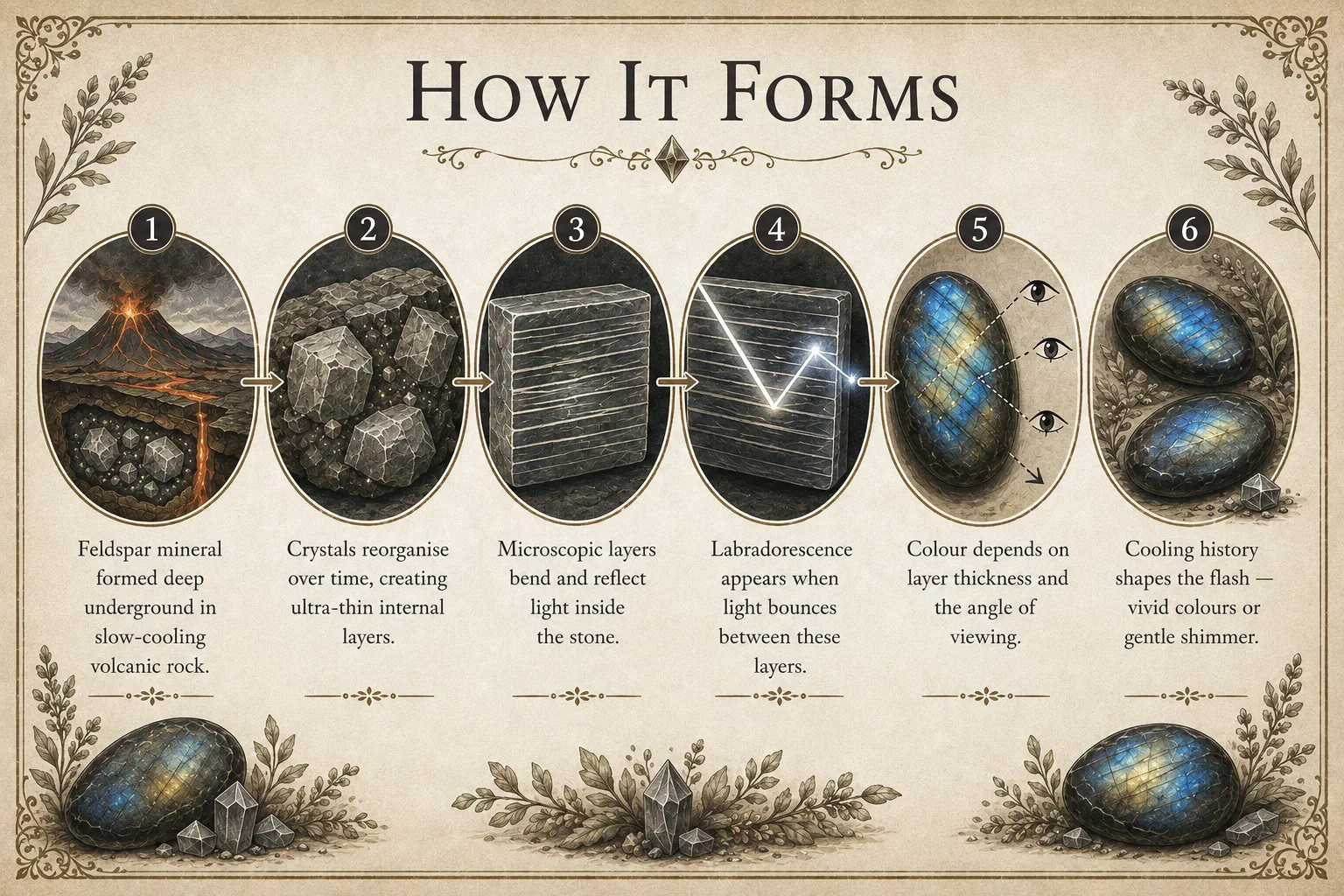
Labradorite belongs to the feldspar family, one of the most abundant groups of minerals on Earth. Its story begins deep underground, inside slow-cooling volcanic rock such as basalt, gabbro, and anorthosite.
As molten rock gradually cools over thousands or even millions of years, the growing crystals quietly rearrange themselves. During this long, patient process, incredibly thin stacked layers are created inside the stone. They’re far too small to see, but they become the secret behind labradorite’s famous flashes of colour.
When light enters the stone and reaches these microscopic layers, it bounces between them before reflecting back to your eye. Different colours are reflected depending on the thickness and arrangement of the layers and the angle from which the stone is viewed. This beautiful optical effect is called labradorescence, and it’s the reason no two pieces of labradorite ever seem to glow in quite the same way.
Every labradorite crystal develops a little differently. The stone’s long cooling history, together with its natural structure, influences how vivid the colours become. Some pieces blaze with brilliant blues, greens, and golds, while others reveal only a gentle shimmer — a quiet reminder that some of nature’s greatest creations take both time and patience.
Why Does Labradorite Flash?
One of the most fascinating things about labradorite is that the colours aren’t actually painted onto the stone or trapped inside it.
Instead, they’re created by the way light interacts with the stone’s microscopic internal layers. As light passes into the crystal, it reflects between these layers before returning to your eye. Depending on the viewing angle, different colours become visible while others disappear.
That’s why a piece of labradorite can appear plain grey one moment and suddenly burst into brilliant blue, green, gold, or violet the next. Turn the stone slightly, and the colours seem to dance across its surface — not because the stone has changed, but because the light has.
Varieties of Labradorite
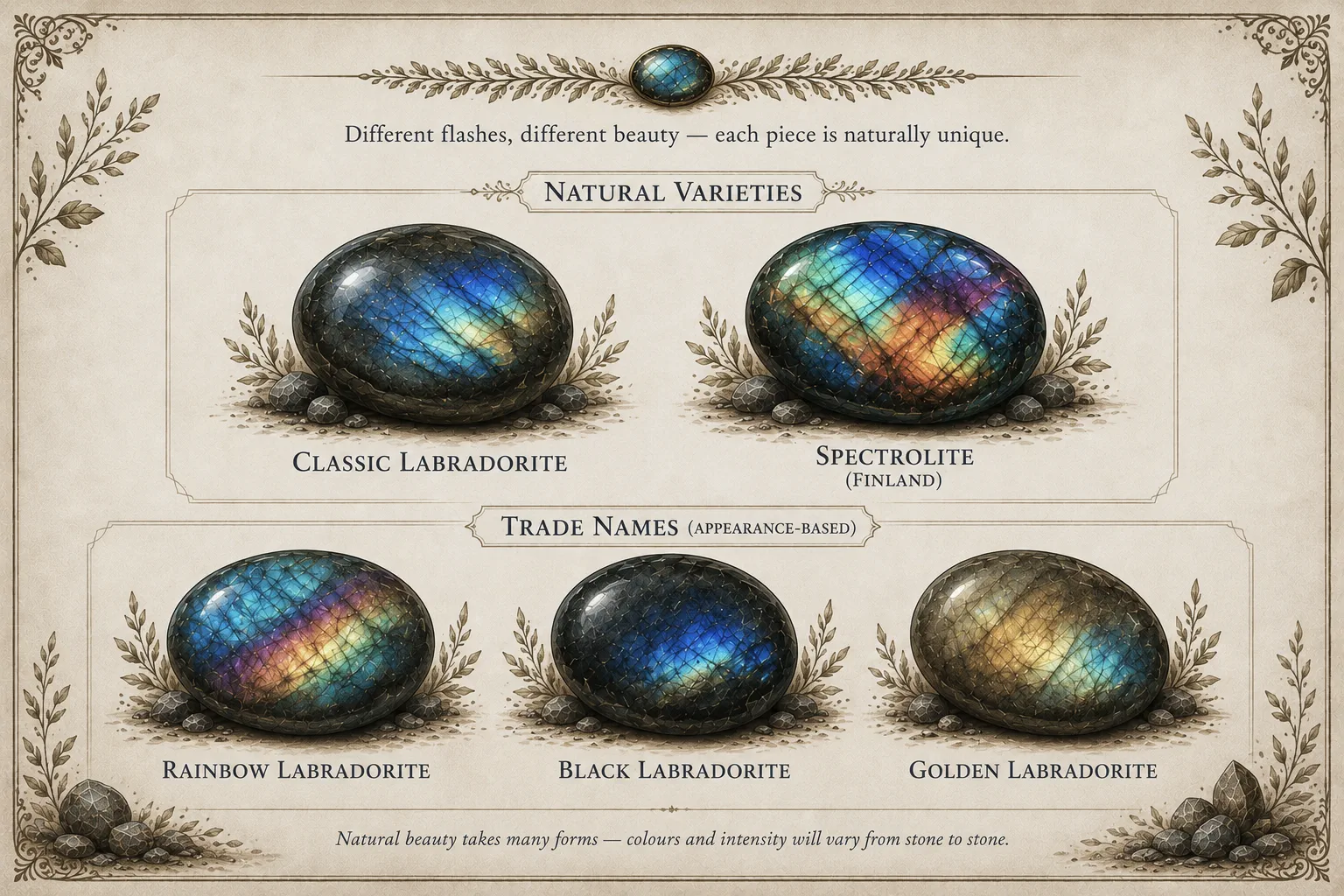
Although people often refer to many different “types” of labradorite, only a few are recognised as distinct natural varieties. Many other names are simply trade terms used to describe a particular appearance.
| Classification | Variety | Description |
|---|---|---|
| Natural variety | Classic Labradorite | The most common variety, with a smoky grey or grey-green base and flashes of blue, green, or gold. |
| Natural variety | Spectrolite | A rare Finnish variety displaying an exceptionally broad range of vivid colours, including blue, green, orange, red, and violet. |
| Trade name | Golden Labradorite | A commercial name for yellow-flashing material with no precise geological definition. |
| Trade name | Rainbow Labradorite | A trade name for especially colourful material; sometimes incorrectly used for Rainbow Moonstone. |
| Trade name | Black Labradorite | A name for darker material whose deep background makes its flashes appear especially dramatic. |
Did You Know?
A single piece of labradorite can appear almost plain from one angle and burst into brilliant colour from another. The best way to appreciate it is simply to turn it slowly in your hand and watch the light reveal what was hidden a moment before.
Labradorite’s famous shimmer, known as labradorescence, is created by microscopic layers inside the stone that are so thin they’re measured in nanometres.
Some historians believe Viking sailors may have navigated cloudy skies using a transparent crystal known as a sunstone. Although this was probably not labradorite itself, the story has helped inspire later legends linking glowing feldspar minerals with navigation and light.
Traditional Beliefs and Folklore
Long before science explained labradorescence, people looked at this shifting, glowing stone and reached for stories grand enough to match it. The Inuit legend of the trapped Northern Lights remains its most famous origin story, but it’s far from the only one. In parts of Northern Europe, labradorite has been linked to folklore about magical creatures and hidden forces of nature, its glow treated as evidence of something otherworldly caught inside ordinary rock.
Travelers and collectors who encountered the stone centuries ago often described it in almost reverent terms, struck by how a plain grey rock could suddenly transform into something that looked alive with colour. That sense of hidden depth — beauty concealed just beneath a quiet surface — has followed labradorite ever since, and it remains one of the central ideas people associate with the stone today.
Healing and Meditation Practices
In modern crystal traditions, labradorite is often described as a stone of transformation and inner insight, valued for encouraging self-discovery rather than offering quick comfort.
Common practices associated with labradorite include:
Encouraging authenticity — some describe it as a stone that helps peel back a false or guarded exterior, encouraging a person’s truer self to come through
Third Eye Chakra work — labradorite is most closely tied to the third eye, associated with intuition, inner vision, and clarity of thought
Meditation — often held or placed on the forehead during meditation, said to support deeper focus and a stronger sense of self-awareness
Navigating change — practitioners sometimes turn to labradorite during major life transitions, leaning on its reputation as a steady companion through uncertainty
Protective use — many traditions describe labradorite as a shielding stone, believed to help guard personal energy from outside negativity
(Note: these are traditional folk beliefs and metaphysical claims, not scientifically established properties.)

Astrological Associations
Labradorite isn’t tied to a single traditional birthstone month, but it’s commonly associated with a handful of zodiac signs:
- Scorpio — widely considered its strongest match, echoing Scorpio’s own themes of transformation, depth, and intensity
- Leo — thought to encourage this bold, expressive sign to look inward and align its outer confidence with a deeper sense of purpose
- Sagittarius — associated with guidance and insight, believed to support this adventurous sign’s search for meaning and new experiences
Some traditions extend labradorite’s reach further still, linking it to Libra, Cancer, and Pisces as well — though its flexible, shifting nature means it’s often described as a stone that can adapt to nearly anyone, rather than one reserved strictly for a select few.

A Moment of Wonder
At first glance, labradorite can seem like an ordinary grey stone. Yet with the slightest change in light, hidden colours awaken — deep ocean blues, shimmering greens, flashes of gold, and sometimes even violet or copper. It reminds us that nature doesn’t always reveal its greatest wonders at first sight.
These remarkable colours are the result of a journey that began deep beneath the Earth’s surface, where heat, pressure, and immense stretches of time quietly shaped the stone’s hidden layers. Long before people admired its beauty or wove stories around it, the Earth had already been creating something extraordinary.
Perhaps that’s part of labradorite’s enduring appeal. It invites us to slow down, turn it gently in our hands, and look a little closer. In doing so, we discover that what first appears simple may hold unexpected beauty beneath the surface — proof that sometimes the most extraordinary things reveal themselves only when you take a second, closer look.


