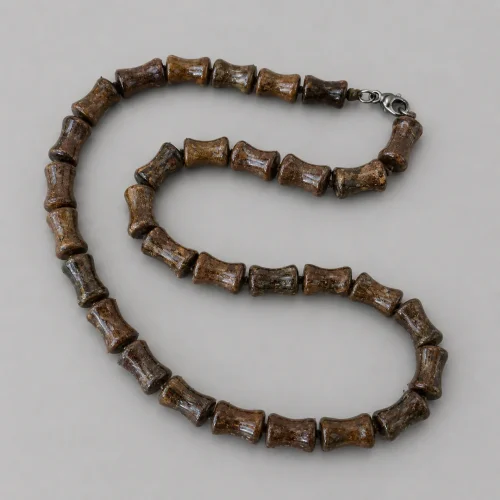
Tiger’s Eye: The Golden-Banded Stone of Courage and Focus
| Property | Details |
|---|---|
| Mineral Family | Quartz |
| Chemical Formula | SiO₂ |
| Typical Colours | Golden brown, honey, reddish-brown, blue-grey (hawk’s eye) |
| Hardness | 6.5–7 (Mohs) |
| Lustre | Silky |
| Transparency | Opaque to slightly translucent |
| Special Feature | Chatoyancy (“cat’s-eye” effect) |
| Main Sources | South Africa, Australia, Namibia, India, Brazil |
| Associated Zodiac Signs | Leo, Capricorn, Gemini |
| Traditionally Associated With | Courage, confidence, focus, protection and grounding |
Few stones seem to come alive in quite the same way as tiger’s eye. As it turns in the light, a bright golden band glides across its surface, giving the illusion that the stone itself is watching. For thousands of years this remarkable effect has inspired stories of courage, protection and clear vision, while modern geology reveals an equally fascinating story hidden inside its fibres.
Where Tiger’s Eye Is Found
Tiger’s eye occurs in a handful of specific geological settings around the world, with a few standout sources:
- South Africa — by far the most significant source, particularly the Northern Cape Province and the Griqualand West region, where the stone’s major commercial deposits were first developed
- Western Australia
- India
- Namibia
- Brazil
- Myanmar (Burma)
- United States — smaller deposits in California
South Africa remains the epicenter of global tiger’s eye production, and much of the material found in jewelry and mineral shops worldwide can be traced back to the region’s iron-rich rock formations.ction, and much of the material found in jewelry and mineral shops worldwide can be traced back to the region’s iron-rich rock formations.

History of Tiger’s Eye
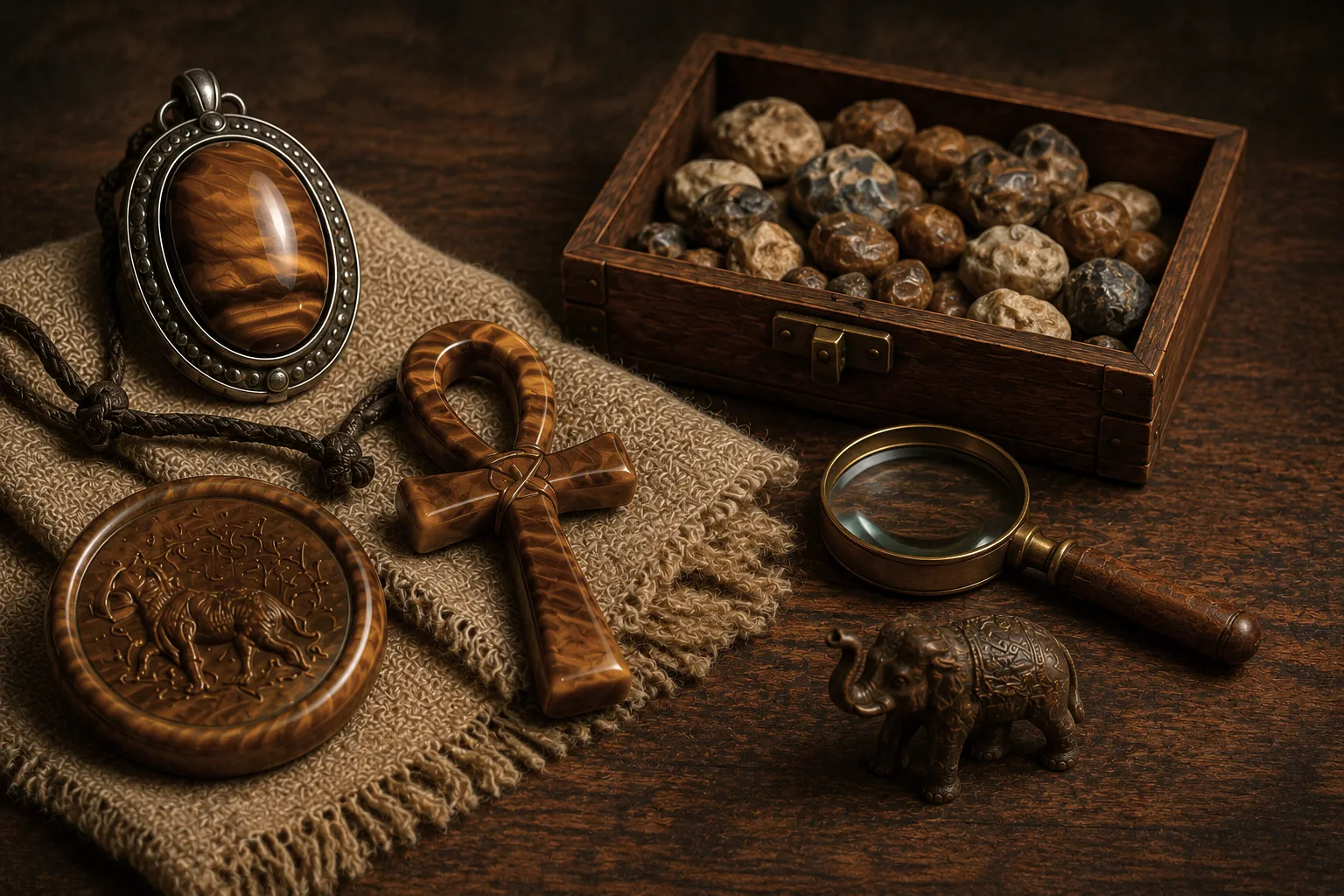
Tiger’s eye’s early history blends ancient use with a much later scientific discovery. Ancient artisans across several civilizations prized the stone, carving it into amulets and decorative pieces valued for their protective reputation and striking golden shimmer. Soldiers in several ancient cultures reportedly carried engraved tiger’s eye talismans into battle, believing the stone offered courage, mental clarity, and a shield against harm.
Its formal scientific story begins much later. French explorer François Levaillant described a similar chatoyant stone from South Africa in 1796, and German naturalist Martin Hinrich Lichtenstein collected type specimens along the Orange River in 1803. The material received its first scientific name, “pseudocrocidolite,” in 1811, courtesy of the German chemist Martin Heinrich Klaproth. It wasn’t until major commercial deposits were uncovered in Griqualand, South Africa, in the 1820s that the now-familiar name “tiger’s eye” caught on, popularized through the growing 19th-century European gem trade.
Formation of Tiger’s Eye
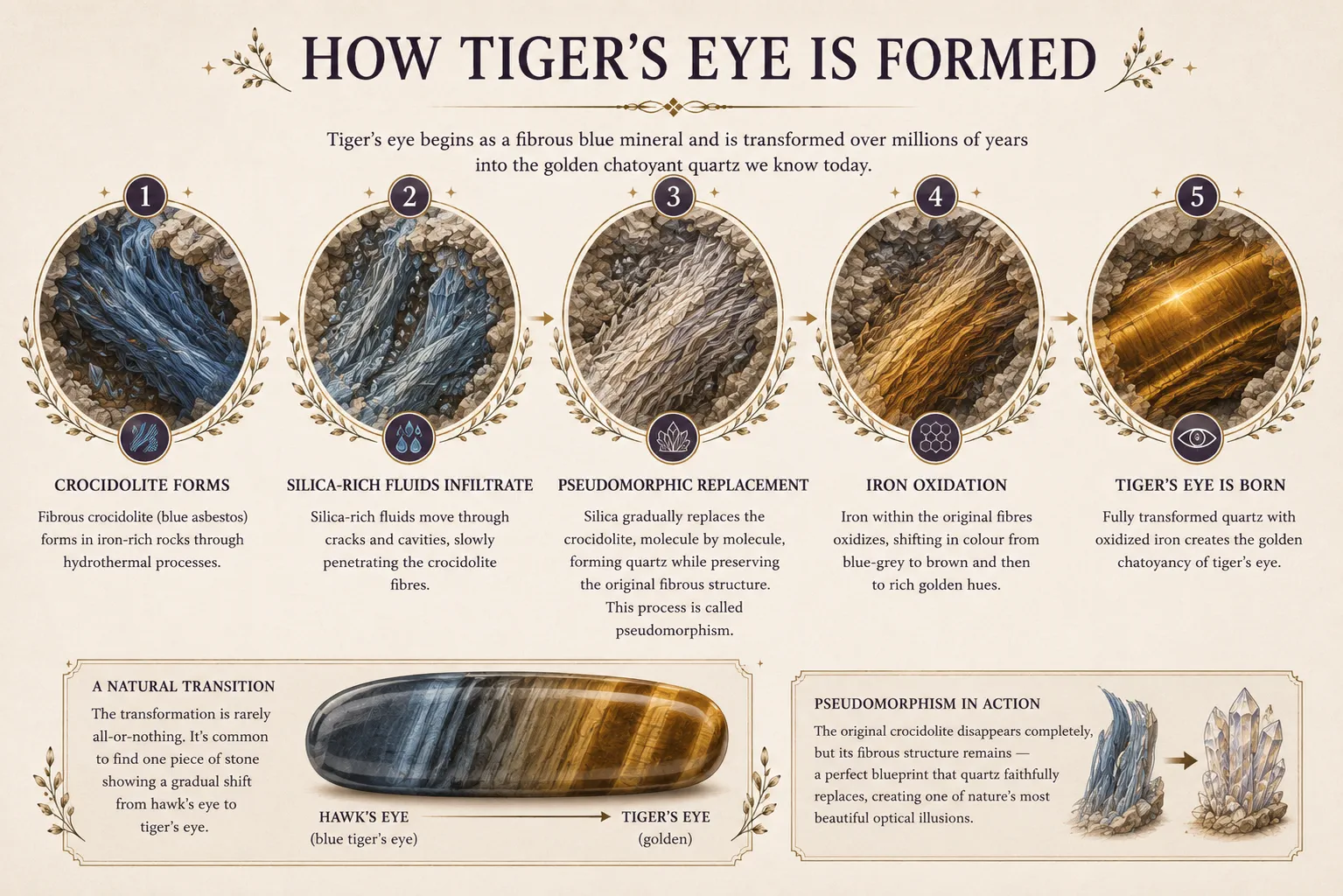
Tiger’s eye has one of the more unusual formation stories of any well-known gemstone. It doesn’t begin life as quartz at all — it starts as crocidolite, a fibrous blue mineral sometimes called blue asbestos. Over long stretches of geological time, silica-rich fluids gradually infiltrate the crocidolite fibers and replace them, molecule by molecule, in a process called pseudomorphism — meaning the original fibrous structure is preserved even as the underlying mineral is entirely swapped out for quartz.
As this replacement happens, the iron within the original crocidolite oxidizes, shifting in colour from blue-grey toward the warm golden-brown tiger’s eye is famous for. When the transformation is incomplete, the stone retains more of its original bluish tone, producing a related material known as hawk’s eye. It’s not unusual to find a single specimen showing a gradual transition from blue hawk’s eye to golden tiger’s eye across its surface, a small window into the exact moment iron oxidation was still underway.
Why Does Tiger’s Eye Shine?
The famous moving band of light is known as chatoyancy, from the French word chat meaning “cat”. It occurs because millions of microscopic fibres inside the quartz all run in the same direction. As light reflects from these parallel fibres, it forms a bright band that appears to move across the stone whenever it is turned..
Varieties of Tiger’s Eye
Tiger’s eye comes in a handful of recognized colour varieties, shaped by how completely the original crocidolite fibers have oxidized:
Tiger iron — a striking banded rock combining tiger’s eye with red jasper and black hematite, rather than a pure single-mineral variety
Golden tiger’s eye — the classic, most widely recognized variety, with warm honey-to-brown banding
Red tiger’s eye — produced through additional heat treatment, deepening the colour toward a rich reddish-brown
Blue tiger’s eye (hawk’s eye) — retaining more of the original crocidolite’s blue-grey tone, formed when iron oxidation is less advanced
Green tiger’s eye — Green tiger’s eye is uncommon in nature, and much of the material sold commercially has been heat-treated or dyed to achieve its colour.
| Variety | Type | Colour | Natural / Treated | Notes |
|---|---|---|---|---|
| Golden Tiger’s Eye | Natural variety | Honey to brown | Natural | The classic and most common form. |
| Blue Tiger’s Eye (Hawk’s Eye) | Natural variety | Blue-grey | Natural | Earlier stage before full iron oxidation. |
| Red Tiger’s Eye | Colour-enhanced variety | Reddish brown | Usually heat-treated | Produced by heating golden tiger’s eye. |
| Green Tiger’s Eye | Colour-enhanced variety | Green | Usually treated or dyed | Natural material is uncommon. |
| Tiger Iron | Composite rock | Gold, red and black | Natural | A banded rock combining tiger’s eye, red jasper and hematite. |

Did You Know?
Despite being named for its resemblance to a tiger’s iris, the stone’s chatoyant “cat’s eye” effect actually takes its name from an entirely different animal — the French term chatoyant comes from chat, meaning cat.
Tiger’s eye doesn’t start out as quartz at all — it begins as crocidolite, a fibrous blue mineral related to asbestos, which is gradually replaced by silica while keeping its original fibrous shape intact.
The related blue variety, hawk’s eye, and golden tiger’s eye can sometimes appear in the very same stone, with one gradually shading into the other depending on how much the original iron content had oxidized at that spot.
Traditional Beliefs and Folklore
Tiger’s eye’s symbolic reputation has stayed remarkably consistent across an unusually wide range of ancient cultures, almost always centered on protection, courage, and clear vision. Soldiers in the ancient world carried it into combat, hoping to borrow some of the tiger’s legendary strength and patience before facing an enemy. Across the Middle Ages, it continued to be viewed as a protective stone, believed to guard against harm and misfortune, while also becoming a favored charm among merchants and travelers hoping for luck and safe passage on long journeys. In several regions, tiger’s eye also picked up a reputation as a grounding stone, valued for its steadying, lower-body energy.
Magical Properties or Tiger’s Eye
In modern crystal healing traditions, tiger’s eye is often described as a stone of confidence and grounded willpower, prized for helping people move through fear and hesitation with a clearer head.
Common practices associated with tiger’s eye include:
Protective use — widely believed to shield the wearer’s energy from negative intentions or psychic disturbance, echoing its long history as a protective talisman
Solar Plexus Chakra work — tiger’s eye is most closely tied to the solar plexus, associated with personal power, confidence, and willpower
Root and Sacral Chakra support — some traditions also link the stone to these two lower chakras, believed to support grounding, creativity, and emotional stability
Meditation — often held near the stomach or solar plexus during meditation, said to encourage steady focus and a stronger sense of inner strength
Decision-making support — practitioners sometimes carry tiger’s eye during periods of major choice or transition, leaning on its long-standing reputation for clarity and discernment
(Note: these are traditional folk beliefs and metaphysical claims, not scientifically established properties.)

Tiger’s Eye in Astrology
Tiger’s eye is associated with a fairly broad range of zodiac signs, though a few stand out as its strongest matches:
- Leo — widely considered tiger’s eye’s primary match, since both are linked to the Sun; believed to help ground Leo’s fiery, expressive energy while amplifying confidence and self-expression
- Capricorn — associated with the stone’s practical, disciplined side, believed to support focus and follow-through on ambitious goals
- Gemini — thought to help calm this naturally scattered, dual-natured sign and support sustained concentration
Some traditions extend tiger’s eye’s compatibility further, linking it to Virgo, Taurus, and even Aries, largely thanks to its flexible, adaptable nature as both a grounding earth-toned stone and an energizing, fire-associated one.

A Moment of Wonder
Every piece of tiger’s eye tells a story of transformation. Deep beneath the Earth’s surface, one mineral slowly disappeared while another quietly took its place, preserving the delicate fibres of what came before. Millions of years later, those ancient structures still catch the light, creating the illusion of a living eye that has fascinated people since antiquity. It is a reminder that some of nature’s most beautiful creations are not formed in an instant, but through patience measured in geological time.