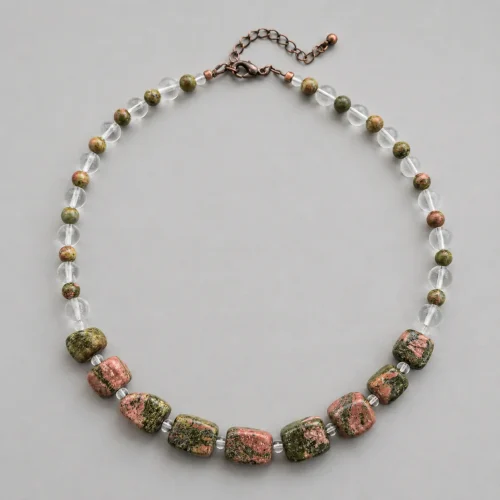
Unakite: The Mottled Pink-and-Green Stone of Balance
| Property | Details |
|---|---|
| Mineral Family | Metamorphic rock |
| Main Minerals | Epidote, Orthoclase Feldspar, Quartz |
| Chemical Formula | Composite rock (no single formula) |
| Typical Colours | Green, salmon pink, cream, white |
| Hardness (Mohs) | 6–7 |
| Lustre | Vitreous to dull |
| Transparency | Opaque |
| Special Feature | Distinctive mottled pink-and-green appearance formed by mineral alteration |
| Main Sources | USA, South Africa, Brazil, China, Sierra Leone |
| Associated Zodiac Signs | Scorpio, Virgo, Taurus, Capricorn |
| Traditionally Associated With | Emotional balance, patience, personal growth |
At first glance, unakite looks like it shouldn’t work — a jumble of salmon-pink and mossy green, speckled together almost like a piece of granite that changed its mind halfway through forming. And in a way, that’s exactly what happened. Unakite is a stone with a genuinely unusual origin story, born when one mineral quietly replaces another inside solid rock over millions of years. That patchwork past has made it a favorite among collectors and a popular symbol of balance, patience, and steady growth.
Where Unakite Is Found
Unakite occurs wherever the right kind of altered granite exists, though a few locations stand out:
- United States — the Blue Ridge Mountains of North Carolina and Tennessee, where the stone’s namesake range is located
- Brazil — particularly Minas Gerais, known for exceptionally vivid, well-coloured material
- China
- South Africa
- Zimbabwe
- Russia
- Switzerland and Austria
- Scandinavia
Despite carrying the name of one specific Appalachian mountain range, unakite has since turned up in scattered pockets across several continents, wherever ancient granite once underwent the right kind of transformation.s.ction, and much of the material found in jewelry and mineral shops worldwide can be traced back to the region’s iron-rich rock formations.

History of Unakite
Unakite takes its name directly from the Unaka Mountains, a range straddling the border of North Carolina and Tennessee and part of the larger Blue Ridge and Appalachian mountain system. The stone was first formally identified and described there in 1874, making it a relatively young addition to the world of named minerals compared to stones with ancient written histories.
The Unaka range itself has long been recognized by the people native to the region for its striking bluish haze, visible from a distance and caused by chemicals released into the air by the surrounding forest. Unakite was quarried locally and gradually gained attention beyond the region as lapidaries and collectors began to appreciate its unusual colour combination. Today, it remains a popular material for cabochons, beads, and decorative carvings, valued as much for its accessible price and easy workability as for its unmistakable good looks.

How Unakite Is Formed
Unakite isn’t technically a single mineral — it’s a metamorphic rock, meaning it’s made up of several different minerals that ended up fused together through geological transformation. It begins life as ordinary granite, a rock built mainly from feldspar, quartz, and other silicate minerals.
Over time, hot, mineral-rich fluids move through the granite in a process called hydrothermal alteration. These fluids gradually convert some of the original feldspar into epidote, a green calcium-aluminum-iron mineral, while the remaining potassium feldspar takes on a warm pink or salmon tone. The original quartz largely survives this transformation unchanged, adding small clear or smoky flecks throughout the mix. The result is a rock that looks less like a single crystal and more like a mosaic — patches of pink and green locked together, each patch a small record of exactly how far the transformation had progressed at that spot.
Varieties of Unakite
Because unakite is a rock rather than a single mineral, its “varieties” come down mostly to differences in colour balance and mineral proportion rather than distinct crystal forms:
Unakite with visible quartz veining — specimens showing more obvious clear or smoky quartz threading through the pink-and-green matrix
Classic unakite — the standard pink-and-green mix, with roughly balanced patches of feldspar and epidote
Deep green unakite — material with a higher concentration of epidote, giving it a more forest-green overall tone
Salmon-dominant unakite — material where pink feldspar makes up the majority of the stone, with green epidote appearing only in smaller patches
| Variety | Description |
|---|---|
| Classic Unakite | Balanced mix of green epidote and pink feldspar |
| Green-rich Unakite | Contains a higher proportion of epidote, producing deeper green tones |
| Pink-rich Unakite | Dominated by salmon-pink feldspar with smaller green areas |
| Quartz-rich Unakite | Displays more visible quartz throughout the stone |
| Coarse-grained Unakite | Larger visible mineral crystals |
| Fine-grained Unakite | More even, finely textured appearance |
| Trade names | No widely recognised geological varieties; commercial names usually describe colour or pattern only |

Did You Know?
Unakite is literally a rock caught in the middle of transformation. As hot, mineral-rich fluids moved through ancient granite, some of its original feldspar slowly changed into green epidote while neighbouring minerals remained untouched. Every pink-and-green patch preserves a snapshot of that geological change, frozen in stone for millions of years.
Traditional Beliefs and Folklore
Because unakite is a relatively recent addition to the world of named stones, it doesn’t carry the same deep well of ancient mythology as stones like quartz or amethyst. It has, however, long been valued by communities native to the Appalachian region where it was first identified, who recognized the stone for its striking colour and connection to the local landscape. In more recent decades, as unakite gained popularity in the wider crystal community, it picked up a reputation as a stone of balance — its two-toned colouring often read symbolically as a visual reminder of harmony between opposing forces, such as heart and mind, or emotion and growth.
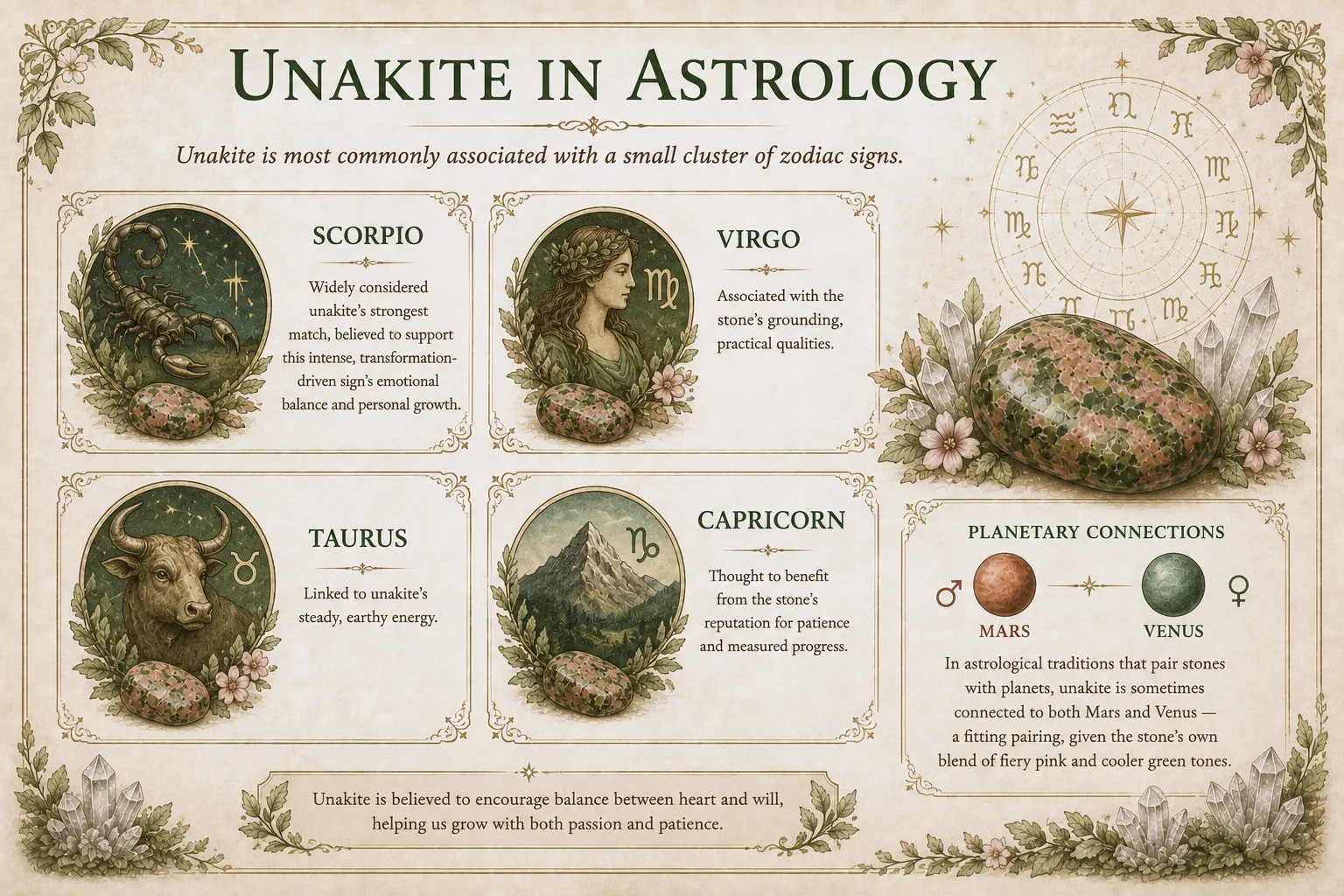
Astrological Associations
Unakite is most commonly associated with a small cluster of zodiac signs:
- Scorpio — widely considered unakite’s strongest match, believed to support this intense, transformation-driven sign’s emotional balance and personal growth
- Virgo — associated with the stone’s grounding, practical qualities
- Taurus — linked to unakite’s steady, earthy energy
- Capricorn — thought to benefit from the stone’s reputation for patience and measured progress
In astrological traditions that pair stones with planets, unakite is sometimes connected to both Mars and Venus — a fitting pairing, given the stone’s own blend of fiery pink and cooler green tones.
Healing and Meditation Practices
In crystal healing traditions, unakite is often regarded as a stone of balance, patient growth and emotional renewal. The following practices and qualities are based on traditional beliefs and are not supported by scientific evidence.
Connection to growth — sometimes placed near houseplants or gardens, in keeping with its reputation as a stone tied to steady, natural growth
Heart and Third Eye Chakra work — unakite is unusually tied to both of these chakras at once, believed to help bridge emotional healing (heart) with clarity and intuition (third eye)
Emotional balance — widely used to help calm erratic emotions and support a steadier, more grounded outlook
Patience through change — often associated with big life transitions or long-term projects, valued for its reminder that meaningful growth takes time
Meditation — commonly held over the chest or between the eyebrows during meditation, said to support emotional release alongside clearer inner vision
Support during pregnancy and recovery — one of unakite’s most widely cited modern uses, popularly associated with emotional steadiness during pregnancy and general recovery from illness or major life changes
Releasing old patterns — believed to help identify and let go of unhelpful emotional habits, making room for healthier ones to take root
(Note: these are traditional folk beliefs and metaphysical claims, not scientifically established properties.)
Caring for Unakite
Because unakite is a composite of several minerals rather than a single uniform crystal, it can be more sensitive to heat and harsh chemical cleaners than some other stones — a soft cloth with mild soap and water is generally the safest way to keep it looking its best.
A Moment of Wonder
Most gemstones are admired for their perfection — a single crystal growing in remarkable purity. Unakite tells a different story. It reminds us that beauty can emerge through change, with several minerals coming together to create something none could become alone. Every patch of pink and green is a quiet record of an ancient mountain’s transformation, preserved across millions of years and carried today in a stone small enough to fit in the palm of your hand.